| Risultati della ricerca nelle immagini - "Fly-by" |

Luna03-26b.jpgThe Moon, from Luna-3141 visiteSe il 'Programma Marte' dell'Agenzia Spaziale Sovietica fu, a ben vedere - ed a nostro parere - un grande successo, il Programma Luna fu anche qualcosa di più: un grande successo senza dubbio (e come vedrete) ma anche una grande "incompiuta".
Il "Fratello Sovietico" del vettore USA Saturno V, proprio al momento del lancio (che avrebbe portato due Cosmonauti Sovietici sulla Luna con un leggero anticipo rispetto all'Apollo 11), si incendiò ed esplose sulla rampa (una colossale catastrofe che provocò decine di morti e della quale sappiamo ancora davvero poco). Fu da quel momento, probabilmente, che l'URSS alzò bandiera bianca e lasciò campo libero agli USA ed alla NASA.
Tuttavia, sebbene nessun Cosmonauta Sovietico riuscì a camminare sulla Luna, il Programma Lunare vide il completamento (con successo) di ben 20 Missioni.
Con questa serie di immagini andremo a vedere da vicino alcuni momenti delle Missioni URSS coronate dal successo e ci accorgeremo (ancora una volta) di come la nostra tecnologia fosse già molto avanzata, sin dalla metà degli Anni '60...
|
|

Luna03-27farside.JPGThe Far-Side of the Moon134 visiteThe Soviet Lunar Programme had 20 successful missions to the Moon and achieved a number of notable lunar "firsts": first probe to impact the Moon, first Fly-By and image of the Lunar Far-Side, first soft landing, first Lunar Orbiter and the first circumlunar probe to return to Earth. The two successful series of Soviet Probes were the Luna (24 Missions) and the Zond (5 Missions).
All the data gathered from the successful Missions were photographic in nature, except for the Lunar Libration data from the Luna 21 Orbiter. Lunar Fly-By Missions (Luna 3, Zond 3, 6, 7, 8) obtained photographs of the Lunar Surface, particularly the limb and Far-Side Regions. The Zond 6, 7 and 8 Missions circled the Moon and returned to Earth where they were recovered: Zond 6 and 7 in Siberia and Zond 8 in the Indian Ocean. The purpose of the photography experiments on the Lunar Landers (Luna 9, 13, 22) was to obtain closeup images of the surface of the Moon for use in lunar studies and determination of the feasibility of manned lunar landings.
|
|

ZW-Mercury-PIA13508-PCF-LXTT.jpgHokusai Crater (Absolute Natural Colors; credits for the additional process. and color.: Dr Paolo C. Fienga - Lunexit Team)128 visiteThis mosaic of NAC images shows the Impact Crater Hokusai, located on Mercury at a latitude of approx. 58° North. The Crater has an impressive System of Rays, which extend as much as a thousand kilometers (more than 600 miles) across the Planet and are the longest that have yet been identified on Mercury.
Such Rays are formed when an impact excavates material from beneath the Surface and throws that material outward from the Crater. These bright Rays, consisting of both Ejecta and Secondary Craters (that form when the ejected material re-impacts the Surface), slowly begin to fade as they are exposed to the harsh Space Environment. Mercury and other airless Planetary Bodies are being constantly bombarded with Micrometeoroids and Energetic Ions, both concurring to produce an effect known as "Space Weathering".
Craters with Bright Rays are thought to be relatively young because the Rays are still visible, indicating that they have had less exposure to such weathering processes than craters that lack rays.
Although the extent of some of Hokusai's Rays have been determined, images acquired during MESSENGER's three Mercury fly-bys have not yet shown all of them.
During MESSENGER's orbital observations, which will begin in March 2011, MDIS will acquire high-resolution color images of Mercury's entire Surface.
This Global Color Map will allow the better understand the extent of the extensive Systems of Rays emanating from Hokusai and other young Craters, to be mapped for the first time.
Date Acquired: October, 6th, 2008
Instrument: Narrow Angle Camera (NAC) of the Mercury Dual Imaging System (MDIS)
Scale: The diameter of Mercury is of about 4880 Km (3030,48 miles) and Hokusai Crater has a diameter of approx. 95 Km (58,995 miles)MareKromium
|
|

ZX-Mercury-PIA13840.jpgCrescent Mercury (an Image-Mosaic by NASA/Johns Hopkins University Applied Physics Laboratory/Carnegie Institution of Washington)98 visiteThis HR mosaic of NAC images shows Mercury as it appeared to MESSENGER as the Spacecraft departed the Planet following its first mission's Fly-By. This mosaic resembles the historic first image transmitted back to Earth after that Fly-By and shows a portion of the Planet never previously seen by Spacecrafts.
Date Acquired: January, 14th, 2008
Instrument: Narrow Angle Camera (NAC) of the Mercury Dual Imaging System (MDIS)MareKromium
|
|

ZY-Mercury-PIA13840-PCF-LXTT.jpgCrescent Mercury (an Image-Mosaic by NASA/Johns Hopkins University Applied Physics Laboratory/Carnegie Institution of Washington - Absolute Natural Colors; credits for the additional process. and color.: Dr Paolo C. Fienga - Lunexit Team)107 visiteThis HR mosaic of NAC images shows Mercury as it appeared to MESSENGER as the Spacecraft departed the Planet following its first mission's Fly-By. This mosaic resembles the historic first image transmitted back to Earth after that Fly-By and shows a portion of the Planet never previously seen by Spacecrafts.
Date Acquired: January, 14th, 2008
Instrument: Narrow Angle Camera (NAC) of the Mercury Dual Imaging System (MDIS)MareKromium
|
|

ZZ-Mercury-Caloris_Basin-PIA13675-PCF-LXTT-3.jpgCaloris Basin (Absolute Natural Colors; credits for the additional process. and color.: Dr Paolo C. Fienga - Lunexit Team)150 visiteThis view is a mosaic of multiple MDIS images and shows the Caloris Basin in its entirety. The Caloris Basin was discovered in 1974 from Mariner 10 images, but when Mariner 10 flew-by Mercury, only the Eastern half of the Basin was in daylight. During MESSENGER's first Mercury flyby, the Spacecraft was able to acquire High-Resolution images of the entire Basin, revealing the full extent of this Great Basin for the first time.
Geologists use the term "Basin" to refer to an impact crater that is larger than about 300 Km (186,3 miles) in diameter and often displays multiple Concentric Rings. Caloris has one Main Topographic Ring (1550-Km diameter). Patterns of concentric structures both inside and outside the Main Ring have been mapped and interpreted as evidence for additional Rings.
Caloris is one of the largest Impact Basins in the Solar System, and MESSENGER's orbital observations will provide much more data for this impressive geologic feature, including high-resolution color and low-Sun images for discerning morphology. This mosaic was obtained when the Sun was high overhead. Such lighting conditions emphasize brightness differences among the Surface Materials, with little shadowing to provide a sense of the texture and topography.
The interior of the Basin has been filled with lighter-hued Plains, which in turn have been modified by Impact Craters. These Craters range from small bright dots to larger Craters with bright Rays. Some of the larger Craters exhibit dark Rims. The dark Rims suggest that dark material underlies the Interior Plains in some places and was exposed through the formation of those Impact Craters.
Date Acquired: January, 14th, 2008
Instrument: Narrow Angle Camera (NAC) of the Mercury Dual Imaging System (MDIS)
Scale: Caloris Basin is roughly 1550 Km in diameter (about 962,55 miles)MareKromium
|
|

ZZ-Mercury-Craters-Crater_Field-PIA13823-1.jpgSome Mercurian Surface Features explained (False Colors; credits: 77 visiteCaption NASA:"During MESSENGER's second Fly-By of Mercury, MDIS acquired a strip of HR images obtained with each of the WAC's 11 different color filters. The graphic shown here displays the resulting enhanced-color mosaic and gives considerable detail about the images, how the mosaic was created and the Geologic Features that can be seen.
Currently, these images are the Highest-Resolution color images ever obtained of the Solar System's innermost Planet, but not for long! On March 18, 2011, MESSENGER will enter into orbit about Mercury and the mission's extensive, year-long science observation campaign will begin.
That campaign includes capturing color images of Mercury's Surface at higher resolution than ever before".MareKromium
|
|

ZZ-Mercury-Craters-Crater_Field-PIA13823-2-PCF-LXTT_(2).jpgThe Surface of Mercury (Absolute Natural Colors; credits for the additional process. and color.: Dr Paolo C. Fienga - Lunexit Team)128 visitenessun commentoMareKromium
|
|

ZZ-Mercury-Craters-Dearin_Crater-PIA13488.jpgDark Spot at "Derain Crater" (Enhanced Absolute Natural Colors; credits for the additional process. and color.: Dr Paolo C. Fienga - Lunexit Team)130 visiteIn the center of this image is Derain, an impact crater first viewed during MESSENGER's 2nd Mercury flyby and named in 2009.
Derain has material within it and in its surroundings that is much darker than the neighboring terrain. In fact, the material associated with Derain appears to have the lowest reflectance yet identified on Mercury's Surface.
The Dark Deposits may be material with a mineralogical composition different from the majority of Mercury's visible Surface, but more data are needed before any further insight into the composition can be gained.
Observations to be acquired during MESSENGER's orbital mission phase will help to identify the uncommonly Dark Material at Derain Crater and similar occurrences elsewhere on the Planet.
Also visible in this image (upper right side), is the rayed Crater "Berkel", which has Dark Material as well in its center and in a ring immediately surrounding it. In contrast, two neighboring craters of Berkel have bright rays but lack Dark Halos. Why do some craters contain Dark Materials while others do not? MESSENGER's orbital data will be used to investigate that question and to improve our understanding of the nature and structure of Mercury's Crust.
Date Acquired: October 6, 2008
Instrument: Narrow Angle Camera (NAC) of the Mercury Dual Imaging System (MDIS)
Scale: Derain Crater is approx. 190 Km in diameter (such as about 118 miles)MareKromium
|
|
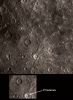
ZZ-Mercury-Craters-Enwonwu_Crater-PIA11784-1.jpgEnwonwu: a young Mercurian Crater (Natural Colors; credits: Lunar Explorer Italia)78 visiteThe feature indicated by the white arrow in this NAC image is the newly named crater Enwonwu (see also PIA11762). It is named in honor of Benedict (Ben) Chukwukadibia Enwonwu, the 20th Century modernist Nigerian sculptor and painter.
Enwonwu Crater displays a Central Peak and a set of bright rays emanating from the Crater Rim. The rays cross the surrounding surface and neighboring craters, indicating that Enwonwu Crater was formed comparatively recently in Mercury’s history. The brightness of the rays also suggests relative youth, as over time rays darken and disappear on Mercury's Surface.
These relationships provide useful indicators for determining the relative ages of features and the sequence of events that have shaped the Surface of Mercury.
Date Acquired: January 14, 2008
Image Mission Elapsed Time (MET): 108829024
Instrument: Narrow Angle Camera (NAC) of the Mercury Dual Imaging System (MDIS)
Resolution: 590 meters/pixel (0,37 miles/pixel)
Scale: Enwonwu Crater is about 38 Km (approx. 24 miles) in diameter
Spacecraft Altitude: about 23.000 Km (approx. 14.300 miles)MareKromium
|
|

ZZ-Mercury-Craters-Tiziano_Vecellio_Crater-PIA11765-2.jpgTiziano Vecellio Crater (Natural Colors; credits: Lunar Explorer Italia)88 visitenessun commentoMareKromium
|
|

ZZ-Mercury-Global_View_of_the_Surface-PIA11795_fig1.jpgVarious Mercurian Surface Features (natural colors; credits: Lunar Explorer Italia)76 visiteThis NAC image displays a number of interesting geologic features characteristic of Mercury’s Surface.
The Crater indicated by the yellow arrow has unusual bright material on its floor, likely due to rocks of a different chemical composition. Bright material also has been seen in the craters Sander and Kertész.
The pink arrows point to a pair of larger and older craters that have been flooded with now solidified volcanic lava, similar to flooding seen at the impact basin Raphael. In the lower right-hand corner of the image is a large peak-ring Basin, about 210 Km (approx. 130 miles) in diameter, which also appears to have been flooded with lava. There is also a small Scarp (or "Cliff") within that Basin that cuts through a smaller crater at the edge of the Basin's inner ring, at the point indicated by the blue arrow.
Scarps on Mercury are often seen intersecting Impact Craters, such as this dramatic, previously released image from the mission's second Mercury flyby (see, for example, PIA11358).
The green arrows on the left side of the image indicate a series of Secondary Crater Chains. Chains of small craters such as these are formed when ejecta are expelled from a Primary Crater after the initial impact. Secondaries are widespread across Mercury's Surface, as was also discussed in the caption to this previously released image (see PIA10178).
Unraveling Mercury's Geologic History requires investigating the complex and overlapping relationships of Volcanic Plains, Impacts and Scarps seen on the Planet's Surface.
Date Acquired: October 6, 2008
Image Mission Elapsed Time (MET): 131774026
Instrument: Narrow Angle Camera (NAC) of the Mercury Dual Imaging System (MDIS)
Resolution: 540 meters/pixel (0,33 miles/pixel)
Scale: This image is about 550 Km (approx. 340 miles) across
Spacecraft Altitude: about 21.000 Km (approx. 13.000 miles)MareKromium
|
|
| 20 immagini su 2 pagina(e) |
1 |
|








