| Risultati della ricerca nelle immagini - "Flank" |
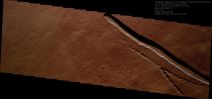
Collapse_Features-PavonisMons-20080306a.jpgChannel on Pavonis Mons (Natural Colors; credits for the additional process. and color.: Dr Paolo C. Fienga - Lunexit Team)82 visitenessun commentoMareKromium
|
|
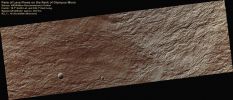
PSP_002909_2000_RED_abrowse-PCF-LXTT.jpgFeatures of Olympus Mons (Absolute Natural Colors; credits: Dr Paolo C. Fienga - Lunexit Team)231 visitenessun commentoMareKromium
|
|
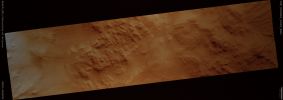
PSP_009660_2020_RED.jpgWest Olympus Mons (Extremely Saturated Natural Colors; credits for the additional process. and color.: Dr Paolo C. Fienga - Lunar Explorer Italia)74 visiteMars Local Time: 15:25 (early afternoon)
Coord. (centered): 21,5° North Lat. and 221,9° East Long.
Spacecraft altitude: 280,3 Km (such as about 175,2 miles)
Original image scale range: 28,0 cm/pixel (with 1 x 1 binning) so objects ~56,1 cm across are resolved
Map projected scale: 25 cm/pixel
Map projection: EQUIRECTANGULAR
Emission Angle: 0,4°
Phase Angle: 47,5°
Solar Incidence Angle: 47° (meaning that the Sun is about 43° above the Local Horizon)
Solar Longitude: 114,3° (Northern Summer)
Credits: NASA/JPL/University of Arizona
Additional process. and coloring: Lunar Explorer ItaliaMareKromium
|
|
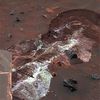
SOL721-A_P2538_L257F-A721R1.jpgMartian "salts" - Sol 721 (false colors)63 visiteOriginal caption:"This view is a false-color composite combining images taken with the PanCam's 750-, 530- and 430-nnmt filters on Jan. 12, 2006, the Rover's 721st Sol on Mars".
|
|

SOL721.jpgMartian "salts" - Sol 72167 visite(...) Spirit discovered this material while driving toward Home Plate, along the floor of the basin south of Husband Hill in Gusev Crater.
These images from Spirit's Pan-Cam show some of the most colorful deposits yet photographed on the surface of Mars. Spirit uncovered several types of materials distinctive in their color, physical properties and chemistry as a result of accidentally digging a trench 30 cm (about 11,8") wide during a turn at the end of a drive. The white material in this image is brighter than any seen previously by the Rover. It has a powdery and cloddy texture and exhibits a high abundance of salts. The materials appear similar in some ways to bright soil deposits seen back at the Paso Robles site that Spirit encountered on the Sol 431 (March 20, 2005) while climbing the northern flank of Husband Hill.
Spirit analyzed the bright, yellowish exposures in the lower left part of the frame using instruments on the Rover's RA. Scientists hypothesized and then confirmed that these materials have a salty chemistry dominated by iron-bearing sulfates. These salts may record the past presence of water, as they are most easily mobilized and concentrated in liquid solution. Spirit also examined the unusual, pitted rock about 10 centimeters (4 inches) wide in the lower center of the frame. Scientists continue to study the origin of these rocks and soils and the role that water has played in their formation.
This view is an approximately true-color composite combining images taken with the Pancam's 600-nanometer, 530-nanometer and 480-nanometer filters on Jan. 12, 2006, the rover's 721st sol on Mars.
|
|

Volcanic_Features-_Ascraeus-PIA14089.jpgCollapse Features on the Eastern Flank of Ascraeus Mons (Natural Colors; credits: Dr Paolo C. Fienga - Lunexit Team)299 visitenessun commentoMareKromium
|
|

Volcanoes-Sapas_Mons-PIA00099-PCF-LXTT-IPF.jpgThe Eastern Flank of Sapas Mons (Absolute Natural Colors; credits for the additional process. and color.: Dr Paolo C. Fienga/Lunar Explorer Italia/Italian Planetary Foundation)92 visiteThis NASA - Magellan Spacecraft's image - centered near 9,6° North Latitude and 189,5° East Longitude - covers an area of approx. 140 Km (such as about 86,94 miles) by approx. 110 Km (such as aabout 68,31 miles) and shows us part of the Eastern Flank of the Venusian Volcano known as Sapas Mons, which is located on the Western Edge of Atla Regio.
The bright Lobate Surface Features visible along the Southern and Western portions of the image, oriented in a North/East to South/West directions, are huge Lava Flows. These Flows range, in width, from approx. 5 to 25 Km (such as from about 3,1 to 15,525 miles), with lengths going from about 50 to approx. 100 Km (such as from about 31,05 to 62,1 miles), and they seem to extend themselves way off the area shown here. Additional Radar-Dark (---> Smooth) Flows are also present. The Radar-Bright Linear Structures found in the North/Western portion of the frame are interpreted to be (relatively) shallow Faults and Fractures, which could possibly be associated with the emplacement of Magma in the Sub-Surface.
Furthermore, located near the center of the image, there is an Impact Crater whose diameter is roughly 20 Km (such as about 12,42 miles). This Impact Crater is superimposed on a North/East-to-South/West trending Fracture, while the Southern Side of the Crater's Ejecta Blanket is covered by an approx. 6 Km (such as about 3,72 miles) wide Radar-Bright Lava Flow. These (just apparently) complicated relations indicate that the Crater post-dates an episode of Fracturing and that is older than the Lava Flows covering its Southern Edge.
Last, but not least, this is one of only a few places on Venus where an Impact Crater is seen to be covered by Volcanic Deposits.
This frame (which is an Original NASA - Magellan Spacecraft Radio-Image-Mosaic published on the NASA - Planetary Photojournal with the n. PIA 00099), since it is just a Radio-Image of the Venusian Surface and NOT a real view of it, has been colorized, according to an educated guess carried out by Dr Paolo C. Fienga (LXTT-IPF), in what they could reasonably be its possible Absolute Natural Colors (such as the colors that a human eye would perceive if someone were onboard the NASA - Magellan Spacecraft and, once the thick layer of Venusian Clouds and Fogs is completely overcome, looked down, towards the Surface of Venus itself), by using an original technique created - and, in time, dramatically improved - by the Lunar Explorer Italia Team.MareKromium
|
|
|
| 7 immagini su 1 pagina(e) |
|








