| Risultati della ricerca nelle immagini - "Faults" |

ESP_017900_2185_RED_abrowse.jpgUnnamed Impact Crater cut by Faults (Natural Colors; credits: Dr Paolo C. Fienga - Lunexit Team)79 visiteThis image reveals an interesting coincidence of two important Planetary Processes: Cratering by Impacts and Tectonism.
Here we have an Impact Crater (the large round feature, approx. 6,2 Km, or 3,9 miles, across) that intersects a series of Faults (the linear features). The Faults are seen to cut the circular Rim of the Impact Crater. Also, the impact did not destroy the adjacent faults. These observations tell us that the Fault was active after the impact occurred.
In addition, by measuring the distance of offset of the different pieces of the Crater Rim separated by the Fault Line (assuming that when the Crater formed, the Rim was continuous around its circumference), the amount of movement along the Fault can be estimated, laterally and vertically. Faults like these cause Troughs to form, called "Graben", of which the heavily shadowed one is a good example. The center (shadowed) section has been dropped downwards relative to the surrounding Terrain, forming the Trough.
It is also clear that parts of the Crater Rim are lower than others where the Graben intersects the Crater. The sides of the Graben (the Faults forming the Walls of the Trough) are sloped, so that the dropped-down part of the Crater Rim has also moved horizontally away from its higher part. The combined down-dropping and moving apart indicates that the land here is being stretched and pulled apart, called "extension". By measuring the amount of offset on all the Faults, we can estimate how much extension has occurred in this part of the Planet.
This location is especially helpful because, as mentioned above, we have a good knowledge of the “before-faulting” configuration of the land, in which the Crater Rim was continuous. Finally, it is interesting that there is no sign of the Fault on the Floor of the Crater – its Floor has not been faulted and no part is down-dropped and stretched apart as the Rim has been. This indicates that some infilling of the Crater (perhaps by Lava or Airborne Sediment) has likely occurred since the Fault was active, burying the trace of the Fault and representing a third stage of geologic history in this area.MareKromium
|
|
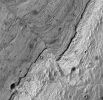
TRA_000823_1720_RED_fault.jpgFault of Jus83 visiteThe sharpness and quality of HiRISE images allows geologists to work out the detailed geometry and sequence of events that have shaped the landscape. For example, this area shows exposures of light- and dark-toned layers of rock that have been faulted and folded. These rocks formed out of sedimentary deposits that originally accumulated in thick horizontal sequences, like a layer cake.
These layers have since been tilted on-end and eroded, exposing the sequence of layers that we now see at the surface. A prominent dark layer extends through the center of the scene from the upper right to the lower left of the image. This dark layer is discontinuous and offset along a fault.
The thin grey zone that extends from the upper left to the lower right of the image delineates the fault plane. This fault was originally a thrust, or compressional fault, that formed prior to the aforementioned tilting event. Tilting of this fault and the surrounding rock reveals a series of drag folds adjacent to the fault plane. These drag folds formed as the layered rock bent in response to friction along the fault plane as the thrust fault formed, prior to the tilting event. This fault offsets the dark layer by a maximum of 70-75 m. Smaller secondary folds and faults are also visible in this scene. The smallest resolved fault offset of an individual rock layer is 1-1.5 m. Also visible in this image are numerous small 4-10-m-diameter impact craters that are surrounded by ejecta of meter-scale boulders.
|
|
|
|
| 2 immagini su 1 pagina(e) |
|








