| Risultati della ricerca nelle immagini - "F-Ring" |

AI-Saturn-Streak in the Sky-N00018041.jpgA new "Bright Streak" in the Sky of Saturn99 visiteUna nuova "striscia luminosa" (bright streak) nel Cielo di Saturno, ripresa il giorno 14 Settembre 2004. Che dire? Secondo noi - anche se accettassimo acriticamente la teoria che spiega alcune (comunque brevi e piuttosto deboli) striature di luce che, spesso, appaiono nelle immagini scattate guardando verso lo spazio come "raggi cosmici" - questa specifica "striscia" sembra qualcosa di molto particolare. Qualcosa che non può essere semplicemente ricondotto all'emissione luminosa di una micro-particella che schizza nello spazio a velocità presso-relativistica.
Secondo noi, questa striscia (come anche altre, riprese dalla superficie di Marte) è causata da qualcosa di diverso.
Cosa?
E se lo sapessimo...Ve lo diremmo!
|
|

AL-Streak Again-N00018570.jpgStreak again!91 visiteUna nuova "Striscia nel Cielo" - del 17/9/2004 - da guardare con estrema cura. Il motivo è questo: abbiamo svolto una semplice analisi sul frame scoprendo che la Striscia, stavolta, è costituita - ed è la 1ma volta che lo si vede con estrema chiarezza - da una sequenza di punti luminosi ravvicinatissimi i quali, per altro, non hanno tutti la stessa intensità luminosa. Un effetto similare (se non identico) lo si può ottenere, sulla Terra, riprendendo - con obbiettivo grandangolare o simile - una porzione di cielo notturno (con esposizione fra i 10 ed i 18/20") mentre un qualsiasi velivolo convenzionale si trovi in transito attraverso tale porzione di cielo. Effettuato lo sviluppo dell'immagine, noterete che il corpo del velivolo risulterà costituito da una serie ravvicinatissima di punti luminosi i quali diventeranno "più luminosi" in corrispondenza dei flash emessi dalle sue luci di posizione. Cosa implichiamo con questo discorso?
Che la Streak in the Sky di oggi NON E' CERTAMENTE un raggio cosmico!
|
|

Rings-PIA07716.jpgCan the "clumps" in the Rings be the TSP (Transient Saturnian Phoenomena)?66 visite"Scientists have long suspected that small moons hiding among Saturn's Rings strands might be producing some of the unusual structure observed in the F-Ring. While the shepherd moon Prometheus is the main culprit behind the strange behavior of Saturn's F-Ring, it cannot explain all observed features. The current dilemma facing scientists is that Cassini is detecting extended objects like those pictured here - that may be either solid moons or just loose clumps of particles within the Ring. This montage of 4 enhanced Cassini narrow-angle camera images shows bright clump-like features at different locations within the F-Ring.
Two objects in particular, provisionally named S/2004 S3 and S/2004 S6, have been repeatedly observed by Cassini over the past 13,5 months and 8,5 months, respectively. The orbits for these 2 objects have not yet been precisely determined, in part because perturbations from other nearby moons make the orbits of objects in this region complicated. Thus, scientists cannot be completely confident at the present time if they in fact have observed new sightings of S3 and S6, or additional transient clumps.
The upper two images show features that may be S6. From previous observations, S6 appears to have an orbit that crosses that of the main F ring. This unexpected behavior currently is a subject of great interest to ring scientists.
The upper left image was taken on June 21, 2005, and shows an object in the outer ringlets of the F ring. The radial (or lengthwise) extent of the feature is approximately 2,000 kilometers (1,200 miles). The radial resolution on the ring is about 13 kilometers (8 miles) per pixel.
The image at the upper right was taken on June 29, 2005, and shows a bright feature within the F ring's inner ringlets. The radial extent of the feature seen here is about 2,000 kilometers (1,200 miles); the radial resolution is 36 kilometers (22 miles).
The image at the lower left was taken on August 2, 2005, and shows a feature that may be S3. S3 has been found to have an orbital path that is tightly aligned with that of the main F ring. The radial resolution in the image is 3.5 kilometers (2.2 miles) per pixel.
The lower right image was taken on April 13, 2005, and has a radial resolution of 7 kilometers (4 miles) per pixel. This object does not appear to be either S3 or S6.
Structures like knots and clumps within the F ring often are transient, appearing and then disappearing within months. Repeated observation of the objects seen in this region hopefully will give scientists firm evidence about whether these features are actual moons that disturb the material around them or perhaps the short-lived products of interactions between the F ring and larger moons such as Prometheus.
|
|

Saturn-The Atlas Ring-PIA06113_modest.jpgThe "F-Ring" (or "Atlas Ring") of Saturn72 visiteRiteniamo la dichiarazione che riportiamo qui di seguito di GRANDE INTERESSE, specie per coloro che sappiano dei cosiddetti "Ring-Masters", ossìa i ("Mitologici") Creatori degli Anelli di Saturno: "...Scientists examining Saturn's contorted F-Ring - which has baffled them since its discovery - have found 1 or 2 small bodies orbiting in the F-ring region, and a ring of material associated with Saturn's moon Atlas...".
Cosa sono questi 1 o 2 "small bodies"? Perchè non si parla di nuovi mini-satelliti?
|
|

Saturn-The Atlas Ring-The New Object-PIA06115.jpgThe "New Object" found in Saturn's "F-Ring" (1)78 visiteEcco il nuovo enigma che ci viene proposto da Saturno e che, come già si era detto, potrà affascinare coloro che conoscono la storia (o la "leggenda", se preferite) dei "Ringmasters of Saturn". Questa, in originale, la nota di commento al fenomeno rilasciata dalla NASA: "A small new found object, temporarily designated S/2004 S 3, has been seen orbiting Saturn's outer F ring. Its nature, moon or clump, is not presently known".
Una dichiarazione che ci lascia davvero pensare...
|
|

Saturn-The Atlas Ring-The New Object-PIA06116.jpgThe "New Object" found in Saturn's "F-Ring" (2)83 visiteMa c'è di più: ingrandite le 2 immagini che Vi abbiamo proposto e poi osservate attentamente in alto alla Vostra Dx. Vedrete una piccola, ma ben definita, linea luminosa. Andate quindi sul Sito NASA "Planetary Photojournal - Images of Saturn": c'è una bellissima animazione ottenuta montando in sequenza 18 frames, oltre ai 2 qui pubblicati (ripresi con frequenza di 1 ogni 8 minuti su un arco di 135 minuti). Noterete che la "striscia" di luce di cui Vi stiamo parlando appare solo in 6.
Strano, vero?!?
|
|

Saturn-W00006821.jpgSpark in the Dark! (possible Anomaly)68 visiteCassini sta viaggiando nel cono d'ombra generato da Saturno e quindi, se il 'volto di Saturno' sta guardando il Sole, noi possiamo pure dire che Cassini è 'alle spalle' del Gigante Anellato.
Ciò premesso, riusciamo comunque a vedere una porzione dell'Anello F (ancora illuminato da Sole e davvero caratteristico ed inconfondibile per i suoi 'clumps'!) sull'estrema Dx dell'immagine mentre, proprio al centro del frame, distinguiamo chiaramente un corpo luminoso sferico e svariati altri puntini luminosi e svariati graffi. Sui 'puntini luminosi' ed i 'graffi', la nostra esperienza in campo di fotografia astronomica e spaziale ci dice che si tratta di semplici photo-artifacts. Il punto luminoso centrale, invece, secondo noi NON lo è.
Ora, dato che stiamo guardando in una regione immersa nell'ombra di Saturno (e dunque nel buio), quel punto - se effettivamente NON è un photo-artifact - NON può neppure essere una delle Lune Saturniane!
E allora che cos'è?
|
|

StreamerChannel-PIA10509.jpgStreamer Channel84 visiteOk: quando Lunexit "chiama", la NASA...risponde! Pubblicata oggi (11 Novembre 2008) sul Planetary Photojournal, ecco la risposta NASA alla nostra illazione: la "vibrazione" dell'Anello "F" di Saturno è, effettivamente, uno Streamer Channel, provocato dalla Luna Pastore Prometheus.
L'effetto vibrazionale appare, nel filmato GIF del Dr Barca, più eclatante (e quindi fisicamente impossibile) solo perchè la ripresa - in quel primo contesto - era stata effettuata da una distanza inferiore ai 970.000 Km di questo frame.
Dunque nessuna "Onda Gravitazionale", ma solo uno Streamer Channel (ossìa un "canale" che viene scavato - letteralmente - da Prometheus quando attraversa l'Anello "F" di Saturno, e cioè una volta per orbita) particolarmente grande e ripreso da (relativamente) vicino.
Questa parte del Mistero, quindi, è risolta. Peccato che la NASA non ci abbia detto nulla, invece, dell'Oggetto Anomalo, ma chissà, magari in futuro...
Caption NASA:"The Cassini spacecraft focuses on a streamer-channel feature in Saturn's F-Ring.
These features are created by the moon Prometheus as it closely approaches the Ring once per orbit (see also PIA08397).
This view looks toward the unilluminated side of the Rings from about 36° above the Ring-Plane.The image was taken in Visible Light with the Cassini Spacecraft narrow-angle camera on Sept. 30, 2008.
The view was acquired at a distance of approx. 970.000 Km (such as about 602.000 miles) from Saturn and at a Sun-Ring-Spacecraft, or Phase, Angle of 45°.
Image scale is roughly 5 Km (about 3 miles) per pixel".
MareKromium
|
|

The F-Ring-PIA06600.jpgAttraction-Repulsion: the strange relationship between Prometheus and the F-Ring64 visiteCaption NASA originale:"Intriguing features resembling drapes and kinks are visible in this Cassini view of Saturn's thin F-Ring. Several distinct ringlets are present, in addition to the bright, knotted core of the ring.
The obvious structure in the ring and its strands has been caused by Prometheus, the inner F-Ring shepherd moon that recently swept past this region. (Prometheus is about 10° ahead of the F-Ring material in this image). These types of features were first seen in images taken just after Cassini entered into orbit around Saturn. The gravitational interaction of Prometheus (102 Km or 63 miles across) on the ring pulls material out the ring once every orbit (every 14,7 hours) as the moon gets close to the ring and its strands".
|
|

The Rings & Rhea-PIA07655.jpgThe F-Ring and crescent Rhea68 visiteThe searing arc of light seen here is Saturn's icy F-Ring, seen nearly edge-on. In the background, Rhea is lit by reflected light from Saturn and the Rings, with only the slightest sliver of light at its bottom being from direct Sunlight.
The faint material surrounding the F-Ring likely lies in the Planet's equatorial plane, extending radially farther out and in from the main F-Ring core.
A smaller fraction of this material could be vertically extended, and Cassini's investigations should help to clarify this.
The image was taken in visible light with the Cassini spacecraft narrow-angle camera on Oct. 30, 2005, at a distance of approximately 689.000 Km (about 428.000 miles) from Saturn. The image scale is approximately 4 Km (2 miles) per pixel.
|
|
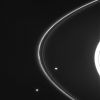
The Rings-N00032099.jpgThe "clumpy" F-Ring and two Shepherd Moons78 visiteUna spettacolare inquadratura dell'Anello F di Saturno il quale, come sapete si caratterizza (anche) a causa delle sue numerose irregolarità ed increspature (che alla NASA chiamano clumps---->grumi/agglomerati) che dovrebbero essere dovute all'azione mareale di Lune-Pastore come Pandora ed Atlas, per esempio.
|
|

The Rings-N00034622.jpgSunshine and stars, through the F-Ring!64 visiteUn'immagine davvero molto bella e suggestiva; inutili altri commenti.
|
|
| 19 immagini su 2 pagina(e) |
1 |
|








