| Risultati della ricerca nelle immagini - "Exhumed" |

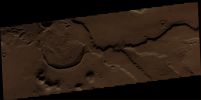
Craters-Exhumed_CFrater_in_Vastitas_Borealis-PIA03926-01.jpgA very unusually-looking Exhumed Crater (Absolute Natural Colors; credits for the additional process. and color.: Dr Paolo C. Fienga - Lunexit Team)151 visiteCaption NASA originale:"This MGS-MOC image shows a circular feature on the Martian Northern Plains. It was once a crater formed by meteoritic impact. It was completely filled and buried by and within layered material. Later, the layered materials have begun to be eroded away, re-exposing the old crater rims in the process".
Location near: 44,9° North Lat. and 264,7° West Long.
Image width: ~3 Km (~1,9) mi
Illumination from: lower left
Season: Northern Autumn
Nota: a giudicare dalle fattezze emergenti dalle sabbie, più che un antico cratere sepolto ed ora in corso di 'riesumazione', diremmo che potrebbe trattarsi di un modesto rilievo vulcanico (un "camino" infossato), caratterizzato da un discreto numero di caldere. Certo, non si è mai sentito parlare di un 'vulcano sepolto' e poi riportato alla luce dal concorso degli agenti geologici ed atmosferici ma, in fondo, anche le ipotesi più 'sfrontate', alle volte, possono rivelarsi esatte. MareKromium
|
|
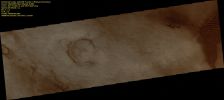
Craters-Exhumed_Craters_in_Amazonis_Planitia.jpgExhumed Craters in Amazonis Planitia (Darkened Absolute Natural Colors; credits for the additional process. and color.: Dr Paolo C. Fienga - Lunexit Team)77 visiteCaption NASA originale:"The exhumation of craters, such as the uncovering of old craters hidden from view by younger surface material, is common in many Regions of Mars. This Unnamed Crater and its covering material are located in Amazonis Planitia".
Coord.: 3,7° North Lat. and 194,9° East Long.MareKromium
|
|
Craters-UnnamedCraterinPlanumChronium-20090729a-00.jpgExhumed Crater in Planum Chronium (ctx frame - Natural Colors; credits: Lunexit)65 visitenessun commentoMareKromium
|
|

Craters-UnnamedCraterinPlanumChronium-20090729a-01.jpgExhumed Crater in Planum Chronium (edm - Natural Colors; credits: Lunexit)67 visitenessun commentoMareKromium
|
|
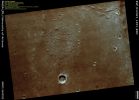
ESP_012425_1455_RED_abrowse.jpgUnusually-looking "Circular Surface Feature" (possible True Colors; credits: Dr G. Barca)70 visiteThis circular feature is a collection of hills, with some connected by ridges. The circularity suggests that perhaps there was once an impact crater here that was subsequently filled with material which was somehow more resistant to erosion than the landscape around it. Over time, as erosion stripped away the ground, the fill material was left standing higher (although it has clearly been eroded as well).
Nota Lunexit: si tratta di un "Exhumed Crater", ossìa di un cratere prima ricoperto da detriti e sedimenti e poi, a seguito di azioni prevalentemente eoliche (un vero e proprio scorticamento del suolo), è stato riportato - parzialmente - alla luce. Lo scorticamento che evidenzia il cratere sepolto è indice del fatto che i materiali i quali lo avevano ricoperto erano più resistenti e stabili dei materiali che circondano il cratere stesse (i quali, appunto, sono stati smossi dai venti). Un fenomeno similare, ma relativo ai canali, dà luogo ai cosiddetti "Inverted Channels", di cui si è già parlato in passatoMareKromium
|
|
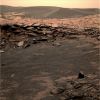
OPP-SOL744-1.jpgThe "Walls" of Payson Outcrop in Meridiani Planum - Sol 744 (natural colors; credits: Dr G. Barca)63 visitenessun commentoMareKromium
|
|

PSP_001374_1805_RED_browse-00~0.jpgLayering in Exhumed Crater at Meridiani Planum Region (context image - MULTISPECTRUM; credits: Lunexit)77 visite...Noi, detto senza falsa modestia, sfidiamo la NASA a fare di meglio...MareKromium
|
|
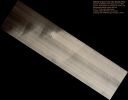
PSP_004980_1035_RED_browse-00~0.jpgUnnamed "Ghost" Crater near the South Pole (CTX Frame - Absolute Natural Colors; credits for the additional process. and color.: Dr Paolo C. Fienga - Lunexit) 174 visiteThis HiRISE image shows a Circular Structure near the South Pole of Mars. This feature is probably a heavily modified Impact Crater. It is currently expressed as a group of concentric circular features with little vertical expression.
This feature was probably once an Impact Crater many tens of meters deep. (Small impact craters are typically about 1/5th as deep as they are wide).
The original topography has been smoothed by some combination of burial and viscous relaxation. Most burial processes will preferentially fill in low areas like craters; the infilling material may then compact, producing arcuate structures. MareKromium
|
|
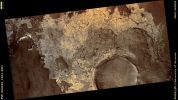
PSP_009945_1835_RED.jpgExhumed Impact Crater in Equatorial Layered Deposits (possible True Colors; credits: Lunar Explorer Italia)70 visiteMars Local Time: 15:30 (middle afternoon)
Coord. (centered): 3,4° North Lat. and 2,9° East Long.
Spacecraft altitude: 273,7 Km (such as about 171,1 miles)
Original image scale range: 27,4 cm/pixel (with 1 x 1 binning) so objects ~82 cm across are resolved
Map projected scale: 25 cm/pixel
Map projection: EQUIRECTANGULAR
Emission Angle: 6,2°
Phase Angle: 59,3°
Solar Incidence Angle: 54° (meaning that the Sun is about 36° above the Local Horizon)
Solar Longitude: 124,7° (Northern Summer)
Credits: NASA/JPL/University of Arizona
Additional process. and coloring: Lunar Explorer ItaliaMareKromium
|
|
|
|
|
| 9 immagini su 1 pagina(e) |
|








