| Risultati della ricerca nelle immagini - "Equatorial" |

04-C_Mars03_Mountains.jpgMars Mountains103 visiteContrary to some reports, the phototelevision cameras on Mars-3 were functional after the dust storm subsided, in December. At least four photographic surveys have been reported (December 12 and 14, February 28 and March 12). Images were returned by pulse-code modulation over the decimeter-band telemetry channel, after the centimeter-band pulse-position modulation system failed.
The decimeter transmitter suffered from intermittant failures and was used very cautiously. Only after important science data was gathered, a small number of images at LR were transmitted (using a 256-line mode). The color image of Mars (picture n. 1) is a composite from the 52 mm camera, using its program of cycling red, green and blue glass filters.
|
|
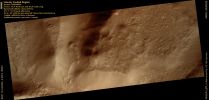
ESP_014306_1905_RED_abrowse.jpgHeavily Faulted Region (Natural Colors; credits: Lunexit)71 visitenessun commentoMareKromium
|
|

ESP_014424_1845_RED_abrowse.jpgBright Deposits and an anomalous Circular Feature - maybe a VERY fresh Impact Crater or a vertical collapse pit (Natural Colors; credits: Lunexit)63 visitenessun commentoMareKromium
|
|

ESP_018485_1765_RED_abrowse.jpgPeri-Equatorial Scarp and Fans (Natural Colors; credits for the additional process. and color.: Dr Paolo C. Fienga - Lunexit Team)74 visitenessun commentoMareKromium
|
|
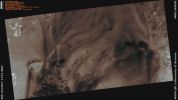
ESP_022607_1725_RED_abrowse.jpgPeri-Equatorial Dunefield (Absolute Natural Colors; credits for the additional process. and color.: Dr Paolo C. Fienga - Lunexit Team)128 visitenessun commentoMareKromium
|
|
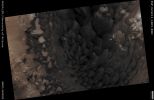
ESP_024213_1805_RED_abrowse.jpgLarge Equatorial Dunefield (Absolute Natural Colors; credits for the additional process. and color.: Dr Paolo C. Fienga - Lunexit Team)227 visiteMars Local Time: 14:17 (Early Afternoon)
Coord. (centered): 0,5° North Lat. and 348,8° East Long.
Spacecraft altitude: 275,9 Km (such as about 172,4 miles)
Original image scale range: 27,6 cm/pixel (with 1 x 1 binning) so objects ~ 83 cm across are resolved
Map projected scale: 25 cm/pixel
Map projection: EQUIRECTANGULAR
Emission Angle: 9,2°
Sun-Mars-Spacecraft (or "Phase") Angle: 43,5°
Solar Incidence Angle: 34° (meaning that the Sun is about 56° above the Local Horizon)
Solar Longitude: 6,2° (Northern Spring)
Credits: NASA/JPL/University of Arizona
Additional process. and coloring: Dr Paolo C. Fienga - Lunar Explorer ItaliaMareKromium
|
|

ESP_032097_1810-PCF-LXTT-IPF.jpgEquatorial Dunefield (Absolute Natural Colors; credits for the additional process. and color. Dr Paolo C. Fienga/Lunar Explorer Italia/Italian Planetary Foundation)127 visiteMars Local Time: 14:08 (Early Afternoon)
Coord. (centered): 1,068° North Lat. and 30,111° East Long.
Spacecraft altitude: 268,9 Km (such as about 166,986 miles)
Original image scale range: 53,8 cm/pixel (with 2 x 2 binning) so objects ~ 1 mt and 61 cm across are resolved
Map projected scale: 50 cm/pixel
Map projection: EQUIRECTANGULAR
Emission Angle: 0,0°
Phase Angle: 34,9°
Solar Incidence Angle: 35° (meaning that the Sun was about 55° above the Local Horizon at the time the picture was taken)
Solar Longitude: 328,5° (Northern Winter - Southern Summer)
Credits: NASA/JPL/University of Arizona
Additional process. and coloring: Lunar Explorer Italia
This picture (which is a NASA - Original Mars Reconnaissance Orbiter NON-Map Projected CTX b/w frame identified by the serial n. ESP_032097_1810) has been additionally processed and then colorized in Absolute Natural Colors (such as the colors that a human eye would actually perceive if someone were onboard the NASA - Mars Reconnaissance Orbiter and then looked down, towards the Surface of Mars), by using an original technique created - and, in time, dramatically improved - by the Lunar Explorer Italia Team.MareKromium
|
|

PSP_008218_1815_red.jpgCharacterize Surface Hazards and Science of MSL Rover Landing Site - Equatorial Regions (Saturated Natural Colors; credits for the additional process. and color.: Dr Paolo C. Fienga - Lunexit Team) 87 visitenessun commentoMareKromium
|
|
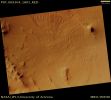
PSP_009304_1805_RED.jpgEquatorial Rocky Terrain (possible True Colors; credits: Lunar Explorer Italia)78 visiteMars Local Time: 15:25 (early afternoon)
Coord. (centered): 0,6° North Lat. and 223,9° East Long.
Spacecraft altitude: 269,2 Km (such as about 168,2 miles)
Original image scale range: 53,9 cm/pixel (with 1 x 1 binning) so objects ~1,62 mt across are resolved
Map projected scale: 50 cm/pixel
Map projection: EQUIRECTANGULAR
Emission Angle: 0,0°
Phase Angle: 55,1°
Solar Incidence Angle: 55° (meaning that the Sun is about 35° above the Local Horizon)
Solar Longitude: 101,7° (Northern Summer)
Credits: NASA/JPL/University of Arizona
Additional process. and coloring: Lunar Explorer ItaliaMareKromium
|
|

PSP_009311_1735_RED.jpgPeri-Equatorial Surface Features (possible True Colors; credits: Lunar Explorer Italia)95 visiteMars Local Time: 15:27 (early afternoon)
Coord. (centered): 6,5° South Lat. and 33,9° East Long.
Spacecraft altitude: 264,3 Km (such as about 165,2 miles)
Original image scale range: 26,4 cm/pixel (with 1 x 1 binning) so objects ~52,9 cm across are resolved
Map projected scale: 25 cm/pixel
Map projection: EQUIRECTANGULAR
Emission Angle: 3,0°
Phase Angle: 57,1°
Solar Incidence Angle: 59° (meaning that the Sun is about 31° above the Local Horizon)
Solar Longitude: 101,9° (Northern Summer)
Credits: NASA/JPL/University of Arizona
Additional process. and coloring: Lunar Explorer ItaliaMareKromium
|
|
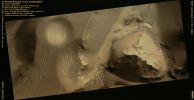
PSP_009342_1725_RED_abrowse-00.jpgPseudo-Pyramid, Dunes, Boulders and Other Misteries...88 visiteUn frame in apparenza di scarso interesse per gli Anomaly Hunters (ma ricco di suggestione per i Cultori delle Scienze Planetarie, con tutte le Surface Features da erosione eolica e da fluidi che mostra), sembra essersi rivelato - dopo un'analisi approfondita svolta usando la sua versione in JP2 - come un'autentica "Fucina di Anomalìe e Singolarità".
Fra le svariate Anomalìe individuabili nel frame, abbiamo deciso di investigarne due: la prima, suggeritaci dalla nostra Amica Elisabetta Bonora - e che ha già suscitato grandi interessi nei Forum di mezzo mondo, a cominciare da quello dei nostri Amici Americani di "AboveTopSecret") -, è rinvenibile in una Surface Feature che, ancora una volta, sembra mostrare ai nostri occhi, avidi di Mistero e di Immaginazione, un Monolito (davvero molto simile a quello di "2001 Odissea nello Spazio").
La seconda, invece, individuata dal nostro Marco Faccin, pare mostrare ai Terrestri il "volto" (si fa per dire...) di una bizzarra e, per certi versi, inquietante Forma Vitale Indigena.
Osservate e giudicate Voi stessi...MareKromium
|
|
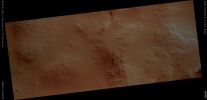
PSP_009714_1725_RED.jpgPeriequatorial Surface Sample (natural colors; credits: Lunar Explorer Italia)72 visiteMars Local Time: 15:31 (middle afternoon)
Coord. (centered): 7,5° South Lat. and 191,3° East Long.
Spacecraft altitude: 265,0 Km (such as about 165,6 miles)
Original image scale range: 26,5 cm/pixel (with 1 x 1 binning) so objects ~80 cm across are resolved
Map projected scale: 25 cm/pixel
Map projection: EQUIRECTANGULAR
Emission Angle: 0,1°
Phase Angle: 59,8°
Solar Incidence Angle: 60° (meaning that the Sun is about 30° above the Local Horizon)
Solar Longitude: 116,2° (Northern Summer)
Credits: NASA/JPL/University of Arizona
Additional process. and coloring: Lunar Explorer ItaliaMareKromium
|
|
| 18 immagini su 2 pagina(e) |
1 |
|








