| Risultati della ricerca nelle immagini - "Eclypse" |
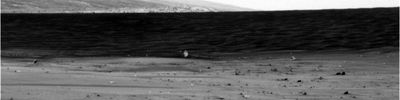
SOL699-2P188412824ESFAKFFP2589R2M1.jpgDark horizon (1) - Sol 69962 visiteUna serie di frames (ne proponiamo 2) davvero strani: non crediamo che l'ombra nera che copre un'abbondante porzione del paesaggio sia un photo-artifact, nè la risultante di un qualche errore nella trasmissione dei dati relativi all'immagine. Sembrerebbe più un improvviso oscurarsi di una porzione del suolo a seguito - magari - di qualche grande nuvola che copre il Sole o, più probabilmente, l'ombra di una eclissi che transita accanto all'area su cui si trova Spirit, ma senza arrivare a coprire Spirit (per maggiori informazioni sulle eclissi marziane - davvero molto diverse dalle eclissi terrestri - Vi suggeriamo di andare a rivedere un frame Viking 1 molto famoso - nella Sez. "Mariner, Viking & MGS's Maps & Mars in the '70s", frame 23 - e quindi rileggere la caption originale).
Caption originale:"Right Pan-Cam Non-linearized Sub-frame EDR acquired on Sol 699 of Spirit's mission to Gusev Crater at approx. 10:17:27 MLT.
Camera commanded to use Filter 2 (754 nm)".
|
|
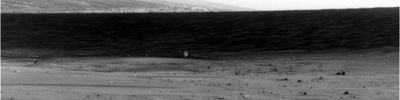
SOL699-2P188412926ESFAKFFP2589R7M1.jpgDark horizon (2) - Sol 69962 visiteOriginal caption:"Right Pan-Cam Non-linearized Sub-frame EDR acquired on Sol 699 of Spirit's mission to Gusev Crater at approx. 10:19:07 MLT.
Camera commanded to use Filter 7 (1009 nm)".
|
|

ZD-VikingLander1-p131b.jpgFrom the "Viking Archive" - Viking 1: Solar Eclypse on Mars152 visitePossibly the most unusual of all Viking Lander pictures records the passage of Phobos' shadow during a solar eclipse. On Earth the apparent size of the Moon is exactly the same as that of the much larger but more distant Sun. Consequently, direct sunlight is completely blocked out during a total solar eclipse. On Mars, Phobos covers only 1/4 of the solar disc. However, passage of the penumbral shadow causes a general drop in light level that is instrumentally detectable. This frame is a repeated line scan image looking back across Viking Lander 1. The colors have been distorted purposely to enhance detail. The blue and white horizontal stripes correspond to test chart patches. The brownish stripes in the middle represent the martian surface visible above the spacecraft. Note a decrease in light levels in the sky midway through the imaging event. The darkening, caused by the passage of the penumbral shadow of Phobos, is present over approx. 100 vertical lines. Moving at about 2 Km/sec, the shadow took about 20 sec to pass over the Lander.
|
|

ZZ-ZZ-Annular_seip_big.jpgThe "Annular Eclipse" of October, 3rd, 2005 (HR)67 visiteDa "NASA - Picture of the Day" del 5 Ottobre 2005:"On Monday, part of the Sun went missing. The missing piece was no cause for concern because the Moon was only momentarily in the way. The event was not a total eclipse of the Sun for any Earth-bound sky enthusiast but rather, at best, an annular eclipse, where the Moon blocked most of the Sun. Because of the relatively large distance to the Moon during this Earth-Moon-Sun alignment, the Moon did not have a large enough angular size to block the entire Sun. Those who witnessed the solar eclipse from a narrow path through Spain and Africa, however, were lucky enough to see the coveted Ring of Fire, a dark Moon completely surrounded by the brilliant light of the distant Sun. Pictured above is a Ring of Fire captured two days ago in unusually HR above Spain. The resulting image shows details of the granular solar surface as well as many prominences around the Sun".
|
|

ZZ-ZZ-HybridEclypse-Espenak_tse2005_1.jpgAn unusual "Hybrid Solar Eclipse" (1)66 visiteDa "NASA - Picture of the Day" del 6 Maggio 2005:"April's spectacular geocentric celestial event was a rare Hybrid Eclipse of the Sun - such as a total or an annular eclipse could be seen depending on the Observer's location.
For Fred Espenak, aboard a gently swaying ship within the middle of the Moon's shadow track about 2.200 Km west of the Galapagos, the eclipse was total, the lunar silhouette exactly covering the bright solar disk for a few brief moments.
His camera captured a picture of totality revealing the extensive Solar Corona and prominences rising above the Sun's edge".
|
|

ZZ-ZZ-HybridEclypse-Heinsius_Panama_tse2005_1.jpgAn unusual "Hybrid Solar Eclipse" (2)72 visiteDa "NASA - Picture of the Day" del 6 Maggio 2005:"(...) But for Stephan Heinsius, near the end of the shadow track at Penonome Airfield, Panama, the Moon's apparent size had shrunk enough to create an anular eclipse, showing a complete anulus of the Sun's bright disk as a dramatic "Ring of Fire".
(...) How rare is such a Hybrid Eclipse?
Calculations show that during the 21st century just 3,1% (7 out of 224) of Solar Eclipses are hybrid while hybrids comprise about 5% of all Solar Eclipses over the period from 2.000 BC to AD 4.000".
|
|
|
|
| 6 immagini su 1 pagina(e) |
|








