| Risultati della ricerca nelle immagini - "Eclipse" |

Black Sun.jpgBlack Sun91 visiteCaption NASA originale:"During a total solar eclipse, Earth's moon blocks the Sun - almost exactly. While the Sun is about 400 times wider than the Moon, it is also about 400 times farther away and each appears to be half a degree or so in diameter. On August 11, 1999 this remarkable coincidence in the apparent size of two vastly different celestial bodies produced tantalizing solar spectacles for denizens of Europe and Asia. For example, prominences along the Sun's limb peer around the Moon's dark edge in this dramatic picture of totality recorded as the lunar shadow swept across Hungary. Subtle structures in the Sun's inner corona are also visible streaming beyond the silhouetted Moon".
|
|

Hungarian Eclypse.jpgMoments of the last Total Eclipse81 visiteCaption NASA originale:"Only in the fleeting darkness of a total solar eclipse is the light of the Solar Corona easily visible from Earth. Normally overwhelmed by the bright solar disk, the expansive corona, the Sun's outer atmosphere, is an alluring sight. But the subtle details and extreme ranges in the corona's brightness discernible to the eye are notoriously difficult to photograph. In this series of images recorded from Siofok, Hungary during the total phase of the August 11, 1999 eclipse, progressively longer exposures (top left to bottom center) have been used to more faithfully capture different regions of the elusive solar corona. The final image (at bottom right) shows light from the solar disk emerging from behind the moon's edge at the end of totality".
|
|

Martian_Eclipse-moc2_msss_3shadow100-00.jpgMOC Views of Martian Solar Eclipses (Original NASA/MGS/MSSS b/w Frame)117 visiteThe shadow of the martian moon, Phobos, has been captured in many recent wide angle camera views of the red planet obtained by the Mars Global Surveyor (MGS) Mars Orbiter Camera (MOC). Designed to monitor changes in weather and surface conditions, the wide angle cameras are also proving to be a good way to spot the frequent solar eclipses caused by the passage of Phobos between Mars and the Sun.This picture shows three samples of MOC's global image swaths, each in this case with a shadow of Phobos visible (arrow). The first scene (left) was taken on September 1, 1999 and shows the shadow of Phobos cast upon southern Elysium Planitia. The large crater with dark markings on its floor at the lower right corner is Herschel Basin. The second scene shows the shadow of Phobos cast upon northern Lunae Planum on September 8, 1999. Kasei Valles dominates the upper right and the deep chasms of Valles Marineris dominate the lower third of the September 8 image. The picture on the right shows the shadow of Phobos near the giant volcano, Olympus Mons (upper left), on September 25, 1999. Three other major volcanoes are visible from lower-center (Arsia Mons) and right-center (Pavonis Mons) to upper-middle-right (Ascraeus Mons).
|
|
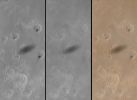
Martian_Eclipse-moc2_msss_3shadow100-01.jpgMOC Views of Martian Solar Eclipses (Original NASA/MGS/MSSS - Natural Color Frame)148 visiteThis picture shows wide angle red (left), blue (middle) and color composite (right) views of the shadow of Phobos (elliptical feature at center of each frame) as it was cast upon western Xanthe Terra on August 26, 1999, at about 2 p.m. local time on Mars. The image covers an area about 250 Km (155 miles) across and is illuminated from the left. The meandering Nanedi Valles is visible in the lower right corner of the scene. Note the dark spots on three crater floors - these appear dark in the red camera image (left) but are barely distingished in the blue image (middle), while the shadow is dark in both images. The spots on the crater floors are probably small fields of dark sand dunes.
|
|
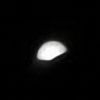
OPP-SOL1583-1P268731057ESF90B2P2633L8M1.jpgPartial Eclipse - Sol 158370 visitenessun commentoMareKromium
|
|

OPP-SOL2415-PIA13737.jpgPhobos eclipsing the Sun - Sol 2415 (credits: NASA/JPL-Caltech/Cornell/Texas A&M)122 visiteThe larger of the two moons of Mars, Phobos, transits the Sun in this image from the PanCam on NASA's Mars Exploration Rover Opportunity taken on the Rover's 2415th Martian Day, or Sol (such as Nov. 9, 2010).
Images of solar transits of Phobos and the other Mars moon, Deimos, taken over many years by Mars Rovers aid in studies of slight changes in the moons' orbits.
The silhouette of Phobos looks smaller here than in some other Mars Rover transit images (for example, PIA05554) because when Phobos is near the Horizon it is more than 30% farther from the camera's location than when it is straight overhead.MareKromium
|
|

Partial_Lunar_Eclipse.jpgEarth's Shadow79 visitenessun commentoMareKromium
|
|
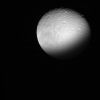
Rhea-N00118973.jpgRhea's Eclipse75 visiteCaption NASA:"N00118981.jpg was taken on August 19, 2008 and received on Earth August 21, 2008. The camera was pointing toward RHEA that, at the time, was approx. 453.710 Km away; the image was taken using the CL1 and CL2 filters. This image has not been validated or calibrated".MareKromium
|
|
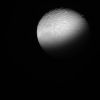
Rhea-N00118975.jpgRhea's Eclipse78 visiteCaption NASA:"N00118981.jpg was taken on August 19, 2008 and received on Earth August 21, 2008. The camera was pointing toward RHEA that, at the time, was approx. 455.227 Km away; the image was taken using the CL1 and CL2 filters. This image has not been validated or calibrated".MareKromium
|
|
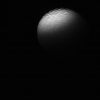
Rhea-N00118979.jpgRhea's Eclipse90 visiteCaption NASA:"N00118981.jpg was taken on August 19, 2008 and received on Earth August 21, 2008. The camera was pointing toward RHEA that, at the time, was approx. 456.744 Km away; the image was taken using the CL1 and CL2 filters. This image has not been validated or calibrated".MareKromium
|
|
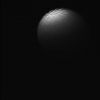
Rhea-N00118981.jpgRhea's Eclipse65 visiteCaption NASA:"N00118981.jpg was taken on August 19, 2008 and received on Earth August 21, 2008. The camera was pointing toward RHEA that, at the time, was approx. 457.502 Km away; the image was taken using the CL1 and CL2 filters. This image has not been validated or calibrated".MareKromium
|
|
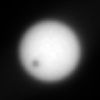
SOL039-PIA05556.gifMartian Eclipse: Deimos (GIF Movie) - Sol 3965 visiteCaption NASA:"This animation shows the passing, or transit, of the Martian Moon Deimos over the Sun. This event is similar solar eclipse seen on Earth in which our Moon crosses in front of the Sun. The animation is made up of images taken by the Mars Exploration Rover Opportunity on sol 39 of its mission. Deimos passed slightly closer to the center of the Sun than expected, and arrived about 30 seconds early. This observation will help refine our knowledge of the orbit and position of Deimos".
|
|
| 14 immagini su 2 pagina(e) |
1 |
|








