| Risultati della ricerca nelle immagini - "Eberswalde" |

Craters-Eberswalde_Crater-PIA15207-PCF-LXTT.jpgFeatures of Eberswalde Crater (Absolute Natural Colors; credits for the additional process. and color.: Dr Paolo C. Fienga - Lunexit Team)226 visiteOrbit Number: 44018
Latitude: 23,94° South
Longitude: 326,37° East
Instrument: VIS
Captured: November, 16th, 2011
Mars Local Time (M.L.T.): 16:00 (Middle Afternoon)MareKromium
|
|

ESP_011331_1560_RED_abrowse.jpgTerrain in Eberswalde Crater (possible Natural Colors; credits: Lunar Explorer Italia)81 visiteMars Local Time: 15:54 (middle afternoon)
Coord. (centered): 23,9° South Lat. and 326,8° East Long.
Spacecraft altitude: 258,6 Km (such as about 161,6 miles)
Original image scale range: 25,9 cm/pixel (with 1 x 1 binning) so objects ~78 cm across are resolved
Map projected scale: 25 cm/pixel
Map projection: EQUIRECTANGULAR
Emission Angle: 1,3°
Phase Angle: 60,3°
Solar Incidence Angle: 61° (meaning that the Sun is about 29° above the Local Horizon)
Solar Longitude: 180,4° (Northern Autumn)
Credits: NASA/JPL/University of Arizona
Additional process. and coloring: Lunar Explorer ItaliaMareKromium
|
|

ESP_013533_1560_RED_abrowse.jpgProposed MSL Landing Site inside Eberswalde Crater (Natural Colors; credits: Lunexit)67 visitenessun commentoMareKromium
|
|

ESP_020891_1560_RED_abrowse-PCF-LXTT.jpgCandidate MSL Landing Site: the Floor of Eberswalde Crater (Absolute Natural Colors; credits for the additional process. and color.: Dr Paolo C. Fienga - Lunexit Team)255 visitenessun commentoMareKromium
|
|

PSP_003222_1565_RED_browse.jpgProposed MSL Site in Eberswalde Crater77 visitenessun commentoMareKromium
|
|

PSP_004000_1560_RED_browse.jpgLayers in Eberswalde Crater75 visiteThis image covers a portion of Eberswalde Crater, revealing a possible delta-lake transition. Water flowed into the crater through a series of tributary channels to the west of the crater and after the water entered, it formed a distributive network and partly filled the crater to form a lake (Eberswalde Crater is approx. 70 Km wide and 1,2 Km deep).
The bright layers are part of the terminal scarp at the eastern edge of the delta. Some of the steeper slopes visible at the edge of the fan may be coarser-grained resistant channel ridges. The CRISM instrument on board the Mars Reconnaissance Orbiter has detected phyllosilicates (clays) in the bright layers. One of the ways clays form on Earth is when water erodes rock and makes fine particles which settle out of water; this often occurs in river deltas and lake beds.
The delta in Eberswalde Crater and the detection of phyllosilicates provides evidence for possible persistent aqueous activity on Mars.MareKromium
|
|
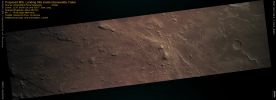
PSP_007481_1560_RED_abrowse.jpgProposed MSL Landing Site in Eberswalde Crater (MULTISPECTRUM; credits: Lunexit)68 visiteThis image covers a portion of Eberswalde Crater, which has an ancient deltaic depositional setting. Eberswalde is an approx. 65 Km diameter, closed basin crater. This image was targeted in the landing ellipse as a possible site for the 2009 Mars Science Laboratory Mission. The image shows resistant mounds and knobs as well as a scoured surface.
The CRISM instrument on board the Mars Reconnaissance Orbiter has detected Phyllosilicates (clays) in the bright layers in the crater. One of the ways clays form on Earth is when water erodes rock and makes fine particles which settle out of water; this often occurs in river deltas and lake beds.
The delta and meandering channels in Eberswalde Crater (to the West of the Landing Ellipse) and the detection of Phyllosilicates provides evidence for possible persistent aqueous activity on Mars.MareKromium
|
|

PSP_010052_1560_RED.jpgFeatures of Eberswalde Crater (natural colors; credits: Lunexit)78 visiteEberswalde Crater is an approx. 65-Km diameter, closed Basin Crater. It contains a delta, which indicates that flowing water was present for an extended period of time in the past.
Parts of the Crater have inverted channels that have higher relief because a more resistant material was deposited in the channel and therefore it was less susceptible to erosion than the surrounding area. The image also shows resistant knobs and mounds as well as a scoured surface.
The CRISM instrument on-board MRO has detected Phyllosilicates (Clays) in some of the bright layers here. On Earth, clays form in the presence of water, so this is more evidence that there was a persistent flow of water in Eberswalde.MareKromium
|
|
| 8 immagini su 1 pagina(e) |
|








