| Risultati della ricerca nelle immagini - "Earth's" |
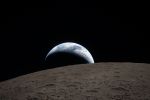
0014-Earthset.jpegEarthset and Ohm Crater130 visiteEarthset captured through the Orion Spacecraft window during the Artemis II crew’s flyby of the Moon.
The dark portion of the Earth is experiencing nighttime. On Earth’s day side, swirling clouds are visible over Australia and Oceania.
In the foreground, Ohm Crater on the Moon has terraced edges and a flat Floor interrupted by Central Peaks.
Artemis II’s historic lunar flyby on Monday was one of new milestones and spaceflight records, but it was also deeply resonant with the past. After flying farther beyond the Earth than any human has ever been before—beating the record set in 1970 during Apollo 13 by about 4,102 miles—and seeing parts of the moon no humans had ever witnessed, the crew recreated “Earthrise,” one of the most famous photographs of all time, with a small twist.
Instead of Earthrise, the Artemis II photo is of Earthset, capturing the surface of the moon and the crescent-lit Earth setting beyond it in the same frame.
In 1968, a year of global political unrest, the crew of Apollo 8 was on a similar flight around the moon, on a test of a spacecraft that would be used for future lunar landings. In an unplanned moment, crew member William “Bill” Anders snapped a photo of the Earth and the moon in the same frame. The photo, called “Earthrise,” would become iconic—inspiring the global environmental movement in the years before the establishment of Earth Day in 1970.MareKromium
|
|
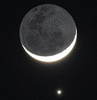
ZZ-ZZ-ZZ-FN-Earthshine.gifCoronal Mass Ejection and Earthsine121 visiteThis photograph was taken by Devgun Chander of Sohna, Haryana, of India. It shows a striking clarity to the earthshine region of the Moon. When I first look at the photograph I was impressed that Aristarchus was standing out so bright even though it very close to the sunset terminator. I sent the photograph to Dr. Anthony Cook the senior recorder for the L.T.P. sections of BAA and ALPO. He sent me the measured brightness of specific lunar formations and of the Lunar Maria.
(...) The Maria across the face of the Moon is uniformly bright except for the formations Mare Humorum, Mare Frigoris and Maria located near Aristarchus. Dr. Anthony Cook believes they are brighter due to the glare from the nearby sunset terminator. (...) The fact that we had a significant coronal mass ejections into space or CME take place on November 8-9,2004 causing aurora reports all over the World. If Solar Excitation is a factor for the extreme brightness of the Earthshine this would be the event to cause it.
|
|
|
|
| 2 immagini su 1 pagina(e) |
|








