| Risultati della ricerca nelle immagini - "E-Ring" |

Saturn from approx. 9.000.000 Km (2).jpgWhat is this?!? (1)55 visiteEsistono centinaia di immagini negli archivi relativi alle raw-images della Sonda Cassini-Huygens che riprendono oggetti imprecisati che si trovano nello Spazio di Saturno. Nella maggior parte dei casi si tratta dei Satelliti (Maggiori e Minori) del Pianeta o di particelle cosmiche (raggi cosmici, forse) che lasciano strane tracce (punti e strisce). In altri casi, la risposta è lasciata al buon senso ed alla prudenza di chi guarda. Secondo noi questa luce è il Satellite Rhea, sovraesposto. E secondo Voi?...
|
|

Saturn from approx. 9.000.000 Km.jpgWhat is this?!? (2)53 visiteUn'immagine curiosa, misteriosa ed affascinante: gli strumenti di bordo della Sonda Cassini-Huygens dicono che questa ripresa si riferisce all'Anello "E"; in pratica diremmo che la fotocamera in questione stava riprendendo (come è già accaduto tante volte) lo Spazio di Saturno. Il chiarore rotondeggiante che vediamo in basso non sembra l'alone di luce che l'Anello "E" emana intorno a sè. E allora di che cosa si tratta?
|
|
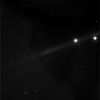
Saturn-E-Ring-W00012982.jpgOver-exposed Moons and the E-Ring55 visiteEscludendo che i due globi luminosi che vediamo in questo frame (in una posizione di quasi allineamento rispetto all'Anello E di Saturno) sìano dei photi-artifacts o degli UFO, la nostra sensibilità nell'analisi dei frames in arrivo dalla Sonda Cassini ci suggerisce l'idea che si tratti di due Lune di Saturno ampiamente sovraesposte.
Ma se ci chiedeste di quali Lune si tratta...Beh, non ci vergognamo di dire che questo proprio non lo sappiamo.
Caption originale:"W00012982.jpg was taken on January 11, 2006 and received on Earth January 12, 2006. The camera was pointing toward Saturn's E-Ring that, at the time, was approximately 2.048.891 Km away.
The image was taken using the CL1 and IRP90 filters and has not been validated or calibrated".
|
|

The Rings-PIA08163-1.jpgThe "E-Ring" of Saturn: the "Enceladus Ring" (1)63 visiteThis excellent view of the faint E-Ring - a ring feature now known to be created by Enceladus - also shows two of Saturn's small moons that orbit within the Ring, among a field of stars in the background.
The E-Ring extends from three to eight Saturn radii - about 180.000 Km(such as about 118.000 miles) to 482.000 Km (about 300.000 miles). Its full extent is not visible in this view.
Calypso (22 Km, or about 14 miles across) and Helene (32 Km, or about 20 miles across) orbit within the E-Ring's expanse. Helene skirts the outer parts of the E-Ring, but here it is projected in front of a region deeper within the Ring.
Calypso and Helene are trojan satellites, or moons that orbit 60° in front or behind a larger moon. Calypso is a Tethys trojan and Helene is a trojan of Dione. An interesting feature of note in this image is the double-banded appearance of the E-Ring, which is created because the Ring is somewhat fainter in the Ring-Plane than it is 500-1000 Km (about 300-600 miles) above and below it.
|
|

The Rings-PIA08163-2.jpgThe "E-Ring" of Saturn: the "Enceladus Ring" (2)55 visiteThis appearance implies that the particles in this part of the Ring have nonzero inclinations (a similar affect is seen in Jupiter's Gossamer Ring). An object with a nonzero inclination does not orbit exactly at Saturn¿s Ring-Plane: its orbit takes it above and below it. Scientists are not entirely sure why the particles should have such inclinations, but they are fairly certain that the reason involves Enceladus. One possible explanation is that all the E-Ring particles come from the plume of icy material that is shooting due South out of the moon's Pole.
This means all of the particles are created with a certain velocity out of the Ring-Plane, and then they orbit above and below that plane.
Another possible explanation is that Enceladus produces particles with a range of speeds, but the moon gravitationally scatters any particles that lie very close to the Ring-Plane, giving them nonzero inclinations. Stray light within the camera system is responsible for the broad, faint "Y" shape across the image.
The image was taken in visible light with the Cassini spacecraft wide-angle camera on March 15, 2006, at a distance of approximately 2.4 million kilometers (1.5 million miles) from Saturn. The image scale on the sky at the distance of Saturn is 142 kilometers (88 miles) per pixel.
|
|

The_Rings-ERing-EB.jpgLuminescence in the E-Ring (by Elisabetta Bonora - Lunexit Team)55 visite...una Visione suggestiva e bellissima...MareKromium
|
|

The_Rings-ERing-W00051101.jpgThe tenuous E-Ring of Saturn (RAW frame)56 visiteCaption NASA:"W00051101.jpg was taken on November 12, 2008 and received on Earth November 13, 2008. The camera was pointing toward SATURN's E-RING that, at the time, was approx. 1.234.847 Km away.
The image was taken using the CL1 and BL1 filters".
Nota Lunexit: in questo frame potete osservare una serie impressionante di image-artifacts (noise, per lo più, come spesso si vede nei frames CASSINI).MareKromium
|
|
|
| 7 immagini su 1 pagina(e) |
|





