| Risultati della ricerca nelle immagini - "Dunes)" |

North_Polar_Features-The_Erg-PCF-LXTT-3.jpgNorth Polar Erg (Absolute Natural Colors; credits for the additional process. and color.: Dr Paolo C. Fienga - Lunexit Team)68 visiteCaption NASA:"A vast Region of sand dunes is located on the margin of the North Polar Cap of Mars. This 'sea' of sand is call "Polar Erg".
Coord.: 80,5° North Lat. and 183,5° East Long.
MareKromium
|
|
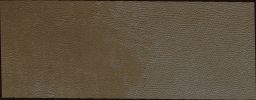
North_Polar_Features-The_Erg-PCF-LXTT-4.jpgNorth Polar Erg (Absolute Natural Colors; credits for the additional process. and color.: Dr Paolo C. Fienga - Lunexit Team)83 visiteCoord.: 73,8° North Lat. and 310,3° East Long.MareKromium
|
|
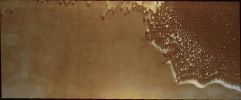
North_Polar_Features-The_Erg-PCF-LXTT-5.jpgVastitas Borealis and the North Polar Erg (Absolute Natural Colors; credits for the additional process. and color.: Dr Paolo C. Fienga - Lunexit Team)81 visiteCoord.: 76,5° North Lat. and 295,6° East Long.MareKromium
|
|
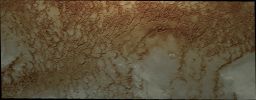
North_Polar_Regions-North_Polar_Erg-PCF-LXTT.jpgNorthern Dunes (Natural Colors; credits for the additional process. and color.: Dr Paolo C. Fienga - Lunexit Team)68 visiteCaption NASA:"This region of North Polar Dunes has less dune materials than other portions of the North Polar Erg. This allows the base (assumption) that the dunes are moving across to be observed".MareKromium
|
|
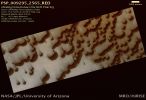
PSP_009295_2565_RED.jpgAbrading Dunes in the North Polar Erg (natural colors; credits: Lunexit)66 visiteThis location is where Mars Global Surveyor (a.k.a.: MGS) saw evidence of dunes that either shrank or completely disappeared over a span of a few years. HiRISE provides new details at higher resolution.
As seen here, the dunes show clear evidence of erosion.
Based on the shape of the dunes in this picture, the strongest winds have blown from the upper right (South-East) to lower left (North-West).
Streamers of dark sand are visible on the white, frost-covered surface downwind of the dunes. This is particularly prominent at the “horns” of the barchan dunes (these are the dunes with the prominent points at their edges).
Scientists believe these dunes are cemented, by ice, such that the wind is progressively eroding them over time. Future observations by HiRISE will determine if the dunes shrink as indicated by MGS, or maybe even migrate, over time.MareKromium
|
|

PSP_009396_2590_red.jpgDefrosted Margin of the North Polar Erg (natural colors; credits: Lunexit)66 visiteThis image shows a traverse across a section of the North Polar Erg, a vast Sea of Sand that surrounds the Polar Cap.
The source of the dunes may be from the eroding North Polar Layered Deposits. Wind, acting on this mixture of sand, dust and ice, has formed several dune types on top of bright megaripples and polygons. A dark mantle of sand lies beyond the dunes.
The central part of the field contains transverse dunes with the dominant wind direction coming from the North/West-West. The outer edges of the Dunefield transition into "Star Dunes" (with multiple arms) and "Barchanoid Dunes" (crescent-like shape). The Star Dunes indicate a multidirectional wind regime or a change in wind direction over the Dunefield’s evolution.
The dunes are somewhat confined to their location and may have taken hundreds of years to form.MareKromium
|
|
|
|
| 6 immagini su 1 pagina(e) |
|








