| Risultati della ricerca nelle immagini - "Double-Crater" |

ESP_011618_1885_RED_abrowse-00.jpgRecent Double-Impact (ctx frame - possible Natural Colors; credits: Lunar Explorer Italia)106 visiteMars Local Time: 15:46 (middle afternoon)
Coord. (centered): 8,6° North Lat. and 46,8° East Long.
Spacecraft altitude: 273,6 Km (such as about 171,0 miles)
Original image scale range: 27,4 cm/pixel (with 1 x 1 binning) so objects ~82 cm across are resolved
Map projected scale: 25 cm/pixel
Map projection: EQUIRECTANGULAR
Emission Angle: 5,9°
Phase Angle: 64,1°
Solar Incidence Angle: 58° (meaning that the Sun is about 32° above the Local Horizon)
Solar Longitude: 193,2° (Northern Autumn)
Credits: NASA/JPL/University of Arizona
Additional process. and coloring: Lunar Explorer ItaliaMareKromium
|
|

ESP_011618_1885_RED_abrowse-01.jpgRecent Double-Impact (edm - possible Natural Colors; credits: Lunar Explorer Italia)82 visiteThe MRO Context Imager (CTX) team has been discovering many new impact events on Mars, and then they request HiRISE follow-up imaging to confirm an impact origin and to identify and measure the craters.
Crater clusters are common as these small (typically less than 1 meter diameter) objects break up in the thin Martian air and separate a little bit to make crater clusters up to a few hundred meters wide. The example shown here is the result of an impact that occurred between May 2003 and September 2007.
It was first discovered as a dark spot in a CTX image acquired in March 2008, but later found to be partly visible at the very edge of a CTX image acquired in September 2007.
A dark spot is not present in the previous image of this location with sufficient resolution to have detected it, acquired by the visible THEMIS camera on Mars Odyssey in May 2003. Thus the impact might have formed anytime between May 2003 and September 2007. The dark markings are created by removing or disturbing the surficial dust cover, and so far new impact sites have been discovered only in dust-covered regions of Mars.
Although small Martian crater clusters are common, this example is unusual because there is a dark line between the two largest craters. We hypothesize that atmospheric breakup coincidentally made two nearly equal-size objects that impacted close together in space and time so the air blasts interacted with each other to disturb the dust along this line.
Hundreds of these small objects (mostly asteroid fragments) impact Mars per year. A comparable number of small objects impact Earth each year, but explode in the upper reaches of our atmosphere and have no effect on the surface, fortunately for those of us who live here.MareKromium
|
|

Panoramic-AS11-40-5888-5891-2.jpgFrom AS 11-40-5888 until 5891 (Processed in possible True Colors - Unnamed double-crater)64 visitenessun commentoMareKromium
|
|

Panoramic-AS11-40-5888-5891.jpgFrom AS 11-40-5888 until 5891 (Processed in natural colors - Unnamed double-crater)64 visitenessun commentoMareKromium
|
|
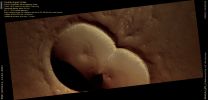
Psp_009619_1630_red.jpgDouble Impact Crater (natural colors; credits: Lunexit)115 visiteThis image shows a double impact crater in Syria Planum, and probably formed when a binary asteroid pair (two asteroids closely orbiting each other, while also orbiting the Sun) struck the Surface. The asteroids must have been about the same size, on the order of a few hundred meters across, to produce these craters.
How is it possible to say that the double crater is due to a binary asteroid, instead of two independent impacts? Neither crater shows signs of burial by ejecta from the other. More importantly, the ejecta (material thrown out of the craters) shows signs of interacting; the ridges extending to the southeast of the crater probably formed when ejecta from the craters collided in midair, causing more debris to pile up at certain points.
This means that the impacts occurred within moments of each other.
Ejecta interaction features like this can also form in association with “secondary” craters (craters made by debris from other impacts, rather than by asteroids), since many secondary craters form at once. In this case, however, a binary asteroid is the likely cause. The very large size is one indicator (secondary craters are generally much smaller than the “primary” crater), and there is not an obvious nearby source crater. While secondary craters are common, binary impacts are expected to occur as well, since binary asteroid pairs are observed.
This crater pair is also of geologic interest since it exposes a cross-section of the local rocks. Thin, flat layers are visible in the upper walls. Since this region has seen extensive volcanic activity, these may be a mix of old lava flows and other volcanic debris. Exposures like this provide evidence for the extent and thickness of these deposits. MareKromium
|
|
|
|
|
| 5 immagini su 1 pagina(e) |
|








