| Risultati della ricerca nelle immagini - "Deposits" |

APOLLO_11_AS_11-45-6708a.JPGAS 11-45-6708 (a) - Glass Deposits97 visiteCrater bottom with prominent "glass deposits".MareKromium
|
|

Channels-Unnamed_Outflow_Channel-PIA00483.jpgOutflow Channel in South Nawka Vallis (possible Natural Colors; credits: Dr Paolo C. Fienga - Lunexit Team)79 visiteThis SAR image from the Southern portion of Navka (24,4-25,3° South Latitude and 338,5-340,5° East Longitude) is a mosaic of twelve Magellan orbits that covers approx. 180 Km (about 108 miles) in width and approx. 78 Km (about 47 miles) in length.
In the center of this image are two bright Deposits running North to South.
These Deposits outline an Outflow Channel that flowed from an about 60-Km diameter Crater that is to the South of the Channel itself. Inside the Outflow Channel and outlined by some so-called 'Bathtub Ring' Deposits are small Cones, most likely of volcanic origin.
At the end of the Outflow Channel, where one would expect the smallest particles to be deposited, are specular features which may represent Sand Dunes.
Seasat and space shuttle radar images of sand dunes on Earth also show specular reflections from smooth dune faces that are near-normal to the radar beam.
Other evidence for aeolian activity are the dark and bright Windstreaks running East to West and that formed behind the Cones. Notice how the wind changes direction from a South/East-North/West flow at the right of the image to an East-West flow at the eastern edge of the Outflow Channel.MareKromium
|
|
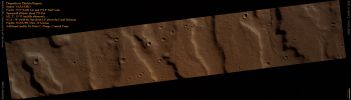
ESP_018471_1420_RED_abrowse.jpgElectris Region (Natural Colors; credits for the additional process. and color.: Dr Paolo C. Fienga - Lunexit Team)86 visitenessun commentoMareKromium
|
|
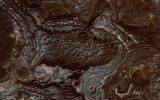
Juventae_Chasma-PIA12489.jpgBright Layered Deposits near Juventae Chasma (Natural Colors; credits: Dr Paolo C. Fienga - Lunexit Team)66 visiteThis view shows color variations in bright Layered Deposits on a plateau near Juventae Chasma in the Valles Marineris egion of Mars. A brown mantle covers portions of the bright deposits. The view covers an area about of 1,2 Km (three-fourths of a mile) across.
The image comes from an observation made by the High Resolution Imaging Science Experiment (HiRISE) camera on NASA's Mars Reconnaissance Orbiter on May 2, 2007.
Researchers have found that these bright Layered Deposits contain Opaline Silica and Iron Sulfates, consistent with low-temperature, acidic aqueous alteration of basaltic materials. They conclude that aqueous activity affected this plateau after formation of the nearby canyons. Although the source of water and sediment remains uncertain, the strong correlation between fluvial landforms and bright Layered Deposits in this Region argues for sustained precipitation, surface runoff, and fluvial deposition occurring during Mars' Hesperian Era on the plateaus adjacent to Valles Marineris and along portions of the canyon walls.
This image is one product from HiRISE observation PSP_003579_1755, centered at 4,7° South Lat. and 296,4 East Long.MareKromium
|
|
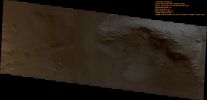
Juventae_Chasma-PIA13278.jpgLayered Hill in Juventae Chasma (Natural Colors; credits: Dr Paolo C. Fienga - Lunexit Team)70 visitenessun commentoMareKromium
|
|

North_Polar_Features-Layers-PIA18238-PCF-LXTT-IPF.jpgNorth Polar Layers with "Unconformities" (Absolute Natural Colors; credits for the additional process. and color.: Dr Paolo C. Fienga/Lunar Explorer Italia/Italian Planetary Foundation)109 visiteIn this VIS image, taken by the NASA - Mars Odyssey Orbiter on March, 3rd, 2014, and during its 54.206th orbit around the Red Planet, we can see a small portion of the so-called North Polar Layered Deposits (or "NPLD", for short), which - according to the data collected so far and duly examined by Planetary Scientists - are (mostly) made of Water-Ice.
Latitude (centered): 79,8759° North
Longitude (centered): 339,4930° East
Instrument: VIS
This image (which is a crop taken from an Original Mars Odyssey Orbiter b/w and Map-Projected frame published on the NASA - Planetary Photojournal with the ID n. PIA 18240) has been additionally processed, magnified to aid the visibility of the details, contrast enhanced, Gamma corrected and then colorized in Absolute Natural Colors (such as the colors that a human eye would actually perceive if someone were onboard the NASA - Mars Odyssey Orbiter and then looked down, towards the Surface of Mars), by using an original technique created - and, in time, dramatically improved - by the Lunar Explorer Italia Team.MareKromium
|
|
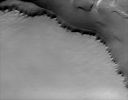
North_Polar_Features-North_Polar_Margin-PIA08705-1.jpgThe North Polar "Margin" (1 - Original NASA/JPL/ASU b/w Frame)64 visiteImage information: VIS instrument;
Latitude: 81,1° North;
Longitude: 299,2° East:
Resolution: 20 meter/pixel.
|
|
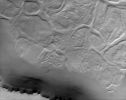
North_Polar_Features-North_Polar_Margin-PIA08705-2.jpgThe North Polar "Margin" (2 - Original NASA/JPL/ASU b/w Frame)68 visiteImage information: VIS instrument;
Latitude: 81,1° North;
Longitude: 299,2° East:
Resolution: 20 meter/pixel.
|
|

North_Polar_Features-North_Polar_Scarp-MGS-01.jpgNorth Polar Panorama (Absolute Natural Colors; credits for the additional process. and color.: Dr Paolo C. Fienga - Lunexit Team)179 visiteCaption NASA originale:"This MGS-MOC image shows a steep slope in the North Polar Region of Mars. The stripes indicate an exposure of layered material; the variations in brightness among the stripes are the result of varying amounts and textures on seasonal Carbon Dioxide (CO2) frost. At the time the image was acquired - such as in June 2006 -, the Carbon Dioxide frost was beginning to sublime way, leaving a variety of different patterns in frost distribution".
Location near: 85,2° North Lat. and 122,7° West Long.
Image width: ~3 Km (~1,9 mi)
Illumination from: lower left
Season: Northern Spring MareKromium
|
|
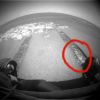
OPP-SOL776-1F197074774EFF67FWP1211L0M1.jpgSalt in Meridiani? - Sol 77681 visiteDopo i depositi di sali e solfati nei pressi di Husband Hill, portati alla luce dalle trincee scavate dalle ruote di Spirit, abbiamo la sensazione che il medesimo fenomeno si stia evidenziando, sebbene in forma meno appariscente, anche nei dintorni del cratere Erebus: guardate Voi stessi...
|
|
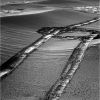
OPP-SOL777-1P197180749EFF67FWP2558L7M1.jpgSalty tracks near Erebus? - Sol 77767 visiteNuovi mega-scavi, simili a quelli eseguiti da Spirit, ci arrivano dai pressi del Cratere Erebus, Meridiani Planum. Ed anche in questo caso, oltre alle annotazioni sulla (diciamo...eccessiva?!?) semplicità con cui la gelida (!) superficie di Marte viene intaccata, dobbiamo notare la presenza di materiale bianco nelle tracce lasciate dal Rover.
Ancora sali e solfati?
Caption originale:"Left PanCam Non-linearized Full frame EDR acquired on Sol 777 of Opportunity's mission to Meridiani Planum at approximately 17:07:25 MLT. Camera commanded to use Filter 7 (432 nm)".
|
|
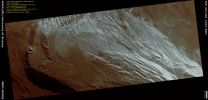
PSP_001456_1695_RED_abrowse-00.jpgLight Layered Deposits in Valles Marineris Region (CTX Frame - Natural Colors; credits: Lunexit)76 visiteThis image shows bright Layered Deposits near the junction of Coprates Chasma and Melas Chasma, both part of the Valles Marineris Canyon System.
The Outcrop visible in this frame is found in a wide Alcove located in the Northern Wall and it forms a broad mound which is several kilometers wide; dark, wind-blown materials cover it in places.
Similar light-toned rock occurs in many places of the Valles Marineris.
An important question is when these materials formed: were they deposited within the Troughs after they opened and then eroded, or are they remnants of the Wall Rock?
Analysis of the orientation of the layers using HiRISE images may help scientists answer this question.
There are no fresh Impact Craters preserved on the Outcrop Surface, suggesting that the Layered Deposits are being eroded rapidly enough to erase the Craters.
In many places, the light rocks have regular fractures called "Joints". Joints are common in Earthly rocks and HiRISE images show them in many places on Mars as well.
These Joints can provide information about the forces that affected - in time - the rocks of this area, and therefore they could also help us to (at least partially) unravel the Geologic History of Mars in general and this Outcrop in particular.MareKromium
|
|
| 54 immagini su 5 pagina(e) |
1 |
 |
|
|








