| Risultati della ricerca nelle immagini - "Dark" |

Craters-Unnamed_Crater-PIA06699-PCF-LXTT.jpgDark Slope Streaks (Natural Colors; credits for the additional process. and color.: Dr Paolo C. Fienga - Lunexit Team)143 visiteCaption NASA:"Dark Slope Streaks are a common feature on the Slopes thickly-mantled by Dust in the Tharsis, Arabia, and Western Amazonis Planitia egions of Mars. Less common are light-toned Slope Streaks, which often occur in the same area as Dark Streaks. They are most common in Arabia Terra, and some are shown in this MGS image. Slope Streaks are probably the result of sudden Avalanches of extremely dry Dust. The behavior of the avalanching dust is somewhat fluid-like and it is a phenomenon often observed during the Martian year.
MareKromium
|
|

Dark_Matter~0.jpgDark Matter160 visiteDark matter is a form of matter thought to account for approximately 85% of the matter in the universe and about a quarter of its total mass–energy density or about 2.241×108722,27 kg/m3. Its presence is implied in a variety of astrophysical observations, including gravitational effects that cannot be explained by accepted theories of gravity unless more matter is present than can be seen. For this reason, most experts think that dark matter is abundant in the universe and that it has had a strong influence on its structure and evolution. Dark matter is called dark because it does not appear to interact with the electromagnetic field, which means it does not absorb, reflect or emit electromagnetic radiation, and is therefore difficult to detect.
Primary evidence for dark matter comes from calculations showing that many galaxies would fly apart, or that they would not have formed or would not move as they do, if they did not contain a large amount of unseen matter. Other lines of evidence include observations in gravitational lensing and in the cosmic microwave background, along with astronomical observations of the observable universe's current structure, the formation and evolution of galaxies, mass location during galactic collisions and the motion of galaxies within galaxy clusters. In the standard Lambda-CDM model of cosmology, the total mass–energy of the universe contains 5% ordinary matter and energy, 27% dark matter and 68% of a form of energy known as dark energy. Thus, dark matter constitutes 85% of total mass, while dark energy plus dark matter constitute 95% of total mass–energy content.
Because dark matter has not yet been observed directly, if it exists, it must barely interact with ordinary baryonic matter and radiation, except through gravity. Most dark matter is thought to be non-baryonic in nature; it may be composed of some as-yet undiscovered subatomic particles. MareKromium
|
|

ESP_016032_2600_RED_abrowse-00.jpgNorthern Spring (CTX Frame - Natural Colors; credits: Dr Paolo C. Fienga - Lunexit Team)65 visiteIn the Winter a layer of Carbon Dioxide (CO2) ice (such as Dry Ice) covers the North Polar Sand Dunes.
In the Spring the sublimation of the ice causes a host of uniquely Martian Phenomena.MareKromium
|
|
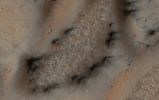
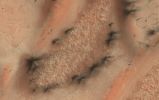
ESP_016032_2600_RED_abrowse-01.jpgNorthern Spring (EDM - Natural Colors; credits: Dr Paolo C. Fienga - Lunexit Team)65 visiteIn this EDM, Streaks of dark Basaltic Sand have been carried from below the ice layer to form Fan-shaped Deposits on top of the seasonal ice.
The similarity in the directions of the fans suggests that they formed at the same time, when the wind direction and speed was the same. They often form along the boundary between the dune and the Surface below the Dunes.MareKromium
|
|
ESP_016032_2600_RED_abrowse-02.jpgNorthern Spring (EDM - Natural Colors; credits: NASA/JPL/Univ. of Arizona)66 visitenessun commentoMareKromium
|
|
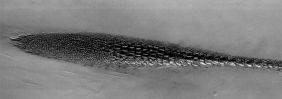
North_Polar_Features-Dunes-PIA08557.jpgNorth Polar Dunes (Original NASA/JPL/ASU b/w Frame)80 visiteImage information: VIS instrument;
Latitude: 82,4° North;
Longitude: 314,5° East;
Resolution: 40 meter/pixel.
|
|
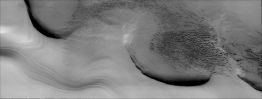
North_Polar_Features-PIA08694-00.jpgNorth Polar Landscape (Original NASA/2001 Mars Odyssey Orbiter b/w Frame)64 visiteImage information: VIS instrument;
Latitude: 83,6° North;
Longitude: 120,3° East;
Resolution: 40 meter/pixel.
|
|
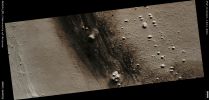
PSP_010420_1855_RED_abrowse.jpgDark Layers in Vernal Crater (Natural Colors; credits: Lunar Explorer Italia)67 visiteMars Local Time: 15:39 (middle afternoon)
Coord. (centered): 5,7° North Lat. and 355,6° East Long.
Spacecraft altitude: 273,4 Km (such as about 170,9 miles)
Original image scale range: 27,4 cm/pixel (with 1 x 1 binning) so objects ~ 82 cm across are resolved
Map projected scale: 25 cm/pixel
Map projection: EQUIRECTANGULAR
Emission Angle: 4,0°
Phase Angle: 50,8°
Solar Incidence Angle: 55° (meaning that the Sun is about 35° above the Local Horizon)
Solar Longitude: 142,7° (Northern Summer)
Credits: NASA/JPL/University of Arizona
Additional process. and coloring: Lunar Explorer ItaliaMareKromium
|
|
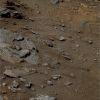
SOL1108-3.jpgDark Sands near Spirit - Sol 1108 (possible True Colors; credits: Dr G. Barca & Lunexit)65 visitenessun commentoMareKromium
|
|

SOL1111-3.jpgSigns of ancient Waters? - Sol 1111 (possible True Colors; credits: Dr G. Barca & Lunexit)65 visitenessun commentoMareKromium
|
|
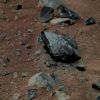
SOL601-1-GB.jpgBlack Glass? - Sol 601 (possible True Colors; credits: Dr G. Barca)63 visitenessun commentoMareKromium
|
|
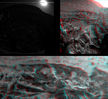
SOL723-2G-Darkness on Mars.jpgWhat is that? (3) - Sol 72378 visiteRingraziamo ancora l'Amico Alessio Feltri per l'aiuto visivo che ci ha dato per la soluzione dello pseudo-enigma dei "puntini luminosi" nell'oscurità: si tratta, come vedete, degli ultimi raggi di Sole che illuminano il RA.
Cogliamo l'occasione per precisare che a questa conclusione era arrivato - prima di tutti - anche il nostro Amico "Roby", che salutiamo caramente.
|
|
| 13 immagini su 2 pagina(e) |
1 |
|








