| Risultati della ricerca nelle immagini - "Daphnis" |

Atlas,_Daphins_and_Pan-PIA21449.jpgAtlas, Daphnis and Pan176 visiteCaption NASA: "This montage of views from NASA's Cassini Spacecraft shows three of Saturn's Small Ring moons: Atlas, Daphnis and Pan at the same scale for ease of comparison.
Two differences between Atlas and Pan are obvious in this montage. Pan's Equatorial Band is much thinner and more sharply defined, and the central mass of Atlas (the part underneath the smooth Equatorial Band) appears to be smaller than that of Pan.
All of these images were taken using the Cassini Spacecraft Narrow-Angle Camera. The images of Atlas were acquired on April 12, 2017, at a distance of about 10.000 miles (approx. 16,0093 Km) and at a Sun-moons-Spacecraft angle (or Phase Angle) of 37°. All three images are oriented so that North is up".MareKromium
|
|

Atlas-PIA09907.jpgBrothers in the Night: Atlas and Daphnis71 visiteCaption NASA:"Looking upward from beneath the Ring-Plane, the Cassini Spacecraft spies Saturn's "Wave Maker" and "Flying Saucer" moons.
Daphnis (8 Km, or about 5 miles across at its widest point) and its gravitationally induced edge waves are seen at left within the Keeler Gap. The equatorial bulge on Atlas (30 Km, or about 19 miles across at its widest point) is clearly visible here.
This view looks toward the sunlit side of the Rings from about 16° below the Ring-Plane. The image was taken in visible light with the Cassini spacecraft narrow-angle camera on April 22, 2008. The view was acquired at a distance of approx. 898.000 Km (such as about 558.000 miles) from Saturn.
Image scale is roughly 5 Km (about 3 miles) per pixel".MareKromium
|
|

Daphnis-N00156646-48-EB-LXTT.jpgGravitational Pulls from Daphnis (an Image-Mosaic in Natural Colors by Elisabetta Bonora - Lunexit Team)74 visitenessun commentoMareKromium
|
|

Daphnis-PIA07809-1.jpgDaphnis and Keeler (context image)72 visiteCaption NASA originale:"Daphnis, the tiny moon that inhabits the Keeler Gap in the outer edge of Saturn's A-Ring, is captured here in remarkable detail with its entourage of waves.
The edge waves are especially bright in places where Ring material piles up, a characteristic that has been seen in computer simulations of the interactions between gap-embedded moons and the surrounding ring particles.
The 7 Km-wide (about 4,3 mile) moon appears to have an unusual shape in this image. It is not simply a bright dot, but instead exhibits a dimmer component immediately to its left. Though it is far from certain, this component may be Ring material caught in the act of accreting onto Daphnis, a process currently being studied by imaging scientists.
The image was taken in visible light with the Cassini spacecraft narrow-angle camera on Sept. 9, 2006, at a distance of approx. 422.000 Km (such as about 262.000 miles) from Saturn. Image scale is roughly 2 Km (a little more than 1 mile) per pixel".
|
|

Daphnis-PIA07809-2.jpgDaphnis and Keeler (detail mgnf)157 visitenessun commento
|
|

Daphnis-PIA08171.jpgDaphnis78 visiteThis splendid view offers a detailed look at the faint Rings within the Cassini Division as well as a rare glimpse of the "Keeler Gap Moon", Daphnis. The small, ring embedded moon is a bright unresolved speck above center, near the outer edge of the A ring.
Discovered in Cassini images in 2005, Daphnis is a mere 7 Km (a little less than 4 miles) across.
The image was taken in visible light with the Cassini spacecraft narrow-angle camera on March 20, 2006, at a distance of approx. 483.000 Km (such as about 300.000 miles) from Saturn. The image scale on the sky at the distance of Daphnis is about 2 Km (a little more than 1 mile) per pixel.
|
|
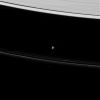
Daphnis-PIA09902.jpgDaphnis and a Little Star...85 visiteCaption NASA:"The Cassini Spacecraft captures a view showing two of Saturn's moons and their gravitational effects on nearby Rings.
At top, Daphnis (about 8 Km, or 5 miles across at its widest point) streaks through the Keeler Gap, with its ever-present edge waves. At center, Prometheus (about 86 Km, or 53 miles across at its widest point) pulls away from a recent encounter with the F-Rring. A bright background star is visible below the F-Ring.
This view looks toward the unilluminated side of the Rings from about 41° above the Ring-Plane. The image was taken in visible light with the Cassini spacecraft narrow-angle camera on April 8, 2008. The view was acquired at a distance of approx. 1,3 MKM (such as about 788.000 miles) from Prometheus and at a Sun-Prometheus-Spacecraft, or phase, angle of 53°.
Image scale is roughly 8 Km (about 5 miles) per pixel".
Nota Lunexit: noi vediamo Daphnis, la "Piccola Stella" in basso rispetto all'Anello "F" e la scia lasciata da Prometheus (sull'estrema Sx del frame) a seguito del suo transito ma, di Prometheus...nessuna traccia! E Voi? Lo vedete Prometheus?MareKromium
|
|

The_Rings-PIA08882.jpgDisturbances...73 visiteCaption NASA:"Daphnis cruises through the Keeler Gap, raising edge waves in the ring material as it passes.
As is characteristic of waves raised by a moon on the edges of a very narrow gap like Keeler, the wave begins as a coherent form near Daphnis and becomes less so with increasing orbital distance from the moon. Daphnis is about 7 Km (4,3 miles) across.
This view looks upon the lit side of the Rings from about 31° below the Ring-Plane.
The image was taken in visible light with the Cassini spacecraft narrow-angle camera on Jan. 17, 2007 at a distance of approx. 768.000 Km (about 477.000 miles) from Daphnis. Image scale is roughly 5 Km (about 3 miles) per pixel".MareKromium
|
|

The_Rings-PIA08941.jpgDaphnis, Atlas and the Rings72 visiteCaption NASA:"Across the expanse of Saturn's Rings, the Cassini spacecraft spies 2 small moons in consort.
Atlas is seen exterior to the bright outer edge of the A-Ring. Daphnis, below Atlas in this view, orbits Saturn within the narrow Keeler Gap. The presence of Daphnis is revealed by the waves it raises in the ring material surrounding it on the edges of the gap. Daphnis and its waves moved between exposures taken to create this color view, resulting in their slight displacement in each color.
This view looks toward the unilluminated side of the Rings from about 18° above the Ring-Plane. Bright clumps are visible in the narrow F-Ring.
Images taken using red, green and blue spectral filters were combined to create this natural color view. The images were acquired with the Cassini spacecraft narrow-angle camera on April 13, 2007 at a distance of approx. 1,8 MKM (about 1,1 MMs) from Atlas.
Image scale is roughly 11 Km (about 7 miles) per pixel".MareKromium
|
|

The_Rings-PIA08985.jpgMoons...70 visiteCaption NASA:"The effects of three of Saturn's Ring Moons can be spotted in this single narrow-angle camera view.
The image has been strongly enhanced to better show the wakes on both sides of the Encke Gap caused by Pan (left of center), as well as a hint of the edge waves in the narrow Keeler Gap caused by Daphnis (just below center).
Bright Prometheus (on the right) pulls away from its latest close encounter with the F-Ring. The aftereffects of its recent passes are visible in the Ring's inner edge.
This view looks toward the unilluminated side of the Rings from about 10° above the Ping-Plane.
Saturn's shadow cuts across the Rings at the top of the scene.
The image was taken in visible light with the Cassini spacecraft narrow-angle camera on June 5, 2007 at a distance of approx. 2,3 MKM (about 1,4 MMs) from Pan.
Image scale is about 13 Km (approx. 8 miles) per pixel".MareKromium
|
|

The_Rings-PIA10529.jpgThe "Good Shepherds"106 visiteCaption NASA:"The moons Pan and Daphnis cruise through the Encke and Keeler gaps, respectively.
The edge waves used to discover Daphnis can be seen here as the brightening on either side of the moon. And although the edge waves Pan raises in the Encke Gap are not visible here, the wakes caused by Pan's disturbance of the Rings are clearly visible.
The image was taken in visible light with the Cassini Spacecraft narrow-angle camera on Oct. 20, 2008 at a distance of approx. 1,2 MKM (such as about 742.000 miles) from Pan and at a Sun-Pan-Spacecraft, or Phase, Angle of 29°.
Image scale is roughly 7 Km (about 4 miles) per pixel".MareKromium
|
|
|
| 11 immagini su 1 pagina(e) |
|








