| |
| Risultati della ricerca nelle immagini - "Dao" |
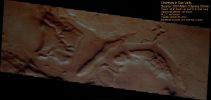
Channels-Dao_Vallis-20071211a-PCF-LXTT.jpgDao Vallis (Enhanced Absolute Natural Colors; additional process.: Dr Paolo C. Fienga - Lunexit Team)114 visitenessun commentoMareKromium
|
|

Channels-Dao_Vallis-PIA15215-PCF-LXTT-IPF.jpgFeatures of Dao Vallis (Absolute Natural Colors; credits for the additional process. and color.: Dr Paolo C. Fienga/Lunar Explorer Italia/Italian Planetary Foundation)88 visiteDao Vallis is a Martian Channel that, as the peculiar texture and color of its bottom and edges show us quite well, was not carved by Molten (and very fluid) Lava, but by real Water instead. Dao Vallis runs South/Westward into the Hellas Planitia Region, and it has been identified (among others, by Dr M.H. Carr) as a so-called Outflow Channel. Dao Vallis has a main Tributary Channel, known as Niger Vallis, and it extends on the Martian Southern Hemisphere's Surface for over 1200 Km. Its name, just out of curiosity, apparently comes from a Thai word meaning "star" (and God only knows why the IAU made such a bizarre and, in our opinion, pointless choice...).
However, talking again about our today's APOD Surface Feature, we can say that we know that the (possible) sources of Dao Vallis are near an extremely old Martian Volcano, called Hadriaca Patera; it is thought by many Scientists that the Water that formed it came out from the Subsurface when a huge quantity of hot Magma, erupted from Hadriaca Patera, melted, in a very short time period (in a case like this, we might be talking about minutes), huge amounts of Ice that was caught in the otherwise already frozen Ground. Anyway, much of this Water may have also been released during the occurrence of a few very large "Outburst Floods".
In addition to the above, and after a carfeul examination of Dao Vallis' now completely desiccated Riverbed, we, as IPF, strongly believe that, whatever the actual origin of the Channel might have been, Dao Vallis must have carried liquid Water for a very long time, before drying up. As a matter of fact, and as it is clearly visible in this NASA - 2001 Mars Odyssey Orbiter frame, on the bottom of the Channel can be identified several layers of dried material (Mud, likely) that, in our opinion, make the physical evidence that the desiccation process of Dao Vallis took some time before it was complete. In other words, the desiccation (or, like some Scientists say, evaporation and/or sublimation) of the Waters that ran through the Channel, was far from being semi-instantaneous or (this, of course, relatively speaking) rather fast. Furthermore, the almost complete lack of Impact Craters on the Riverbed, if seen and evaluated in direct contrast with the strong presence of Impact Craters (of various size and shape - meaning both Primary and Secondary Craters) that exist and is VERY well visible on both the edges of the Channel, proves us that, when Liquid Water ran through Dao Vallis, the strong meteoric activity which scarred most of the Surface of the Red Planet, was already ended. In other words, Dao Vallis hosted liquid and running Waters until a very (always relatively - and geologically - speaking) recent time.
Picture Data: Orbit Number: 44201; Latitude: 39,4843�° South and Longitude: 86,4444�° East; Instrument: VIS; Captured: December, 1st, 2011; Mars Local Time (M.L.T.): 17:39 (Late Aftrnoon)
This frame has been colorized in Absolute Natural Colors (such as the colors that a human eye would actually perceive if someone were onboard the NASA - 2001 Mars Odyssey Orbiter and then looked down towards the Surface of Mars), by using an original technique created - and, in time, dramatically improved - by the Lunar Explorer Italia Team.MareKromium
|
|
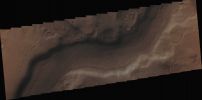
Channels-Dao_Vallis-PIA15215-PCF-LXTT.jpgFeatures of Dao Vallis (Saturated Absolute Natural Colors; credits for the additional process. and color.: Dr Paolo C. Fienga - Lunexit Team)151 visiteOrbit Number: 44201
Latitude: 39,4383° South
Longitude: 86,4444° East
Instrument: VIS
Captured: December, 1st,
Mars Local Solar Time: 17:39 (Late Afternoon)
MareKromium
|
|
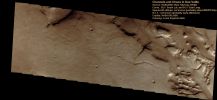
Channels_and_Chaotic_Terrain-DaoVallis-PCF-LXTT.jpgChannels and Chaotic Terrain in Dao Valles (Absolute Natural Colors; additional process.: Dr Paolo C. Fienga - Lunexit Team)74 visitenessun commentoMareKromium
|
|
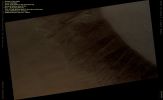
ESP_014267_1460_RED_abrowse.jpgGullies in Dao Vallis (Natural Colors; credits: Lunexit)102 visitenessun commentoMareKromium
|
|
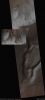
ESP_024315_1435_RED_abrowse-PCF-LXTT-000.jpgGullies on the South Wall of Dao Vallis near the Confluence with Niger Vallis (Absolute Natural Colors; credits for the additional process. and color.: Dr Paolo C. Fienga - Lunexit Team)191 visiteMars Local Time: 14:32 (Early Afternoon)
Coord. (centered): 36,1° South Lat. and 90,3° East Long.
Spacecraft altitude: 258,3 Km (such as about 161,4 miles)
Original image scale range: 51,7 cm/pixel (with 2 x 2 binning) so objects ~ 1 mt and 55 cm across are resolved
Map projected scale: 50 cm/pixel
Map projection: EQUIRECTANGULAR
Emission Angle: 5,6°
Sun-Mars-Spacecraft (or "Phase") Angle: 50,5°
Solar Incidence Angle: 54° (meaning that the Sun is about 36° above the Local Horizon)
Solar Longitude: 10,1° (Northern Spring)
Credits: NASA/JPL/University of Arizona
Additional process. and coloring: Dr Paolo C. Fienga - Lunar Explorer MareKromium
|
|
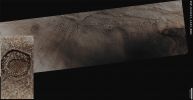
ESP_024315_1435_RED_abrowse-PCF-LXTT-001.jpgUnusually-looking Unnamed Crater near the Confluence of Dao Vallis with Niger Vallis (Absolute Natural Colors; credits for the additional process. and color.: Dr Paolo C. Fienga - Lunexit Team)201 visiteMars Local Time: 14:32 (Early Afternoon)
Coord. (centered): 36,1° South Lat. and 90,3° East Long.
Spacecraft altitude: 258,3 Km (such as about 161,4 miles)
Original image scale range: 51,7 cm/pixel (with 2 x 2 binning) so objects ~ 1 mt and 55 cm across are resolved
Map projected scale: 50 cm/pixel
Map projection: EQUIRECTANGULAR
Emission Angle: 5,6°
Sun-Mars-Spacecraft (or "Phase") Angle: 50,5°
Solar Incidence Angle: 54° (meaning that the Sun is about 36° above the Local Horizon)
Solar Longitude: 10,1° (Northern Spring)
Credits: NASA/JPL/University of Arizona
Additional process. and coloring: Dr Paolo C. Fienga - Lunar Explorer MareKromium
|
|
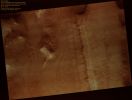
PSP_002545_1430_RED_browse-00~0.jpgJuncture of Two Branches of Dao Vallis (ctx frame - possible True Colors; credits: Lunar Explorer Italia)90 visiteMartian outflow channels are believed to be some of the largest features formed from the catastrophic flooding that scoured the landscape during ancient times. The source of the water likely originated in the subsurface and was somehow disturbed, depressurizing an aquifer, causing a sudden burst of water onto the surface.
This image shows multiple branches of the outflow channel Dao Vallis, which flows towards the West (down), ending near Hellas Basin. Although it is not clear exactly where the water that created these floods ended up, it is possible that Dao Vallis and its neighboring outflow channel, Niger Vallis, deposited water in Hellas Basin and formed a short-lived lake. Within the floor of Dao Vallis is material that appears striped, known as "lineated valley fill".
Valley fill material is thought to be ice-rich material that has flowed or been deposited onto the floor. Several lineations or "flow lines" appear to merge towards the upper left of the scene which supports this idea that the fill materials flowed, similar to slow-moving glacial material on Earth.
Also present in this scene is a mantling deposit which drapes much of the mid-latitudes of Mars. The deposit or "mantle" can be seen on south-facing slopes of positive-relief features, appearing as if its sliding off the walls. The mantle material is thought to be ice-cemented dust that was deposited during times when snowfall occurred on Mars.MareKromium
|
|
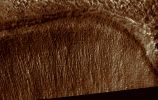
PSP_002545_1430_RED_browse-01~0.jpgJuncture of Two Branches of Dao Vallis (edm - possible True Colors; credits: Lunar Explorer Italia)73 visiteHiRISE images, such as this one (here, approximately 680 mt across), show that the mantled unit is textured and full of boulders, which contrasts with the smooth appearance of this material in MOC images.MareKromium
|
|

PSP_006237_1460_RED_abrowse.jpgLandforms of Dao Valles (MULTISPECTRUM-2; credits: Lunexit)70 visiteThis image in a section of Dao Valles contains a multitude of landforms that may result from the actions of ice. Aligned ridges on the valley floors are evidence of glacier-like flow of this material as it gets diverted around obstacles such as the valley walls and local mesas and knobs.
In some areas where the flow appears to have traveled over an obstacle instead of around, a series of fractures occur, analogous to crevasses that form in glaciers on Earth when ice flows over obstacles. The surface we see is covered with rocky debris and soil that may be protecting ice from sublimation.
Throughout the Region, the surface has been mantled by a smooth deposit that appears to have been eroded in a few locations. This sort of mantle is common at Martian High Latitudes and is thought to be a mixture of dust and ice, either ice-cemented soil or very dirty snow. The eroded areas could be due to ice loss trough sublimation, leaving the remaining surface to collapse or be eroded by the wind.
Many gullies are observed that appear to be carved into the valley walls by liquid water. Incised channels in places cut deeply into the surface and fans of debris with crisscrossing small channels indicate where the flow of water slowed and deposited material eroded from upstream. The source of water is as yet unknown. One theory has been proposed involving melting of surface ice or ice-rich soil in the cold Martian climate. Another theory suggests that an aquifer a few hundred meters (yards) below ground is feeding the gullies.
MareKromium
|
|
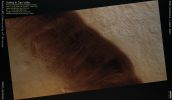
PSP_006659_1460_RED_abrowse~0.jpgGullies in Dao Vallis (MULTISPECTRUM; credits: Lunexit)65 visiteGullies on the North-West side of Dao Vallis, a Martian outflow channel, are the focus of this observation. The outflow channels are thought to have been carved by gigantic, ancient floods.
Gullies are largely thought to be the result of water flow, but the origin of the water is much debated.
One theory proposes that melting snowpack, or a mantling (blanketing) unit, forms gullies. Such a mantling unit is visible here between some of the gullies, in the full high-resolution image. Some alcove-shaped features appear to have mantling material in them.
If the mantling unit is indeed related to gully formation, then gullies are potentially forming here.
MareKromium
|
|
|
| 11 immagini su 1 pagina(e) |
|

|
|








