| Risultati della ricerca nelle immagini - "Curiosity" |

APOLLO 11 AS 11-40-5970.jpgAS 11-40-5970 - Sun-struck!211 visiteLa Luna adesso è arancione?
No, è solo un effetto - carino dobbiamo dire - causato dal fatto che la pellicola, al momento del cambio di rullino, ha preso luce.
|
|

SOL0000-Mars_Descent_Imager_0000MD9999000027I1_DXXX-0000MD9999000621I1_DXXX-00.gifLet's go to Gale! - Sol 0 (a GIF-Movie by Dr Gianluigi Barca - Lunexit Team/Italian Planetary Foundation)88 visiteThis GIF-Movie shows all the "thumbnail" frames acquired by the Mars Descent Imager during the time between the jettison of the Heat-Shield and the moment of Landing ("Touchdown"). The GIF-Video covers approx. the last 2,5 (two and one-half) minutes of descent before the Mars Exploration Rover and Laboratory "Curiosity" landed inside Gale Crater - Mars.MareKromium
|
|

SOL0003-MF-EB-LXTT-IPF.jpgSundial and Surface - Sol 3 (Natural Colors; credits for the additional process. and color.: Elisabetta Boniora and Marco Faccin/Lunar Explorer Italia/Italian Planetary Foundation)127 visitenessun commentoMareKromium
|
|

SOL0034-MH0063001000E1_DXXX-2-GB-LXTT-IPF.jpgThe First "Martian Fly" of Gale Crater? - Sol 34 (RAW Natural Colors; credits for the additional process. and color.: Dr Gianluigi Barca/Lunar Explorer Italia/Italian Planetary Foundation) 146 visiteQuante ne abbiamo viste di queste "mosche" nei frames Spirit ed Opportunity? Innumerevoli. Si tratta di un image-artifact ripetitivo? Forse. Ma va comunque detto che gli image-artifacts ripetitivi "autentici" (ossìa quelli derivanti da un vizio fisico di una delle lenti - o dei filtri/colore - delle fotocamere presenti sui Rover) si ripetono su ogni frame, nello stesso punto, e sono SEMPRE ASSOLUTAMENTE (ed ovviamente) UGUALI! Questo "vizio" lo vediamo anche in altri frames del MER Curiosity e sempre nel medesimo punto? No. Allora potrebbe anche non trattarsi di un image-artifact e SICURAMENTE non di un image-artifact derivante da vizio (lesione) della lente. Di che cosa si tratta? Non ne abbiamo idea.
Complimenti al Dr Barca per il suo solito "Occhio", davvero eccezionale (anche dopo anni di ricerche e di sforzi visivi davvero non indifferenti)!MareKromium
|
|

SOL0034-MH0063001000E1_DXXX-2-GC-LXTT-IPF.jpgNOT a "Martian Fly"! - Sol 34117 visiteRisolto il "Mistero" della "Mosca Marziana": grazie all'attenzione prestata a tutti i dettagli (anche i più nascosti) del frame da parte del nostro Grande Amico e Senior Partner, Gianluca Caricchia (alias "Omomoto") abbiamo scoperto che il particolare controverso è un image-artifact, ossìa non si tratta di un oggetto reale, bensì di una aberrazione dell'immagine. A scopo di promemoria, Vi ricordiamo che questa "aberrazione" che chiamiamo "artifact" può avere diverse origini e caratterizzazioni. Ad esempio, essa può essere causata da un vizio nella trasmissione del frame a Terra (ex.: "dead pixel"), altre volte da un gioco di luci ingannevole o da un contrasto eccessivo luce/ombra o anche da riflessi (ex.: "lens flares" e "strutture effimere") ed altre volte ancora da un vizio "fisico" della fotocamera (ex.: scheggiature e/o graffiature della lente o di un filtro/colore oppure presenza di uno o più corpi estranei - polvere o particolato - all'interno della fotocamera).
In questo caso specifico, la nostra ipotesi è che ci si trovi davanti ad un vizio fisico della fotocamera (probabilmente una microscopica serie di tre corpi estranei, due minori ed una maggiore - la "Mosca", appunto). Che altro dire? Complimenti a TUTTI, poichè è così che si fa vera Ricerca e Divulgazione: guardando, scoprendo e poi verificando, con ognuno di noi che agisce in piena indipendenza e con TUTTI noi che agiamo sempre in piena Onestà Intellettuale. Più di così...MareKromium
|
|

SOL0034-PIA16134.jpgWheels... - Sol 34 (Natural Colors; credits: NASA/JPL-Caltech/Malin Space Science Systems)176 visiteCaption NASA:"This view of the 3 (three) Left Wheels of NASA's Mars Rover Curiosity combines two images that were taken by the Rover's Mars Hand Lens Imager (MAHLI) during the 34th Martian Day, or Sol, of Curiosity's work on Mars (such as September 9, 2012). In the distance is the lower Slope of Mount Sharp. The camera is located in the turret of tools at the end of Curiosity's Robotic Arm. The Sol 34 imaging by MAHLI was part of a week-long set of activities for characterizing the movement of the Arm in the Mars (Environmental) conditions.
The main purpose of Curiosity's MAHLI camera is to acquire close-up, high-resolution views of Rocks and Soil at the Rover's Gale Crater Field Site. The camera is capable of focusing on any target at distances of about 0,8" (inch), such as 2,1 centimeters, to infinity, providing versatility for other uses, such as views of the Rover itself from different angles".
Nota Lunexit: si poteva fare decisamente di meglio...MareKromium
|
|

SOL0050-GB-LXTT-IPF-1.jpgCuriosity and the Distant Horizon of Gale Crater - Sol 50 (An Image-Mosaic in Calibrated Natural Colors; credits for the additional process. and color.: Dr Gianluigi Barca/Lunar Explorer Italia/Italian Planetary Foundation) 99 visitenessun commentoMareKromium
|
|

SOL0060-EB-MF-LXTT-IPF.jpgUnder My Wheels... - Sol 60 (Natural Colors; credits for the additional process. and color.: Elisabetta Bonora and Marco Faccin/Lunar Explorer Italia/Italian Planetary Foundation)110 visitenessun commentoMareKromium
|
|

SOL0061-ML0315000082M0_DXXX-0061ML0315000239M0_DXXX-GB-LXTT-IPF.gifGood Vibrations... - Sol 61 (a GIF-Movie by Dr Gianluigi Barca/Lunar Explorer Italia/Italian Planetary Foundation)83 visitenessun commentoMareKromium
|
|

SOL0063-PIA16194-PCF-LXTT-IPF.jpgAnother "Scoop" at Gale - Sol 63 (Absolute Natural Colors; credits for the additional process. and color.: Dr Paolo C. Fienga/Lunar Explorer Italia/Italian Planetary Foundation)114 visiteCaption NASA:"In this image, the Scoop on NASA's Curiosity Mars Exploration Rover shows the larger Soil Particles that were too big to filter through a sample-processing "Sieve" that is porous only to Particles less than 0,006" (i.e.: about 150 microns) across. After a full-scoop sample had been vibrated over the Sieve, this held-back portion was returned to the Scoop to be accessible for inspection by the Rover's Mast Camera. The image is part of the first "decontamination" exercise by the Collection and Handling for "In-Situ" Martian Rock Analysis (CHIMRA) tool on the end of the Rover's Robotic Arm, which includes the Scoop, the Sieve and other minor components.
The decontamination exercise involved scooping some Soil, shaking it thoroughly inside the Sample-processing Chambers to scrub the internal surfaces, putting it through a Sieve, dividing it into the appropriate portions and then discarding the sample. This process will be repeated 3 (three) times. The rinse-and-discard cycles serve a quality-assurance purpose similar to a common practice in geochemical laboratory analysis on Earth.
This image was taken by Curiosity's right Mast Camera (Mastcam-100) on October, 10, 2012, such as the 64th Sol, or Martian Day, of operations".MareKromium
|
|

SOL0084-MF-LXTT-IPF-1.jpgH E L L O! (High-Def-3D; credits for the additional process. and color.: Marco Faccin/Lunar Explorer Italia/Italian Planetary Foundation)121 visiteOur personal and "tri-dimensional" Tribute, as IPF, to the NASA - Mars Exploration Rover and Mars Laboratory "Curiosity". We hope that you may like it and, of course, if you really want to enjoy this work, do not forget to wear your red and blue glasses!...MareKromium
|
|
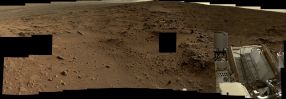
SOL0118-GB-LXTT-IPF-01.jpgCuriosity, the Surface and the Distant Horizon of Gale Crater - Sol 118 (An Image-Mosaic in Calibrated Natural Colors; credits for the additional process. and color.: Dr Gianluigi Barca/Lunar Explorer Italia/Italian Planetary Foundation) 147 visitenessun commentoMareKromium
|
|
| 19 immagini su 2 pagina(e) |
1 |
|








