| Risultati della ricerca nelle immagini - "Computer" |

022-Vesta-4.jpg4-Vesta (computer generated imaging - credits: Ben Zellner - Georgia Southern University -, Peter Thomas - Cornell University - and NASA)89 visiteUn'immagine decisamente bella, precisa, distinta. Ma è un'immagine "vera"? NO! Questa immagine dell'Asteroide 4-Vesta è "computer generated", così come sono "computer generated" TUTTE LE IMMAGINI CHE RITRAGGONO - IN CHIAVE PROSPETTICA - DELLE SEZIONI ISOLATE DELLA SUPERFICIE DI MARTE E CHE SONO STATE OTTENUTE DALLA SONDA ESA "MARS EXPRESS".
La differenza?
La differenza è nella "qualità" dell'immagine "computer generated": le immagini ESA sono - e lo ripeteremo sino alla nausea - alquanto dozzinali (Voi sapete che la pixellatura dei frames ESA ottenuti con questa tecnica è talmente grezza che, alla fine dell'opera, gli image-artifacts che li caratterizzano sono così tanti che, come è già accaduto tantissime volte, le sviste e le traveggole che essi ingenerano e suggeriscono sono davvero allucinanti); le immagini NASA, invece, sono di gran lunga più "smooth" (lisce, nel senso di prive di difettosità palesi ed artifacts) e, globalmente parlando, di fattura enormemente superiore.
Ma in ENTRAMBI I CASI SI TRATTA DI PSEUDO-IMMAGINI! Non lo dimenticate...
Caption NASA:"A 3-D computer model of the asteroid Vesta synthesized from Hubble topographic data. The crater's 8-mile high central peak can clearly be seen near the pole. The surface texture on the model is artificial, and is not representative of the true brightness variations on the asteroid. Elevation features have not been exaggerated". MareKromium
|
|

A-Phoenix-003B.jpgThe Landing Phase: inside the Martian Atmosphere (Entry Phase)79 visitenessun commentoMareKromium
|
|

A-Phoenix-004.jpgThe Landing Phase: Parachute and Landing "Nest"82 visitenessun commentoMareKromium
|
|

ISD_highres_AS13_AS13-60-8589-1.jpgAS 13-60-8589 - S-IV-B in the distance? (1 - extra-detail mgnf)84 visiteIl Dr Barca ha reperito questa versione originale HR/Uncompressed e, a nostro parere giustamente, si è posto la domanda se l'oggetto inquadrato sia effettivamente - come suggerisce la caption dell'Apollo Image Atlas - lo stadio S-IV-B che va a perdersi nello Spazio (e che già trasse in inganno in C.U.N. e tanti altri Appassionati...) oppure se potrebbe trattarsi di qualcosa di "meno convenazionale".
A nostro avviso una risposta è impossibile darla con certezza assoluta; a logica (e visti i frames che precedono questo) si potrebbe/dovrebbe effettivamente trattare dell'S-IV-B che "floats away" ma, se osservate bene il detail mgnf, non potrete non vedere i raggi di luce azzurra che sembrano dipartirsi da esso in ambo i sensi.
Sarà carburante residuo che si perde nello Spazio? O forse è più probabile un "gioco di luce". O magari quello che stiamo guardando - semplicemente - NON E' l'S-IV-B ma qualcosa di diverso?
Noi non abbiamo risposte, purtroppo.
Un caro saluto ed un ringraziamento al Dr Barca per aver procurato il frame originale!MareKromium
|
|

Inside_a_Red_Giant.jpgInside a "Red Giant"216 visiteCaption NASA:"A journey to the center of a Red Giant Star is very firmly in the realm of science fiction.
But the Science of Asteroseismology can explore the conditions there. The technique is to time the small variations in a star's brightness measured by the planet hunting Kepler Spacecraft. Regular variations indicate Stellar Oscillations, analogous to sound waves, that compress and decompress the gas causing brightness changes.
As recently discovered in Red Giant Stars, some of the Oscillations detected have periods that would cause them to penetrate to the Stellar Core. In that extreme environment they actually become more intense and can return to the Surface. These Echoes from the Red Giant's Core are illustrated in this frame from a computer generated animation. Remarkably, the periods measured for the Oscillations can even indicate how and where the Red Giant Star's energy production, by Hydrogen or Helium fusion, is taking place".MareKromium
|
|
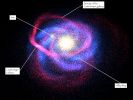
TheCanisMajorDwarfGalaxy_2mass_big.jpgThe Canis Major "Dwarf" Galaxy68 visite"...Nihil enim semper floret; aetas succedit aetati..."
(Cicerone)
"...Non v'é nulla a questo Mondo che sia sempre in fiore, poiché ad ogni stagione ne succede sempre un'altra..." (trad. libera)MareKromium
|
|
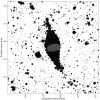
The_Rings-PIA10083.jpgFrom "Clump" to "Moonlet"75 visiteCaption NASA:"This is a computer simulation of the final stage of the growth of a "clump" in Saturn's Rings. The gravity from a hypothesized moonlet (solid gray sphere in frame center) has collected smaller ring particles (black) to form a temporary aggregation. The particles shown in the simulation are from centimeters to meters (su ch as inches to yards) across. The gray moonlet is 61 meters (200 feet) across". MareKromium
|
|

The_Rings-PIA12820.gifTilting Saturn's Rings (a Computer Animation by NASA/JPL/Cornell)179 visiteCaption NASA:"This animated graphic shows in a series of three images how Saturn's Rings, after they became tilted relative to Saturn's Equatorial Plane, would have transformed into a Corrugated Ring.
Images taken after Saturn's August 2009 equinox from NASA's Cassini Spacecraft revealed alternating light and dark bands extending from Saturn's D-Ring, completely across the C-Rg, and right up to the inner B-Rg Ege. These brightness variations are almost certainly caused by the changing slopes in the rippled Rng-Plane, much like the corrugations of a tin roof.
This series of images shows how such a vertical corrugation can be produced from an initially inclined ring by the natural tendency for inclined orbits to wobble systematically and slowly at different rates, depending on their distance from Saturn. The top image shows a simple inclined ring (the central planet is omitted for clarity), while the lower two images show the same ring at two later times, where the ring particles' wobbling orbits have sheared this inclined sheet into an increasingly tightly-wound spiral corrugation.
Cassini images show the corrugation extends for about 19.000 Km (11.799 miles). Based on detailed studies of this structure, scientists conclude that a broad swath of the Rings became suddenly tilted in the early 1980s, likely because Cometary Debris crashed into them.
The corrugation's radial extent implies that the impacting material was a dispersed cloud of debris instead of a single object. The corrugation's amplitude of about 2 to 20 meters (7 to 60 feet) indicates that the debris' total mass was around 1 Trillion Kg (or 1 Billion Metric Tons)".
MareKromium
|
|
| 8 immagini su 1 pagina(e) |
|








