| Risultati della ricerca nelle immagini - "Comets:" |

Comets-Borrelly_Comet-PIA03500_modest.jpgThe "Borrelly" Comet from Deep Space 169 visiteIn this highest resolution view of the icy, rocky nucleus of comet Borrelly, (about 45 meters or 150 feet per pixel) a variety of terrains and surface textures, mountains and fault structures, and darkened material are visible over the nucleus's surface. This was the final image of the nucleus of comet Borrelly, taken just 160 seconds before Deep Space1's closest approach to it. This image shows the 8-km (5-mile) long nucleus about 3417 kilometers (over 2,000 miles) away.
Smooth, rolling plains containing brighter regions are present in the middle of the nucleus and seem to be the source of dust jets seen in the coma. The rugged land found at both ends of the nucleus has many high ridges along the jagged line between day and night on the comet. This rough terrain contains very dark patches that appear to be elevated compared to surrounding areas. In some places the dark material accentuates grooves and apparent faults.
|
|

Comets-Comet_Ikeya_Zhang_2.jpgComet Ikeya-Zhang (from Colorado)74 visiteThis lovely early evening view of the comet in Rocky Mountain skies looks northwest over ridges and low clouds. The time exposure was recorded on March 31st from an 8.000 foot elevation near Yampa, Colorado, USA. Sporting a sweeping yellowish dust tail and blue ion tail eight to ten degrees long, Ikeya-Zhang is nestled near the horizon in the northern constellation of Andromeda. To the comet's left is the bright star Mirach or Beta Andromedae while the stretched celestial fuzzball to the comet's right is M 31 or the Andromeda galaxy, the nearest bright spiral galaxy to our own Milky Way. As the days pass, Comet Ikeya-Zhang's apparent motion through the sky is towards the right in this image. Tonight, comet-watchers blessed with clear skies should find Ikeya-Zhang posing perfectly for binoculars and cameras just above M 31, less than two degrees from the center of the bright galaxy.
|
|

Comets-Comet_Ikeya_Zhang_3.jpgComet Ikeya-Zhang - the "ion tail"101 visiteThis composite color image from March 3rd, 2002, captured with a wide-field telescope, shows this active comet's bright, condensed coma and a delightful array of subtle structures in its developing tail. The bluish tail stretches for 5 degrees or so against a background of stars in the constellation Pisces. Cataloged as comet C/2002 C1, improved orbit determinations now make it seem very likely that Comet Ikeya-Zhang has been around here before. Refined calculations indicate this comet's last trip through the inner Solar System was 344 years ago, in 1661, when it was recorded as a bright comet.
|
|

Comets-Comet_Ikeya_Zhang_4.jpgComet Ikeya-Zhang - the "ion tail"96 visiteAs Comet Ikeya-Zhang approached the Sun, it developed a complex blue "ion tail". The "ion tail" is composed of ions that boiled off the nucleus and were pushed away from the Sun by the out-flowing fast-moving particles of the solar wind. Complexity in the tail is created by comet nucleus rotation, variability in the comet surface evaporation rate and variability of the Sun's magnetic field and solar wind.
|
|
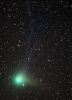
Comets-Comet_Mach_Holz.jpgThe C/2004 Q2 Comet117 visiteScoperta solo pochi mesi fa, la Cometa C/2004 Q2 (Machholz) è già chiaramente visibile (a magn. 5 o superiore) nei Cieli del Sud. Ma nessuna paura, non occorrerà viaggiare per vederla: essa si sta rapidamente portando verso i nostri Cieli e, nel frattempo, continuerà ad aumentare il suo splendore (probabilmente sino alla prima metà di Gennaio 2005). La luminosità massima che C/2004 Q2 potrà raggiungere non ci è ancora nota; ciò che sappiamo, invece, è che essa resterà nei "nostri" Cieli per buona parte del 2005 e la potremo anche vedere in prossimità della Stella Polare nei primi giorni di Marzo. L'immagine che Vi proponiamo (da "NASA - Picture of the Day" del 13.12.2004) è stata ripresa ai primi di Dicembre e, come potete vedere, la cometa già ci mostra una consistente "chioma", un'abbondante coda di polveri e detriti (di colore bianco e verde) ed un'abbastanza intricata "coda ionica" (andante verso la Dx dell'Osservatore), che presenta delle increspature verso la fine.
|
|

Comets-Comet_Machholz-Pleiades.jpgComet Machholz and M 4588 visiteRipresa amatoriale (ma di grande effetto scenico) effettuata il giorno 9 Gennaio 2005 dalla Germania - Baviera (località Oberjoch) dal Sig. Stefan Seip. Perfetta la visione della chioma - color verde/acqua - della Cometa (le dimensioni stimate della chioma stessa si aggirano intorno ai 500.000 Km mentre il suo nucleo roccioso dovrebbe avere un diametro compreso fra i 5/7 Km) e molto suggestiva la combinazione (ma si tratta, come ovvio, di un semplice effetto prospettico) fra l'alone blu proprio di M 45 e la coda ionica (anch'essa vagamente bluastra) della Cometa Machholz. Da notarsi che le dimensioni ridotte (ma solo in apparenza) della coda di Machholz (la quale si estende per svariati milioni di Km - 8/10) dipendono anch'esse da un semplice effetto prospettico il quale sfavorisce la nostra osservazione.
|
|

Comets-Comet_Machholz.jpgComet Machholz87 visiteDa "NASA - Picture of the Day" del 5 Gennaio 2005:"Good views of Comet Machholz are in store for northern hemisphere comet watchers in January. Now making its closest approach to planet Earth, the comet will pass near the lovely Pleiades star cluster on January 7th and the double star cluster in Perseus on January 27th as Machholz moves relatively quickly through the evening sky. Currently just visible to the unaided eye from dark locations, the comet should be an easy target in binoculars or a small telescope. In fact, this telephoto time exposure from January 1, shows Comet Machholz sporting two lovely tails in skies over Colorado, USA. Extending to the left, strands of the comet's ion or gas tail are readily affected by the solar breeze and point away from the Sun. Dust, which tends to trail along the comet's orbit, forms the tail jutting down and to the right".
|
|

Comets-Halley-30155.jpgThe Halley Comet, from Giotto76 visiteCaption ESA originale:"A composite image of the nucleus of comet Halley. This image is composed of 68 images of varying resolution. The data at the brightest point on the nucleus is at the highest resolution (50 m).
The Sun comes from 30° above the horizontal to the left and is 17° behind the image plane (observation phase angle of 107°). The night side of the nucleus can be seen silhouetted against a background of bright dust in the far-field. Jets can be seen originating from 2 regions on the nucleus. Structure can be seen within the jets. A bright area is seen within the night side of the nucleus. We believe this to be a hill or mountain approximately 500 mt high. Other surface details can be seen in the illuminated region".
|
|

Comets-Machholz___Meteor.jpgComet Machholz and a "corkscrew" meteor78 visiteCaption NASA originale:"Meteor trains (train--->trajectory) that twist noticeably are rare but have been noted before. The underlying reason for unusual meteors trains is that many meteors are markedly non-spherical in shape and non-uniform in composition. Meteors, usually sand sized grains that originate in comets, will disintegrate as they enter the Earth's atmosphere. Non-uniform meteors may evaporate more on one side than another. This may cause a rotating meteor to wobble slightly in its path, and also to spray fast moving debris in a nearly spiral path. The fast moving meteor debris ionizes molecules in the Earth's atmosphere that subsequently glow when they reacquire elections. Surely no meteor is perfectly uniform and spherical, so that a slight swagger that is below perceptibility is likely typical. Meteors may well have seeded Earth with the prebiotic molecules that allowed for the development of life".
|
|
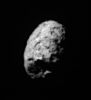
Comets-Wild_2-00.jpgApproaching Wild 2 (1)69 visiteCaption NASA originale:"This image was taken during the close approach phase of Stardust's Jan 2, 2004 flyby of comet Wild 2. It is a distant side view of the roughly spherical comet nucleus. One hemisphere is in sunlight and the other is in shadow analogous to a view of the quarter moon. Several large depressed regions can be seen. Comet Wild 2 is about 5 Km (3,1 miles) in diameter".
|
|

Comets-Wild_2-01.jpgApproaching Wild 2 (2)76 visiteCaption NASA originale:"On January 2, 2004 NASA's Stardust spacecraft made a close flyby of comet Wild 2.
Among the equipment the spacecraft carried on board was a navigation camera.
This is the 34th of the 72 images taken by Stardust's navigation camera during close encounter. The exposure time was just 10 milliseconds".
|
|

Comets-Wild_2-02.jpgWild 2 - stereo image pair80 visitenessun commento
|
|
| 15 immagini su 2 pagina(e) |
1 |
|








