| Risultati della ricerca nelle immagini - "Columbia" |

ESP_021569_1650-PCF-LXTT.jpgOver the Columbia Hills (Absolute Natural Colors; credits: Dr Paolo C. Fienga - Lunexit Team)317 visiteAcquisition date: 04 March 2011
Mars Local Time (M.L.T.): 15:11 (Early Afternoon)
Latitude (centered): 14,6° South
Longitude (East): 175,6°
Spacecraft Altitude: approx. 264 Km (163,944 miles)
Original Image Scale Range: 26,4 cm/pixel (with 1 x 1 binning) so objects ~79 cm across are resolved
Map Projected Scale: 25 cm/pixel and North is up
Map Projection: EQUIRECTANGULAR
Emission Angle: 2,9°
Sun-Surface-Spacecraft Angle (i.e.: Phase Angle): 48,7°
Solar Incidence Angle (S.I.A.): 46°, with the Sun about 44° above the Local Horizon
Solar Longitude: 247,7° - Northern AutumnMareKromium
|
|

ESP_021569_1650_RED_abrowse-PCF-LXTT-1.jpgOver the Columbia Hills (Natural Colors; credits: Dr Paolo C. Fienga - Lunexit Team)253 visiteAcquisition date: 04 March 2011
Mars Local Time (M.L.T.): 15:11 (Early Afternoon)
Latitude (centered): 14,6° South
Longitude (East): 175,6°
Spacecraft Altitude: approx. 264 Km (163,944 miles)
Original Image Scale Range: 26,4 cm/pixel (with 1 x 1 binning) so objects ~79 cm across are resolved
Map Projected Scale: 25 cm/pixel and North is up
Map Projection: EQUIRECTANGULAR
Emission Angle: 2,9°
Sun-Surface-Spacecraft Angle (i.e.: Phase Angle): 48,7°
Solar Incidence Angle (S.I.A.): 46°, with the Sun about 44° above the Local Horizon
Solar Longitude: 247,7° - Northern AutumnMareKromium
|
|

ESP_021569_1650_RED_abrowse-PCF-LXTT-2.jpgOver the Columbia Hills (Enhanced Natural Colors; credits: Dr Paolo C. Fienga - Lunexit Team)210 visiteAcquisition date: 04 March 2011
Mars Local Time (M.L.T.): 15:11 (Early Afternoon)
Latitude (centered): 14,6° South
Longitude (East): 175,6°
Spacecraft Altitude: approx. 264 Km (163,944 miles)
Original Image Scale Range: 26,4 cm/pixel (with 1 x 1 binning) so objects ~79 cm across are resolved
Map Projected Scale: 25 cm/pixel and North is up
Map Projection: EQUIRECTANGULAR
Emission Angle: 2,9°
Sun-Surface-Spacecraft Angle (i.e.: Phase Angle): 48,7°
Solar Incidence Angle (S.I.A.): 46°, with the Sun about 44° above the Local Horizon
Solar Longitude: 247,7° - Northern AutumnMareKromium
|
|

Image015.jpgThe "Hills of Disgrace" : the "Area from below"356 visiteLa situazione diviene addirittura "comica" in questa immagine delle pendici delle Columbia Hills ripresa diversi Soles prima dell'inizio della salita (siamo nel Sol 147).
Tutti i dettagli che avevamo osservato così bene nella planimetria ora ci appaiono spianati in modo assolutamente innaturale ed il possible outcrop di West Spur - che in seguito sarebbe stato battezzato "Longhorn" - ne esce quantomeno ridimensionato.
Guardate anche l'immagine successiva...
|
|
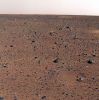
SOL002-PIA04995Det.jpgThe "True Colors" of Mars: a new interpretation - Sol 274 visitenessun commento
|
|
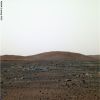
SOL004-2P127071642-2416colorbestcopy_sm.jpgThe "True Colors" of Mars: a new interpretation - Sol 4101 visitenessun commento
|
|
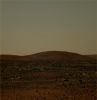
SOL004-PCF-LXTT2.jpgLooking Around... - Sol 4 (Absolute Natural Colors; credits for the additional process. and color.: Dr Paolo C. Fienga - Lunexit Team)152 visitenessun commentoMareKromium
|
|

SOL011-PAN-GB-2.jpgGusev's Horizon - Sol 11 (Enhanced Natural Colors; credits for the additional process. and color.: Dr G. Barca - Lunexit Team)69 visitenessun commentoMareKromium
|
|
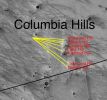
SOL020-ColumbiaHills-MGS.jpgThe "Columbia Hills", from MGS - Sol 20116 visiteCaption NASA originale:"An image taken by the Mars Global Surveyor's Mars Orbiter Camera of the Columbia Memorial Station and the nearby hills named after the Columbia crew. The 28th and final flight of Columbia (STS-107) was a 16-day mission dedicated to research in Physical, Life and Space Sciences. The Columbia crew worked 24 hours a day in two alternating shifts, successfully conducting approximately 80 separate experiments. On February 1, 2003, the Columbia and its crew were lost over the southern United States during the spacecraft's re-entry into Earth's atmosphere".
|
|

SOL040-PCF-LXTT.jpgHorizon - Sol 40 (Absolute Natural Colors; credits for the additional process. and color.: Dr Paolo C. Fienga - Lunexit Team)193 visitenessun commentoMareKromium
|
|

SOL0707-2P189125486EFFAL00P2428L7M1.jpgUps and Downs before the Hill - Sol 707 (Absolute Natural Colors; credits for the additional process. and color.: Elisabetta Bonora and Paolo C. Fienga - Lunexit Team)127 visitenessun commentoMareKromium
|
|
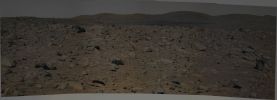
SOL074-GB-LXT-Panoramic.jpgFoggy Panorama - Sol 74 (Natural Colors; credits: Dr G. Barca & Lunar Explorer Italia)73 visitenessun commentoMareKromium
|
|
| 56 immagini su 5 pagina(e) |
1 |
 |
|
|








