| Risultati della ricerca nelle immagini - "Cluster" |

Craters-Crater_Cluster-Meridiani_Planum-PIA07151_modest-01.jpgCrater Cluster in Meridiani Planum (Absolute Natural Colors; credits for the additional process. and color.: Dr Paolo C. Fienga - Lunexit Team)136 visitenessun commentoMareKromium
|
|

Craters-Crater_Cluster-PIA08088-1.jpgSeeps, Dust and Landslides in a Crater Cluster (Original NASA/2001 Mars Odyssey Orbiter b/w Frame)65 visiteImage information: VIS instrument;
Latitude: 18,8° North;
Longitude: 18,5° East;
Resolution: 18 meter/pixel.
|
|

Craters-Crater_Cluster-PIA08088-2.jpgSeeps, Dust and Landslides in a Crater Cluster (Absolute Natural Colors; credits for the additional process. and color.: Dr Paolo C. Fienga - Lunexit Team)188 visiteImage information: VIS instrument;
Latitude: 18,8° North;
Longitude: 18,5° East;
Resolution: 18 meter/pixel.MareKromium
|
|

Craters-Highly_Cratered_Terrain-Arabia_Terra-PIA08759-PCF-LXTT.jpgHighly Cratered Area in Arabia Terra Region (Absolute Natural Colors; credits for the additional process. and color.: Dr Paolo C. Fienga - Lunexit Team)319 visitenessun commentoMareKromium
|
|

ESP_011732_1595_RED_abrowse-00.jpgLarge Cluster of Small Craters near Maadim Vallis (ctx frame - Natural Colors; credits: Lunar Explorer Italia)79 visitenessun commentoMareKromium
|
|

ESP_011732_1595_RED_abrowse-01.jpgLarge Cluster of Small Craters near Maadim Vallis (edm - Natural Colors; credits: Dr M. Faccin & Lunar Explorer Italia)80 visitenessun commentoMareKromium
|
|

ESP_019482_2135_RED_abrowse-03.jpgEverything fades... (Absolute Natural Colors; credits for the additional process. and color.: Dr Paolo C. Fienga - Lunexit Team)113 visiteThis young impact site was discovered by the MRO CTX Science Team. A new "Dark Spot" appeared in a CTX image from July 2008 that was not seen when the region was previously imaged by the Mars Odyssey THEMIS VIS instrument in November 2004. High resolution imaging by HiRISE in November 2008 (left panel of the inset) confirmed that the Dark Spot was Ejecta from a Cluster of Craters.
Three large craters ranging from about 3 to 5 meters diameter and at least 5 smaller craters make up the Cluster. A smaller outlier (approximately 2 meters in diameter, not pictured in the inset) landed 300 meters away to the North/West. These craters were likely produced by a single Impactor that broke into pieces as it fell through the Martian Atmosphere.
The Impactor probably approached from the North/West, judging from the shape of the Ejecta Pattern and the location of the small outlier.
The impacts sprayed the site with Dark Ejecta excavated from beneath the bright Surface. The conspicuous, newly formed feature, will now provide an ideal location to monitor the effects of Winds on the (relatively) modern Martian Surface.
HiRISE imaged the site again in September 2010, after the passage of a full Martian year, when the illumination was similar to the previous HiRISE image. By luck, the SIA (Solar Incidence Angle, such as the Zenith Angle of the Sun) of the later image was only 0,2° different from that of the earlier image.
However, the Phase Angle (such as the angle between the Sun, the Target, and the Spacecraft Camera) was smaller by about 14° as the Spacecraft rolled in the opposite direction.
The new picture shows the Ejecta Pattern apparently faded in comparison to the previous image. The contrast of other features in the scene (such as the Hills and Boulders) is similar, but the Ejecta from the Crater Cluster are noticeably brighter in the HiRISE image from 2010. One possibility is that the Dark Ejecta reflects Sunlight differently than the bright surrounding Terrain - becoming darker more rapidly as Phase Angle increases.
Another possibility is that the Ejecta Pattern was mantled by a thin Layer of bright Dust that settled out of the Atmosphere during the 20 month interval between the two images.
Further monitoring of this site by HiRISE will help choose between these hypotheses.
This target illustrates how the various instruments on MRO work together. The spatial coverage of HiRISE is too limited to search for new impact craters across the Martian globe. Yet the spatial resolution of HiRISE can be used to verify and study details in sites identified as suspicious by CTX.
The complimentary capabilities of the MRO instruments provide a fuller understanding of Mars together than their insights taken separately.MareKromium
|
|

ESP_020842_2030_RED_abrowse-00-PCF-LXTT.jpgFresh Primary Crater on a Secondary Craters' Cluster (Absolute Natural Colors; credits for the additional process. and color.: Dr Paolo C. Fienga - Lunexit Team:)102 visitenessun commentoMareKromium
|
|

NGC-6397-0.jpgNGC 6397 - Globular Star Cluster92 visite"...Omnia Mors aequat..."
(Claudiano)
"...La Morte riconduce ogni cosa in equlibrio..."
|
|

Original nasa - apollo 16 - as16-m-0008.jpgAS 16-m-0008 - Metric Frames63 visitenessun commento
|
|

PSP_002917_2175_RED_browse.jpgCrater Cluster in the Northern (Mid-Latitude) Plains71 visiteA Northern Mid-Latitude scene consisting of craters, intercrater plains and mantled material is seen in PSP_002917_2175. The mantled material seen here covers much of the Middle Latitudes in both Hemispheres of Mars; it has been visibly removed in some locations. It's called "mantled" because it looks as if it's just draped over, or mantling, the topography underneath. The mantled material is what causes the craters to have a muted, softened appearance. It's thought to be ice-rich material deposited in a climate different from that of today.
The mantled unit is dissected here, meaning that is not pristine and has likely undergone modification since it was originally laid down. The intercrater plains have a pitted texture that is thought to be caused by water ice sublimating and leaving depressions behind.
Unlike that of Earth, the obliquity (tilt of the planet's rotation axis) of Mars changes wildly.
Earth has the Moon to keep its axis stable, but Mars' satellites, Phobos and Deimos, are not massive enough to do the same.
Today Mars' obliquity (25.19°) is similar to that of Earth's (23.45°), but this has not always been the case. As the obliquity changes, the portions of Mars that receive the most sunlight shift. During periods of high obliquity, polar regions receive the most sunlight. This causes polar ices, including water ice and carbon dioxide ice, to sublimate (evaporate) into the atmosphere. They would then potentially be re-deposited in the mid-latitudes, similar to where this image is located. It is believed that this process is responsible for the mid-latitude mantled unit.
MareKromium
|
|
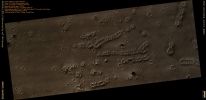
PSP_003494_2075_RED_abrowse.jpgCrater Cluster with Cones and Ridges in Utopia Planitia (Natural Colors; credits for the additional process. and color.: Dr Paolo C. Fienga - Lunexit Team)150 visiteThis image shows Cratered Cones in Utopia Planitia. Cones with Summit Craters join together in places to form Ridges up to several kilometers long, with Troughs running along the Summit.
In many of these cases it is evident that the Ridge Systems formed by merging of multiple Cones, since the arcs of individual Cones can be distinguished.
These features are probably formed by eruption of Subsurface material-Mud or Lava. Lava can form Cinder or Spatter Cones, and eruptions from localized sources along a single Fissure could produce the Ridges.
The absence of obvious (---> evidenti) Lava Flows near the Cones may argue against this mechanism, but ascending Lava could have interacted with Subsurface Water or Ice, leading to a more explosive eruption.
An alternative is eruptions of pressurized Mud from depth ("Mud Volcanism"), a process which occurs in certain environments on Earth.
This observation has a few minor gaps where transmission errors caused data to be lost. These appear as narrow black bars.MareKromium
|
|
| 17 immagini su 2 pagina(e) |
1 |
|








