| |
| Risultati della ricerca nelle immagini - "Clementine" |

000-Clementine.gif000 - Clementine82 visiteDescription
Clementine was a joint project between the Ballistic Missile Defense Organization (BMDO, nee the Strategic Defense Initiative Organization, or SDIO) and NASA. The objective of the mission was to test sensors and spacecraft components under extended exposure to the space environment and to make scientific observations of the Moon and the near-Earth asteroid 1620 Geographos. The Geographos observations were not made due to a malfunction in the spacecraft. The lunar observations made included imaging at various wavelengths in the visible as well as in ultraviolet and infrared, laser ranging altimetry, gravimetry, and charged particle measurements. These observations were for the purposes of obtaining multi-spectral imaging the entire lunar surface, assessing the surface mineralogy of the Moon and obtaining altimetry from 60N to 60S latitude and gravity data for the near side. There were also plans to image and determine the size, shape, rotational characteristics, surface properties, and cratering statistics of Geographos. Clementine carried 7 distinct experiments on-board: a UV/Visible Camera, a Near Infrared Camera, a Long Wavelength Infrared Camera, a High Resolution Camera, two Star Tracker Cameras, a Laser Altimeter, and a Charged Particle Telescope. The S-band transmitter was used for communications, tracking, and the gravimetry experiment.
Spacecraft and Subsystems
The spacecraft was an octagonal prism 1.88 meters high and 1.14 m across with two solar panels protruding on opposite sides parallel to the axis of the prism. A high-gain fixed dish antenna was at one end of the prism, and the 489 N thruster at the other end. The sensor openings were all located together on one of the eight panels, 90 degrees from the solar panels, and protected in flight by a single sensor cover. The spacecraft propulsion system consisted of a nonpropellant hydrazine system for attitude control and a bipropellant nitrogen tetraoxide and monomethyl hydrazine system for the maneuvers in space. The bipropellant system had a total capability of about 1900 m/s with about 550 m/s required for lunar insertion and 540 m/s for lunar departure. Attitude control was achieved with 12 small attitude control jets, two star tracker cameras, and two inertial measurement units. The spacecraft was three-axis stabilized in lunar orbit via reaction wheels with a precision of 0.05 Deg. in control and 0.03 Deg. in knowledge. Power was provided by gimbaled, single axis, GaAs/Ge solar panels which charged a 15 amp-hour, 47-w hr/Kg Nihau (Ni-H) common pressure vessel battery. Spacecraft data processing was performed using a MIL-STD-1750A computer (1.7 million instructions per second) for savemode, attitude control, and housekeeping operations, a RISC 32-bit processor (18 million ips) for image processing and autonomous operations, and an image compression system provided by the French Space Agency CNES. A data handling unit sequenced the cameras, operated the image compression system, and directed the data flow. Data was stored in a 2 Gbit dynamic solid state data recorder.
Mission Profile
The mission had two phases. After two Earth flybys, lunar insertion was achieved approximately one month after launch. Lunar mapping took place over approximately two months, in two parts. The first part consisted of a five hour elliptical polar orbit with a periapsis of about 400 Km at 30 degrees south latitude and an apoapsis of 8300 Km. Each orbit consisted of an 80 minute lunar mapping phase near periapsis and 139 minutes of downlink at apoapsis. After one month of mapping the orbit was rotated to a periapsis at 30 degrees north latitude, where it remained for one more month. This allowed global imaging and altimetry coverage from 60 degrees south to 60 degrees north, over a total of 300 orbits. After a lunar/Earth transfer and two more Earth flybys, the spacecraft was to head for Geographos, arriving three months later for a flyby, with a nominal approach closer than 100 Km. Unfortunately, on May 7, 1994, after the first Earth transfer orbit, a malfunction aboard the craft caused one of the attitude control thrusters to fire for 11 minutes, using up its fuel supply and causing Clementine to spin at 80 rpm. Under these conditions, the asteroid flyby could not yield useful results, so the spacecraft was put into a geocentric orbit passing through the Van Allen radiation belts to test the various components on board. The mission ended in June 1994 when the power level onboard dropped to a point where the telemetry from the spacecraft was no longer intelligible.
|
|

007-The Moon from Clem-Gagarin.JPG030 - Jules Verne Crater85 visiteThis oblique image was acquired by Clementine during orbit 255. The images used to form this color composite were taken with the UV/VIS camera at wavelengths of 415, 750, and 1000 nnmts. In the lower right are seen mare materials (flood lavas) in the floor of the impact crater Jules Verne. To the left, near the Limb of Gagarin, is another mare unit in the floor of Tsiolkovsky.
|
|
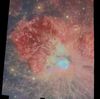
021-The Moon from Clem-Aristachus-PIA00090.jpg042 - Aristarchus Crater (false colors)70 visiteThe Aristarchus region is one of the most diverse and interesting areas on the Moon. About 500 Clementine images acquired through three spectral filters (415, 750, and 1000 nm) were processed and combined into a multispectral mosaic of this region. Shown here is a color-ratio composite, in which the 750/415 ratio controls the red-channel brightness, it inverse (415/750) controls the blue, and the 750/1000 ratio controls the green. Color ratios serve to cancel out the dominant brightness variations and topographic shading, thus isolating the color differences related to composition or mineralogy. The Aristarchus plateau is a rectangular, elevated crustal block about 200 km across, surrounded by the vast mare lava plains of Oceanus Procellarum. Clementine altimetry shows that the plateau is a tilted slab sloping down to the northwest, that rises more than 2 km above Oceanus Procellarum on its southeastern margin. The plateau was probably uplifted, tilted, and fractured by the Imbrium basin impact, which also deposited hummocky ejecta on the plateau surface. The plateau has experienced intense volcanic activity, both effusive and explosive. It includes the densest concentration of lunar sinuous rilles, including the largest known, Vallis Schroteri, which is about 160 km long, up to 11 km wide, and 1 km deep. The rilles in this area begin at 'cobra-head' craters, which are the apparent vents for low-viscosity lavas that formed vents for 'dark mantling' deposit covering the plateau and nearby areas to the north and east. This dark mantling deposit probably consists primarily of iron-rich glass spheres (pyroclastics or cinders), and has a deep red color on this image. Rather than forming cinder cones as on Earth, the lower gravity and vacuum of the Moon allows the pyroclastics to travel much greater heights and distances, thus depositing an extensive regional blanket. The Aristarchus impact occurred relatively recently in geologic time, after the Copernicus impact but before the Tycho impact. The 42 km diameter crater and its ejecta are especially interesting because of its location on the uplifted southeastern corner of the Aristarchus plateau. As a result, the crater ejecta reveal two different stratigraphic sequences: that of the plateau to the northwest, and that of the portion of Oceanus Procellarum to the southwest. This asymmetry is apparent in the colors of the ejecta as seen in this image, which is reddish to the southeast, dominated by excavated mare lava, and bluish to the northwest, caused by the excavation of highland materials in the plateau. The extent of the continuous ejecta blanket also appears asymmetric: it extends about twice as far to the north and east than in other directions, approximately following the plateau margins. These ejecta lobes could be caused by an oblique impact from the southeast, or it may reflect the presence of the plateau during ejecta emplacement. Two dark blue spots in the center of Aristarchus represent tan especially interesting discovery. The infrared spectral properties measured by Clementine are consistent with a composition of almost pure anorthosite, the primitive rock type produced by the lunar magma ocean. This is the first discovery of a major exposure of anorthosite in this region of the Moon, well within the boundary of the hypothetical Procellarum basin. Don Wilhelms (Geologic History of the Moon, USGS Professional Paper, 1984) proposed that the giant Procellarum basin entirely removed the upper anorthositic crust from the north-central nearside of the Moon.
|
|

022-The Moon from Clem-FroelichCrater.gif081 - Froelich Crater81 visitenessun commento
|
|

030-The Moon from Clem-Copernicus.jpg054 - Copernicus77 visiteCopernicus is a rayed crater, 97 Km in diameter, that formed about 800 MY ago. In this image of the Crater Copernicus, color differences are shown for the eastern half of the crater.
A false-color mosaic is created by making ratio images and assigning each to one of the 3 primary colors: the red channel is controlled by the 750/415-nnmts ratio; the green channel is controlled by the 750/950-nnmts ratio and the blue channel is controlled by the 415/750-nnmts ratio.
|
|
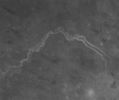
033-The Moon from Clem-Aristarchus-3.jpg041 - Aristarchus and Vallis Schroteri75 visiteThe plateau of the Aristarchus Crater has experienced intense volcanic activity, both effusive and explosive.
It includes the densest concentration of Lunar "sinuous rilles" ("snake-like" valleys) including the largest known, Vallis Schroteri, which is about 160 km long, up to 11 km wide and 1 km deep.
The rilles in this area begin at cobra-head craters, which are the apparent vents for a dark mantling deposit covering the plateau and nearby areas to the North and East.
|
|

040-The Moon from Clem-KeplerCrater-1.jpg151 - Kepler Crater74 visitenessun commento
|
|

043-The Moon from Clem-North Pole-2.jpg035 - Plaskett Crater (natural colors)76 visitePlaskett Crater ID:
Location: 82° North Lat. and 174° East Long.;
Dimension: about 110 Km in diameter
Interesting Features: the huge "central peak"
|
|

051-The Moon from Clem-Aristarchus.jpg043 - Aristarchus Plateau (natural colors)82 visiteA mosaic of more than 250 images showing the complex and diverse Aristarchus Region of the Moon in approximately natural colors (blue = 415 nanometers, green = 750 nanometers, red = 950 nanometers). The plateau is an uplifted block of complex, highland terrain, partly flooded by later mare basalt lavas. Dark, pyroclastic glasses partly cover the uplifted terrain. The crater Aristarchus (47 Km in diameter) has formed in the South-East corner of the plateau, excavating both highlands and mare rocks.
|
|
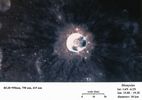
052-The Moon from Clem-Dionysus.jpg061 - Dionysius Crater (natural colors)73 visiteThe Crater Dionysius (3° North Lat. and, 17° East Long.; western edge of Mare Tranquillitatis; 18 Km in diameter) shows striking contrasts in albedo. The outside of the Crater is a very bright halo in its near-rim field, while farther out, darker material is exposed, including rare dark rays. Crater deposits on the left side of this mosaic are on light Cayley plains of highland composition, while deposits on the right side are on the basalts of Mare Tranquillitatis.
|
|

090-The Moon from Clem-KeplerCrater.jpg152 - Kepler Crater78 visitenessun commento
|
|

Antoniadi-UVVis.jpg160 - Antoniadi Crater77 visitenessun commento
|
|
| 60 immagini su 5 pagina(e) |
1 |
 |
|
|
|
|





