| |
| Risultati della ricerca nelle immagini - "Charon" |

B-Caron.jpgThe Discovey of Charon85 visiteCharon was discovered in June 1978 by U.S. Naval Observatory astronomers James Christy and Robert Harrington. They weren't even looking for satellites of Pluto - they were trying to refine Pluto's orbit around the Sun!
Charon was discovered when sharp-eyed Christy noticed the images of Pluto were strangely elongated - it looked like Pluto had an irregular blob attached to its side. Perhaps the telescope was joggled when the picture was taken? No, that possibility was quickly eliminated by noticing that the other stars on the photo were round. Moreover, the blob itself seemed to move around Pluto - the direction of elongation cycled back and forth over 6.39 days - Pluto's rotation period. From this, Christy, after being checked by Harrington, concluded that Pluto either possessed a mountain thousands of kilometers high or a satellite that orbited in its synchronous orbit.
Searching through their archives of Pluto images taken years before, Christy found more cases where Pluto appeared strangely elongated. Working independently, Christy measured the angle (from north) where the elongations appeared while Harrington calculated what the answer "should be" if the elongation was caused by an orbiting satellite. When the anxious moment came for them to compare their answers, they found perfect agreement. Just to be sure, they waited for the U. S. Naval Observatory 60-inch telescope to make one more confirmation. And sure enough, on July 2 new images showed the elongation due to a satellite right where it was supposed to be. They announced their discovery to the world on July 7, 1978. Christy proposed the name "Charon", after the mythological ferryman who carried souls across the river Acheron, one of the five mythical rivers that surrounded Pluto's underworld. Apart from the mythological connection for this name, Christy chose it because the first four letters also matched the name of his wife, Charlene.
Charon's satellite status was finally confirmed when Pluto and Charon began a series of mutual eclipses in 1985. Later, Hubble Space Telescope and even advanced ground-based telescopes were able to spot Charon orbiting nearby — just 1/4000th of a degree from Pluto!MareKromium
|
|

C-Pluto_Charon.jpgPluto and Charon, from the Subaru Telescope64 visiteThe excellent quality of its 8,3-meter primary mirror and the stability of the atmosphere above Mauna Kea, Hawaii, allowed the Subaru Telescope to provide clearly separated images of Pluto and Charon using its Cooled Infrared Spectrograph/Camera.
This image is produced from three 2-second exposures taken through infrared filters on June 9, 1999.
MareKromium
|
|
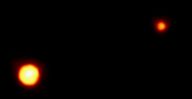
PLUTO&CHARON.jpgPluto & Charon (1) from the Hubble Space Telescope145 visitePluto Statistics: discovered by Clyde W. Tombaugh on February, 18, 1930.
Mass (Kg): 1.27e+22
Mass (if Earth = 1): 2,125e-03
Equatorial radius (Km): 1,137
Equatorial radius (if Earth = 1): 0,1783
Mean density (gm/cm^3): 2,05
Mean distance from the Sun (Km): 5.913.520.000
Mean distance from the Sun (if Earth = 1): 39,5294
Rotational period (in days): 6,3872
Orbital period (in years): 248,54
Mean orbital velocity (Km/sec): 4,74
Orbital eccentricity: 0,2482
Tilt of axis (in degrees): 122,52°
Orbital inclination (in degrees): 17,148°
Equatorial surface gravity (in mt/sec^2): 0,4
Equatorial escape velocity (in Km/sec):1,2
Visual geometric albedo: 0,3
Magnitude (Vo): 15,12
Atmospheric composition: Methane and Nitrogen
Una delle poche immagini in nostro possesso che rappresentano il Sistema (Binario) Plutone-Caronte.
Posto ad una distanza pari a circa 40 volte la distanza Terra/Sole, Plutone (un mondo gelido - si pensa che la temperatura media al suolo sia intorno ai - 233° C - ed eternamente immerso nella notte) si trova ai confini del Sistema Solare, a ridosso della cd "Fascia di Kuiper".
Per lo studio di questo affascinante Sistema e per "spiare" ciò che si trova oltre i suoi confini, è stata progettata la Sonda "New Horizons" la quale dovrebbe partire nel 2006 e raggiungerlo nel Luglio 2015, se tutto andrà bene.
|
|

PLUTO&CHARON2.jpgPluto & Charon (2) from the European Southern Obs.139 visiteLa Sonda, a quel punto, "sfiorerà" Plutone (passandogli a circa 9600 Km di distanza) e Caronte (transito previsto a circa 27.000 Km), prima di dirigersi (e perdersi...) nella Fascia di Kuiper, alla ricerca sia di oggetti oscuri - che, con non grandissima fantasia, sono stati chiamati "KBO", ovvero Kuiper's Belt Objects (o anche "TNO", e cioè Trans Neptunian Objects) -, sia di risposte a tutti quei quesiti che ogni Scienziato, ogni volta che guarda il Cielo, non può non porsi.
|
|

Pluto.jpgPluto & Charon (Ground View + HST View)127 visiteA dire il vero, il rischio maggiore per New Horizons (più dei rischi di un viaggio di quasi 6 miliardi di Km) è che i fondi necessari al suo lancio non vengano raccolti in tempo per soddisfare la citata "finestra di lancio". Inoltre, ad essere onesti, siamo rimasti molto sorpresi dai tempi stimati per il raggiungimento di Giove (poco più di un anno) e quindi di Plutone.
Nuovi sistemi di propulsione, finestra di lancio (ultra) ottimale - con possibilità di effettuare qualche "swing" attorno ad altri Pianeti durante il viaggio e dunque accelerare), nostro errore di valutazione o informazioni eccessivamente ottimistiche?
Vedremo!...
|
|

ZJ-Charon.gifCharon (the surface - speculation)63 visiteOriginal caption:"This image shows 4 views of Pluto's moon Charon.
The images are centered in 0° Lat. and 0° (top-left), 90° (top-right), 180° (bottom-left) and 270° (bottom-right) Long.
The images are based on photometric measurements of Marc Bouie/Lowell Observatory".
|
|

ZK-CharonMap.jpgThe surface of Charon (speculation)63 visiteOriginal caption:"This is the first surface map of Charon, the moon of the Solar System's most remote planet, Pluto. The map is only based on photometric measurements and it covers the entire surface of the moon. (Courtesy A.Tayfun Oner, based on pictures courtesy of Marc Buie/Lowell Observatory)
|
|

ZZ-Pluto & Charon.jpgPluto & Charon120 visitenessun commento
|
|

ZZ-ZZ-ZZ-ZZ-ZZ-ZZ-Charon-Mordor_Macula.jpgMordor Macula (Credits: NASA, Johns Hopkins Univ./APL, Southwest Research Institute, U.S. Naval Observatory)134 visiteA darkened and mysterious north polar region known to some as Mordor Macula caps this premier view of Charon, Pluto's largest moon. The high-resolution image was captured by the interplanetary space probe New Horizons near its closest approach to distant Pluto on July 14, 2015. The combined blue, red, and infrared image data was processed to enhance colors and follow variations in Charon's surface properties with a resolution of about 2.9 kilometers (1.8 miles). A stunning image of Charon's Pluto-facing hemisphere, it also features a clear view of an apparently moon-girdling belt of fractures and canyons that seems to separate smooth southern plains from varied northern terrain. Charon is 1,214 kilometers (754 miles) across. That's about 1/10th the size of planet Earth but a whopping 1/2 the diameter of Pluto itself, and makes it the largest satellite relative to its parent body in the Solar System. Still, the moon appears as a small bump at about the 1 o'clock position on Pluto's disk in the grainy, negative, telescopic picture inset at upper left. That image was used by James Christy and Robert Harrington at the U.S. Naval Observatory in Flagstaff to discover Charon in June of 1978.MareKromium
|
|

ZZ-ZZ-ZZ-ZZ-ZZ-ZZ-Charon-PIA19709-PCF-LXTT-IPF-1.jpgThe Dark North Polar Regions of Charon (Absolute Natural Colors; credits for the additional process. and color.: Dr Paolo C. Fienga - Lunexit Team)71 visiteAs you can see very well here, in today's APOD, remarkable new details of Pluto's largest moon Charon are revealed in this wonderful Extra Detail Magnification (or "EDM", for short) that shows us the North Polar Regions of Charon itself - the original Contextual Picture was taken from the New Horizons' Long Range Reconnaissance Imager (or "LORRI", for short), late on July 13, 2015, from a distance of about 289.000 miles (such as approx. 465.099,26 Km) from the Surface of this - however - unusually-looking Celestial Body.
Generally speaking, the Mission Scientists are surprised by the apparent lack of Impact Craters on Charon. But, in particular, all over Charon's North Polar Regions (that is VERY WELL seen here), a dark marking - which was already prominent in the NASA - New Horizons Spacecraft' approach images - is now showing a diffuse (---> lighter in color) Boundary, suggesting that it could be a (thin?) Deposit of Dark Material (whose nature and origin are still - and, maybe, will remain - unknown).
So, what are we talking about? A North Polar Cap made out of Frozen Hydrocarbons? Or, perhaps, a Layer of a powdered dark mineral - like Coal - which, eons after eons, fell over a Surface of bright Water Ice North Polar Cap and then turned its color (almost) completely black? Who knows...
The image has been compressed to reduce its file size for transmission to Earth. In high-contrast areas of the original Contextual Image, Surface Features as small as about 3 miles (approx. 4,828 Km) across can be seen. Some lower-contrast detail is obscured by the compression of the image, which may make some areas appear smoother than they really are. The uncompressed version still resides in New Horizons' Computer Memory and is scheduled to be transmitted at a later date. Remember that the NASA - New Horizons Spacecraft traveled more than three billion miles over nine-and-a-half years to reach the Plutonian System.
The image (which is a crop taken from an Original NASA - New Horizons Spacecraft's falsely colored and NON Map-Projected frame published on the NASA - Planetary Phojournal with the ID n. 19709) has been additionally processed, magnified to aid the visibility of the details, contrast enhanced and sharpened, Gamma corrected and then re-colorized (according to an educated guess carried out by Dr Paolo C. Fienga-LXTT-IPF) in Absolute Natural Colors (such as the colors that a normal human eye would actually perceive if someone were onboard the NASA - New Horizons Spacecraft and then looked ahead, towards the Plutonian moon Charon), by using an original technique created - and, in time, dramatically improved - by the Lunar Explorer Italia Team.MareKromium
|
|

ZZ-ZZ-ZZ-ZZ-ZZ-ZZ-Charon-PIA19709-PCF-LXTT-IPF.jpgCharon (Absolute Natural Colors; credits for the additional process. and color.: Dr Paolo C. Fienga - Lunexit Team)98 visiteRemarkable new details of Pluto's largest moon Charon are revealed in this wonderful image from New Horizons' Long Range Reconnaissance Imager (or "LORRI", for short), that was taken late on July 13, 2015, from a distance of about 289.000 miles (such as approx. 465.099,26 Km). A swath of Cliffs and Troughs stretches about 600 miles (approx. 1609,34 Km) from left (Sx) to right (Dx), suggesting the occurrence, in a remote past, of a widespread fracturing of Charon's Crust (likely a result of internal processes). At the upper righ (Dx) of the framet, along the moon's curving edge, there is a Canyon that is estimated to be approx. 4 to 6 miles (such as about 6,437 to roughly 9,656 Km) deep.
The Mission Scientists are surprised by the apparent lack of Impact Craters on Charon. South of the moon's Equator, at the bottom of this image, Terrain is lit by the slanting Rays of the Sun, and thus creating shadows that make it easier to distinguish its real Topography. Even here, however, relatively few Impact Craters are visible, and this circumstance indicates a (relatively speaking) young Surface that, probably, has been often reshaped by Geologic Activites.
In Charon's North Polar Regions, a dark marking - which was already prominent in the NASA - New Horizons Spacecraft' approach images - is now seen to have a diffuse (---> lighter in color) Boundary, suggesting that it could be a thin Deposit of Dark Material. Underlying, it is a distinct, sharply bounded, Angular Surface Feature; higher resolution images still to come are expected to shed more light on this truly enigmatic Region.
The image (which is an Original NASA - New Horizons Spacecraft's falsely colored and NON Map-Projected frame published on the NASA - Planetary Phojournal with the ID n. 19709) has been additionally processed, magnified to aid the visibility of the details, contrast enhanced and sharpened, Gamma corrected and then re-colorized (according to an educated guess carried out by Dr Paolo C. Fienga-LXTT-IPF) in Absolute Natural Colors (such as the colors that a normal human eye would actually perceive if someone were onboard the NASA - New Horizons Spacecraft and then looked ahead, towards the Plutonian moon Charon), by using an original technique created - and, in time, dramatically improved - by the Lunar Explorer Italia Team.MareKromium
|
|

ZZ-ZZ-ZZ-ZZ-ZZ-ZZ-ZZ-ZZ-Pluto_and_Charon-01-NewHorizons-1422.jpgSo close, and yet so far...86 visitenessun commentoMareKromium
|
|
| 12 immagini su 1 pagina(e) |
|

|
|








