| Risultati della ricerca nelle immagini - "Chain" |

APOLLO 16 AS 16-1973.jpgAS 16-1973 - The "Davy Crater Chain"73 visiteThe Davy Crater Chain (arrow) is one of the most spectacular chains of craters on the Moon. It extends for about 50 Km across the floor of the large, very old crater Davy "Y" and onto its eastern rim. The chain may be related in origin to the pair of irregular craters Davy "G" and Davy "GA", 75 Km from the furthest end of the chain.
Two origins have been proposed: some lunar geologists believe it is a chain of secondary impact craters and others believe it is a line of volcanic craters. The simple geometry of the Davy Chain, the symmetry and uniform spacing of its individual craters and its alinement with Davy "G", strongly support, in my opinion, a volcanic origin. Also arguing against a secondary impact origin is the fact that the Davy Chain is a lone feature. There are no other similar chains with this trend in the area. Secondary crater chains tend to occur in large numbers within the belt of secondary craters surrounding a large primary crater.
On Earth some rocks from deep within the crust have been brought to the surface through volcanic orifices, thus providing a means of studying material that would otherwise be inaccessible. For this reason the Davy area was once seriously considered as a landing site. However, when the originally planned number of Apollo missions was reduced, the Davy area was one of those eliminated.
|
|

APOLLO 17 AS 17-149-22838.jpgAS 17-49-22838 - Crater Chain (Far-Side)63 visiteThis oblique view taken with the Hasselblad camera shows a crater chain on the Far-Side, about 500 Km North of Tsiolkovsky. For an idea of the scale, the large crater near the upper left corner is about 26 Km wide. The origin of this chain is controversial. To some geologists, the irregular shape of many of the craters suggests that the chain was formed by the impact of a stream of ejecta from a large primary crater. The presence of herringbone ridges would have strengthened this interpretation, but none are visible; perhaps the high Sun angle and the oblique viewing angle of this scene have obscured them. To others the simple geometry of the chain suggests a volcanic origin. However, there is an apparent lack of faulting to control the alinement of the craters and an apparent absence of a blanket of volcanic ejecta.
The origin of this chain may not be decipherable until, and unless, additional photography becomes available.
|
|

APOLLO 17 AS 17-2321.jpgAS 17-2321 - Crater Chain76 visiteThis crater chain in Southern Mare Serenitatis is clearly of internal origin because it is lined up parallel to several fault valleys or grabens.
The craters in the chain do not appear to have any rims; consequently, they may have formed by collapse and not by the explosive ejection of volcanic material.
The large crater in the right side of this scene, however, has a rim and so cannot be the result of collapse alone.
The finely lineated texture across the left side of the photograph is caused by ejecta from the crater Dawes to the south.
|
|

Ascraeus_Mons-PIA13209.jpgPortion of the N/W Flank of Ascraeus Mons (Enhanced and Saturated Natural Colors; credits for the additional process. and color.: Dr Paolo C. Fienga - Lunexit Team)76 visitenessun commentoMareKromium
|
|

ESP_011290_1800_RED_abrowse.jpgFresh Crater Chain in Meridiani Planum (Natural Colors; credits: Lunar Explorer Italia)88 visiteMars Local Time: 15:47 (middle afternoon)
Coord. (centered): 0,0° Lat. and 2,6° East Long.
Spacecraft altitude: 271,1 Km (such as about 169,4 miles)
Original image scale range: 27,1 cm/pixel (with 1 x 1 binning) so objects ~ 81 cm across are resolved
Map projected scale: 25 cm/pixel
Map projection: EQUIRECTANGULAR
Emission Angle: 7,3°
Phase Angle: 64,0°
Solar Incidence Angle: 57° (meaning that the Sun is about 33° above the Local Horizon)
Solar Longitude: 178,6° (Northern Summer)
Credits: NASA/JPL/University of Arizona
Additional process. and coloring: Lunar Explorer ItaliaMareKromium
|
|

ESP_020793_1935_RED_abrowse-PCF-LXTT.jpgElliptical Impact Crater or Crater Chain? (Natural Colors; credits for the additional process. and color.: Dr Paolo C. Fienga - Lunexit Team)335 visiteCaption NASA:"This image shows what appears to be a highly Elliptical Crater, which would be unusual. Closer examination reveals that it is probably two overlapping Craters that formed concurrently, plus several smaller Craters aligned with the Long Axis of the elliptical depression.
This type of "Crater Chain" can form from a highly oblique impact, in which the Impactor (Bolide) trajectory is almost parallel to the Surface".MareKromium
|
|

ESP_020924_1455_RED_abrowse.jpgTriple (Simultaneous) Impact (Absolute Natural Colors; credits for the additional process. and color.: Dr Paolo C. Fienga - Lunexit Team)601 visitenessun commentoMareKromium
|
|
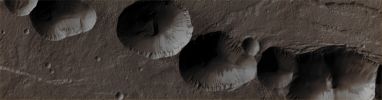
ESP_023597_2260_RED_abrowse-PCF-LXTT.jpgArtynia Catena (Absolute Natural Colors; credits for the additional process. and color.: Dr Paolo C. Fienga - Lunexit Team)295 visiteMars Local Time: 13:57 (Early Afternoon)
Coord. (centered): 45,8° North Lat. and 240,4° East Long.
Spacecraft altitude: 296,2 Km (such as about 185,1 miles)
Original image scale range: 59,3 cm/pixel (with 2 x 2 binning) so objects ~ 1 mt and 78 cm across are resolved
Map projected scale: 50 cm/pixel
Map projection: EQUIRECTANGULAR
Emission Angle: 0,4°
Phase Angle: 59,9°
Solar Incidence Angle: 60° (meaning that the Sun is about 30° above the Local Horizon)
Solar Longitude: 341,8° (Northern Winter)
Credits: NASA/JPL/University of Arizona
Additional process. and coloring: Dr Paolo C. Fienga - Lunar Explorer ItaliaMareKromium
|
|
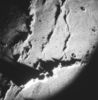
ORIGINAL NASA - APOLLO 15 - AS 15-98-13331.jpgAS 15-98-13331 - Peaks and Shadows81 visite
|
|
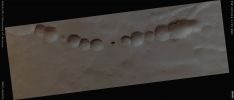
PSP_005414_1735_RED_abrowse-PCF-LXTT-00.jpgPit Chain on Arsia Mons (CTX Frame - Absolute Natural Colors; credits for the additional process. and color.: Dr Paolo C. Fienga - Lunexit Team)169 visiteCaption NASA:"The Chain of Collapse Pits visible in this image formed by collapse as the giant Shield Volcano, Arsia Mons, was pulled apart. While Magma intruding into the Volcano might have pushed the rocks aside, it is also possible that the collapse is caused by the volcano falling apart underneath its own weight.
Acquisition date: September, 22nd, 2007
M.L.T.: 14:14 (Early Afternoon)
Latitude (centered): 6,5° South
Longitude (East): 240,0°
Spacecraft Altitude: 252,4 Km
Original Image Scale Range: 25,3 cm/pixel (with 1 x 1 binning) so objects ~76 cm across are resolved
Map Projected Scale: 25 cm/pixel and North is up
Map Projection: EQUIRECTANGULAR
Emission Angle: 3,9°
Sun-Mars-Spacecraft (Phase) Angle: 38,1°
S.I.A.: 34°, with the Sun about 56° above the Local Horizon
Solar Longitude: 318,2° (Northern Winter)MareKromium
|
|
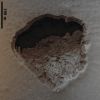
PSP_005414_1735_RED_abrowse-PCF-LXTT-01.jpgPit Chain on Arsia Mons - "Annie" (EDM - Absolute Natural Colors; credits for the additional process. and color.: Dr Paolo C. Fienga - Lunexit Team)214 visiteCaption NASA:"This small Pit located in the middle of the Chain was discovered by a team of scientists from the U.S. Geological Survey and Arizona State University using data from the THEMIS camera onboard the Mars Odyssey Spacecraft during a search for possible Cave Entrances. They informally named this pit "Annie".
A section of the HiRISE image over "Annie" has been specially processed to enhance the contrast in the shadowed areas. This shows that the Pit is is largely filled with wind blown materials. Shadow measurements indicate that the Floor is about 112 meters (367 feet) below the Rim".MareKromium
|
|

Tharsis_Region-Pit_Chain-MGS-PIA03930-PCF-LXTT.jpgCollapse Pit-Chain in Tharsis Region (Absolute Natural Colors; credits for the additional process. and color: Dr Paolo C. Fienga - Lunexit Team)277 visitenessun commentoMareKromium
|
|
| 34 immagini su 3 pagina(e) |
1 |
|








