| Risultati della ricerca nelle immagini - "Central" |

Craters-Unnamed_Crater-Layered_Outcrop-Thaumasia_Region-00.jpgLayered Rocky Outcrops (Original NASA/MGS/MSSS b/w Frame)67 visiteCaption NASA originale:"This MGS-MOC image shows light-toned, layered rock outcrops in the central pit of an impact crater in the Thaumasia Planum Region of Mars. The outcrops were tilted and broken-up by the extreme energy of the impact that formed the crater in which they occur. These are layers of rock that were brought up by the impact from horizontal beds that lie below the floor of the crater".
Location near: 21,7° South Lat. and 69,4° West Long.
Image width: ~3 Km (~1,9 mi)
Illumination from: upper left
Season: Southern Summer
Nota: difficile pensare, per spiegare i rilievi catturati in questo frame, ad una costruzione logica più improbabile di quella proposta dalla NASA...
|
|
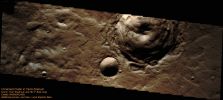
Craters-Unnamed_Crater-Terra_Sirenum-20090318a-PCF-LXTT.jpgHighly Degraded Unnamed Crater in Terra Sirenum (Natural Colors; credits: Dr Paolo C. Fienga - Lunar Explorer Italia)64 visitenessun commentoMareKromium
|
|
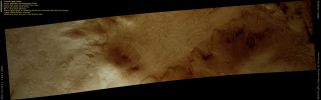
ESP_013071_1365_RED_abrowse.jpgCentral Peak Gullies (Natural Colors; credits: Lunar Explorer Italia)85 visitenessun commentoMareKromium
|
|

ESP_013726_1475_RED_abrowse.jpgGullies and Flow Features on an Unnamed Crater Wall (Natural Colors; credits: Lunexit)75 visiteThis HiRISE image shows a sample of the variety and complexity of processes that may occur on the walls of Martian Craters, well after the impact crater formed.
At the very top of the image is the high Crater Rim; at the bottom of the image is the Crater's Central Peak - a dome of material rising above the surrounding Crater Floor uplifted during the impact event. Reaching down the Walls of the crater are windy and crooked troughs, or Gullies. Some of these Gullies may have formed with the help of liquid water, melted from ice or snowpack on the Crater Walls or from groundwater within the Walls. Also notable is the long tongue-like lobe stretching down the middle of the image, with a darker, rounded snout, and prominent parallel grooves on its surface. These characteristics, together with faint cracks on its surface, suggest that this lobe may have formed by movement of ice-rich material from up on the Crater Wall down to the floor.
Because surface features on this lobe, as well as most Gullies, do not appear sharp and pristine, and wind-blown dunes have blown up on the front snout of the lobe, and because there are several small craters on the lobe's surface, the movement of ice-rich material, and possibly water, have probably not occurred very recently.
MareKromium
|
|

ESP_014176_1810_RED_abrowse.jpgCentral Uplift of an Unnamed Impact Crater (Natural Colors; credits: Lunexit)72 visitenessun commentoMareKromium
|
|
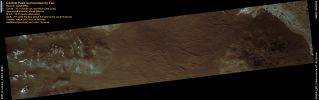
ESP_014320_1465_RED_abrowse.jpgCentral Peak surrounded by Fan (Natural Colors; credits: Lunexit)75 visitenessun commentoMareKromium
|
|
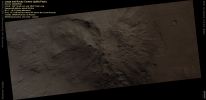
ESP_014410_1470_RED_abrowse.jpgUnnamed Crater with Rocky central Uplift (Natural Colors; credits: Lunexit)67 visitenessun commentoMareKromium
|
|
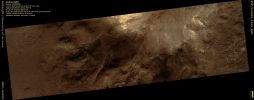
ESP_014439_1505_RED_abrowse.jpgCentral Uplift (Natural Colors; credits: Lunexit)66 visitenessun commentoMareKromium
|
|
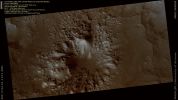
ESP_016136_1525_RED_abrowse-00.jpgColourful Streaks (CTX Frame - Natural Colors; credits: NASA/JPL/Univ. of Arizona and Dr Paolo C. Fienga - Lunexit Team)65 visiteThis is an image of the Central Pit of an Unnamed Impact Crater located in the ancient Southern Highlands.
The Central Uplifts of large Impact Craters often collapse to form Pits on Mars, but they are still structural Uplifts and often expose deep Bedrock with diverse rock types which, like in this case (see the EDM that follows) may show a variety of colors.MareKromium
|
|

ESP_020873_1640_RED_abrowse.jpgLayered Bedrock in Central Uplift (Absolute Natural Colors; credits: Dr Paolo C. Fienga - Lunexit Team)293 visitenessun commentoMareKromium
|
|

ESP_020929_1360_RED_abrowse.jpgUplifted Bedrock (Absolute Natural Colors; credits for the additional process. and color.: Dr Paolo C. Fienga - Lunexit Team)352 visiteCaption NASA:"Large Impact Craters expose deep Bedrock. After the transient cavity forms, the Crater Floor rebounds and creates a permanent structural Uplift, typically equivalent to about 10% of the Crater diameter.
A Crater approx. 70 Km (43,47 miles) wide like this one, can raise up and expose Bedrock that was approx. 7 Km (4,34 miles) lower in elevation prior to the Impact.
Deeper rocks are usually older, and on Mars the oldest rocks are interesting because they are more likely to have been altered by water and provide clues to ancient environments and processes. This image reveals good Bedrock exposures with diverse rock types (as indicated by colors and textures)".MareKromium
|
|
ESP_020949_2115_RED_abrowse.jpgUnnamed Crater's Central Uplift in Amazonis Planitia (Natural Colors; credits for the additional process. and color.: Dr Paolo C. Fienga - Lunexit Team)192 visitenessun commentoMareKromium
|
|
| 29 immagini su 3 pagina(e) |
1 |
|








