| Risultati della ricerca nelle immagini - "Cape" |
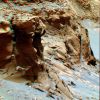
000-OPP-SOL1095-MF-LXT.jpgVictoria's Capes - Sol 1095 (Hi-Def3-D - credits and Copyright: Dr M. Faccin and Lunar Explorer Italia)114 visiteUna "Nuova Visione" di Marte, Made by Lunexit: si tratta di frames processati tridimensionalmente, ma adottando una tecnica ed un processing totalmente innovativi.
Confrontate queste "Visioni di Marte" con i 3D "Standard" NASA e...Vedrete la differenza, e CHE differenza!
Questa tecnica di elaborazione delle immagini (sviluppata da Marco Faccin e Gianluigi Barca, sotto Copyright Lunar Explorer Italia) è il primo passo verso la creazione di frames tridimensionali a colori (non più il "solito" blu/verde e rosso) e ad altissima definizione. Frames che permetteranno a chiunque li guardi (ed anche a persone che hanno problemi di vista) di mettere - letteralmente - gli occhi ed il naso "all'interno del paesaggio ripreso".
Ed ora (e per il momento), indossate gli "occhialini" e...in un istante Vi ritroverete DENTRO e AD UN PASSO dal margine e dai Promontori di Victoria Crater!
MareKromium
|
|
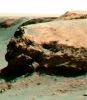
OPP-SOL0953-3D-2_copia.jpgVictoria's Capes - Sol 953 (Hi-Def3-D - credits and Copyright: Dr G. Barca and Lunar Explorer Italia)79 visitenessun commentoMareKromium
|
|
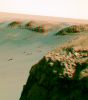
OPP-SOL0985-3D-2_copia.jpgVictoria's Capes - Sol 985 (Hi-Def3-D - credits and Copyright: Dr G. Barca and Lunar Explorer Italia)77 visitenessun commentoMareKromium
|
|

OPP-SOL1063-1.jpgFrom inside Victoria - Sol 1063 (True Colors; credits: Dr G. Barca)65 visitenessun commentoMareKromium
|
|

OPP-SOL1167-PIA10210-1.jpgCape St. Vincent (natural - but sligthly darkened - colors; MULTISPECTRUM processing; credits: Lunexit)67 visiteCaption NASA:"The cliff in this image from Opportunity's PanCam is informally named Cape St. Vincent. It is a promontory approx. 12 mt (39 feet) tall on the Northern Rim of Victoria Crater, near the farthest point along the Rover's traverse around the rim. Layers seen in Cape St. Vincent have proven to be among the best examples of meter scale cross-bedding observed on Mars to date. Cross-bedding is a geologic term for rock layers which are inclined relative to the horizontal and which are indicative of ancient sand dune deposits. In order to get a better look at these outcrops, Pancam Super-Resolution (SR) imaging techniques were utilized.
SR is a type of imaging mode which acquires many pictures of the same target to reconstruct a digital image at a higher resolution than is native to the camera.
These SR images have allowed scientists to discern that the rocks at Victoria Crater once represented a large Dunefield, not unlike the Sahara desert on Earth, and that this Dunefield migrated with an ancient wind flowing from the North to the South across the Region. Other Rover chemical and mineral measurements have shown that many of the ancient sand dunes studied in Meridiani Planum were modified by surface and subsurface liquid water long ago.
This is a Mars Exploration Rover Opportunity PanCam image acquired on Sol 1167 (May 7, 2007), and was constructed from a mathematical combination of 16 different blue filter (480 nm) images".MareKromium
|
|
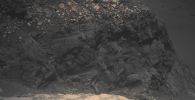
OPP-SOL1213-PIA10211-1.jpgCape St. Mary (natural - but highly darkened - colors; MULTISPECTRUM processing; credits: Lunexit)64 visiteCaption NASA:"Another of the best examples of spectacular cross-bedding in Victoria Crater are the outcrops at Cape St. Mary, which is an approx. 15 mt (45 foot) high promontory located along the Western Rim of Victoria Crater and near the beginning of the Rover's traverse around the rim. Like the Cape St. Vincent images, these Pancam Super-Resolution images have allowed scientists to discern that the rocks at Victoria Crater once represented a large dune field that migrated across this region.
This is a Mars Exploration Rover Opportunity PanCam image mosaic acquired on Sol 1213 (June 23, 2007), and was constructed from a mathematical combination of 32 different blue filter (480 nm) images".
Nota Lunexit: attraverso il darkening del frame originale e l'esaltazione dei contrasti, riteniamo di poter dire - con un ragionevole margine di certezza - che il "Paving" (di Victoria come di Endurance) ed il "Boulders Carpet" (tappeto di macigni) che paiono caratterizzare l'outer rim di questi Crateri, posseggono un'albedo molto più alta delle pareti dei Crateri stessi ed un colore molto più vicino all'argento/arancio, piuttosto che al giallo/cenere. Questi indizi, a nostro parere, sono il possibile indice di una matrice cristallina dei rilievi in questione (vetrificazione?); una matrice che potrebbe essere "responsabile" dei curiosi giochi di colore che i Crateri Victoria ed Endurance sembrano generare allorchè viene tentata la colorizzazione di frames ottenuti in particolari ore del giorno (e cioè con luci radenti e/o con luci perpendicolari al rim dei Crateri).MareKromium
|
|
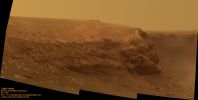
OPP-SOL1329-1193591285_32257-4_Sol1329B_P2379_L257atc-1.jpgCape Verde, according to NASA - Sol 132968 visiteCaption NASA:"A promontory nicknamed "Cape Verde" can be seen jutting out from the walls of Victoria Crater in this approximate true-color picture taken by the PanCam on NASA's MER Opportunity. The Rover took this picture on Martian Day, or Sol, 1329 (Oct. 20, 2007), more than a month after it began descending down the crater walls - and just 9 Soles shy of its second Martian birthday on Sol 1338 (Oct. 29, 2007).
Opportunity landed on the Red Planet on Jan. 25, 2004. That's nearly 4 years ago on Earth, but only 2 on Mars, because Mars takes longer to travel around the Sun than Earth. One Martian year equals 687 Earth days.
The overall soft quality of the image, and the "haze" seen in the lower right portion, are the result of scattered light from dust on the front sapphire window of the Rover's camera.
This view was taken using 3 PanCam filters, admitting light with wavelengths centered at 750 (near infrared), 530 (green) and 430 nanometers (violet)".MareKromium
|
|
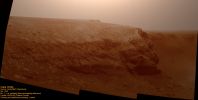
OPP-SOL1329-1193591285_32257-4_Sol1329B_P2379_L257atc-3.jpgCape Verde, according to Lunexit - Sol 132964 visiteLe "Verità", come abbiamo scritto qualche centinaio di volte, non la può conoscere ancora nessuno. Tuttavia, se non la "Verità", almeno alcuni frammenti di plausibilità, nel tempo e con il tempo (e la pazienza e la competenza...) possono essere trovati e proposti.
Questa è la nostra ultima elaborazione in "Possibili Colori Veri" di Cape Verde: essa è il frutto di un (ormai lungo) lavoro di confronti, riflessioni, tentativi e speculazioni.
E' giusta?
Non lo è?
Lo è solo in parte?
Non importa. Voi provate a confrontarla con le elaborazioni NASA degli ultimi 3 anni e poi decidete da soli.
La differenza sostanziale, a nostro parere, è solo una: la nostra elaborazione è il frutto di un percorso.
Magari errato in nuce, ma un percorso (guardate le nostre prime elaborazioni a colori per rendervene conto).
L'elaborazione NASA, invece, è solo un frame in b/n processato (MOOOOLTO alla svelta e moooolto alla buona...) con un programmino tipo Photo o Paintshop.
Tutto qui.MareKromium
|
|
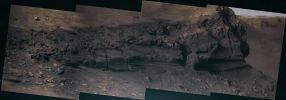
OPP-SOL1342-PIA10209-1.jpgCape Verde (natural colors; MULTISPECTRUM processing; credits: Lunexit)85 visiteCaption NASA:"This MER Opportunity PanCam Super Resolution mosaic of the approx. 6 mt (20 foot) high cliff face of the Cape Verde promontory was taken by the Rover from inside Victoria Crater, during the Rover's descent into Duck Bay. Super-resolution is an imaging technique which utilizes information from multiple pictures of the same target in order to generate an image with a higher resolution than any of the individual images. Cape Verde is a geologically rich outcrop and is teaching scientists about how rocks at Victoria Crater were modified since they were deposited long ago. This image complements SR mosaics obtained at Cape St. Mary and Cape St. Vincent and is consistent with the hypothesis that Victoria crater is located in the middle of what used to be an ancient sand dune field. Many Rover Team Scientists are hoping to be able to eventually drive the Rover closer to these layered rocks in the hopes of measuring their chemistry and mineralogy.
This is a MER Opportunity PanCam image mosaic acquired on Soles 1342 and 1356 (November 2 and 17, 2007), and was constructed from a mathematical combination of 64 different blue filter (480 nm) images".MareKromium
|
|

OPP-SOL1395-1N252021242EDN8800P1586L0M1.jpgDust and fog over Victoria Crater - Sol 1395 (natural colors + MULTISPECTRUM; credits: Lunexit)63 visitenessun commentoMareKromium
|
|
OPP-SOL1580-1P268466569ESF90B0P2271L1M2.jpgLooking up! - Sol 1580 (MULTISPECTRUM; credits: Lunexit)73 visitenessun commentoMareKromium
|
|
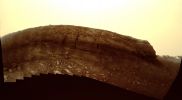
OPP-SOL1580-PIA11048.jpgDusk Lighting of Layered Textures in 'Cape Verde' - Sol 1580 (natural colors; credits: Lunexit)68 visiteFull-shade lighting in the late Martian afternoon helps make details visible in this view of the layered cliff face of the "Cape Verde" promontory making up part of the rim of Victoria Crater in the Meridiani Planum Region of Equatorial Mars.
NASA's Mars Exploration Rover Opportunity used its Panoramic Camera (Pancam) to shoot the dozens of individual images that have been combined into this mosaic. Opportunity was inside Victoria Crater and near the base of the cliff when it took these images on the 1579th and 1580th Martian Days, or Soles, of the mission (such as July 2nd and 3rd, 2008).
Photographing the promontory from this position in Victoria Crater presented challenges for the rover team. The geometry was such that Cape Verde was between the Rover and the Sun, which could cause a range of negative effects, from glinting off PanCam's dusty lenses to shadowing on the cliff face. The team's solution was to take the images for this mosaic just after the Sun disappeared behind the Crater Rim, at about 17:30 M.L.T..
The atmosphere was still lit, but no direct Sunlight was illuminating the wall of Cape Verde. The result is a high-resolution view of Cape Verde in relatively uniform diffuse sky lighting across the scene.
PanCam used a clear filter for taking the images for this mosaic. Capturing images in low-light situations was one of the main motivations for including the clear filter among the camera's assortment of filters available for use.
The face of Cape Verde is about 6 meters (20 feet) tall. Victoria Crater, at about 800 meters (one-half mile) wide, is the largest and deepest crater that Opportunity has visited. It sits more than 5 Km (almost 4 miles) away from Opportunity's Eagle Crater Landing Site. Researchers sent Opportunity into Victoria Crater to study the rock layers exposed inside. The textures seen in the rock layers of Cape Verde suggest that the exposed layers were originally deposited by wind.MareKromium
|
|
| 25 immagini su 3 pagina(e) |
1 |
|








