| Risultati della ricerca nelle immagini - "Calypso" |

Calypso-EB1.jpgCalypso (Natural Colors; credits: Elisabetta Bonora)79 visitenessun commentoMareKromium
|
|

Calypso-EB2.jpgCalypso (Natural Colors; credits: Elisabetta Bonora)141 visite...Altro "Frammento Artistico" che ci rammenta le sfumature e le tenui - ma sempre affascinanti - colorazioni di Mondi immersi nel solo "Chiaro di Stelle" e, probabilmente, ancora troppo lontani dall'Immaginario Collettivo per suscitare interessi particolari. Purtroppo.
Grandi Complimenti ad Elisabetta Bonora per il Lavoro!MareKromium
|
|

Calypso-N00040025.jpgCalypso in the darkness81 visitePerduta nell'oscurità incombente dello Spazio, così come una minuscola isola - dimenticata dalle mappe dei Naviganti - è persa nell'Oceano: questa è Calypso, una piccola luna di Saturno la quale, se la osservate con attenzione, denuncia la sua natura di "scheggia vagante", catturata dalle braccia gravitazionali di Saturno e sottratta, in epoche (presumiamo) assai remote, al suo peregrinare senza mèta nei recessi del Sistema Solare.
Valutazioni romantiche a parte, in questo bellissimo frame, Calypso è a poco più di 100.000 Km di distanza da Cassini, ma qualche suo rilievo superficiale - oltre alla forma, decisamene peculiare... - si può già intuire: un grande bacino (da impatto?) marca il Polo Sud di Calypso, mentre un altro cratere, più vasto e meno profondo, sembra segnare il Polo Nord di questo piccolo mondo la cui forma - attenzione! - ricorda in maniera davvero impressionante quella dell'asteroide 433 Eros.
Identità di natura, coincidenza o un segnale di ripetitività?
|
|

Calypso-PIA07633.jpgCalypso (in false colors)65 visiteThis color image provides the best look yet at Saturn's moon Calypso, a Trojan of the larger moon Tethys. Calypso trails Tethys in its orbit by 60°. Telesto is the other Tethys Trojan, orbiting Saturn 60°ahead of Tethys. Calypso is only 22 Km (about 14 miles) across. Calypso, like many other small Saturnian moons and small asteroids, is irregularly shaped by overlapping large craters. Although the resolution here is not as high as in Cassini's best images of Pandora and Telesto, this moon appears to also have loose surface material capable of smoothing the appearance of craters. (...) The images were taken with the Cassini spacecraft narrow-angle camera on Sept. 23, 2005, at a distance of approx. 101.000 Km (about 63.000 mi) from Calypso and at a phase angle of 61°. Resolution in the original image was 602 mt per pixel (...) ".
Nota: notiamo un'incredibile somiglianza fra Calypso e l'asteroide 433-Eros. Coincidenza, o c'è una sorta di "marchio di fabbrica" che unisce le piccole lune agli asteroidi?
|
|
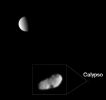
Tethys_and_Calypso-PIA09735.jpgTethys and Calypso64 visiteCaption NASA:"Two companion moons share the sky before the Cassini Spacecraft. Tethys is seen here with one of its two Trojan moons. Calypso, which trails the larger moon in its orbit by 60°, is a couple of pixels across near lower right. Telesto (not pictured) is the other Tethys co-orbital moon, leading Tethys by 60°.
The image was taken in visible light with the Cassini spacecraft narrow-angle camera on Aug. 25, 2007. The view was obtained at a distance of approx. 2,2 MKM (about 1,4 MMs) from Tethys.
Image scale is roughly 13 Km (about 8 miles) per pixel on Tethys".MareKromium
|
|
|
|
|
| 5 immagini su 1 pagina(e) |
|








