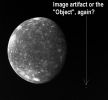
45-vg1_1639948.jpgCallistus: the "dark moon" and another (?) "strange companion" (b/w)65 visiteCome segnalatoci dal nostro Ricercatore Esterno, Dr G. Barca, anche nelle prossimità di Callisto sembra esserci uno "strano compagno". Che sia lo stesso oggetto che avevamo incontrato nei pressi di "Io"?
Le porte della Fantasia sono aperte: allora, escludendo (con riserva e sino a prova contraria) l'ipotesi per cui il "puntino bianco" sia un image-artifact, che cosa potrà mai essere? Un'altra "luna provvisoria", questa volta di Callisto? Un altro "corpo vagante" - magari una "futura cometa"?
O forse si tratta di un qualcosa di Alieno che sta osservando (e seguendo?) la Sonda Voyager 1?
Come sempre, noi Vi diamo tutti gli elementi disponibili: al resto provate a rispondere Voi stessi...
|
|

Callisto-040507.jpgCallistus, from New Horizons66 visiteThe New Horizons Long Range Reconnaissance Imager (LORRI) captured these two images of Jupiter's outermost large moon, Callisto, as the spacecraft flew past Jupiter in late February.
New Horizons' closest approach distance to Jupiter was 2,3 MKM (about 1,4 MMs), not far outside Callisto's orbit, which has a radius of 1,9 MKM (about 1,2 MMs). However, Callisto happened to be on the opposite side of Jupiter during the spacecraft's pass through the Jupiter System, so these images, taken from 4,7 MKM (about 3 MMs) and 4,2 MKM (about 2,6 MMs) away, are the closest of Callisto that New Horizons obtained.
Callisto's ancient, crater-scarred surface makes it very different from its three more active sibling satellites, Io, Europa and Ganymede. Callisto, 4800 Km (about 3000 miles) in diameter, displays no large-scale geological features other than impact craters and every bright spot in these images is a crater. The largest impact feature on Callisto, the huge basin Valhalla, is visible as a bright patch at the 10 o'clock position. The craters are bright because they have excavated material relatively rich in water ice from beneath the dark, dusty material that coats most of the surface.
The two images show essentially the same side of Callisto - the side that faces Jupiter - under different illumination conditions. The images accompanied scans of Callisto's infrared spectrum with New Horizons' Linear Etalon Imaging Spectral Array (LEISA).
The New Horizons Science Team designed these scans to study how the infrared spectrum of Callisto's water ice changes as lighting and viewing conditions change, and as the ice cools through Callisto's late afternoon.
The infrared spectrum of water ice depends slightly on its temperature, and a goal of New Horizons when it reaches the Pluto system (in 2015) is to use the water ice features in the spectrum of Pluto's moon Charon, and perhaps on Pluto itself, to measure surface temperature.
Callisto provided an ideal opportunity to test this technique on a much better-known body.
The left image, taken at 05:03 Universal Time on February 27, 2007, is centered at 5° South, 5° West, and has a Solar Phase Angle of 46°. The right image was taken at 03:25 Universal Time on February 28, 2007. It is centered at 4° South, 356° West, and has a Solar Phase Angle of 76°.MareKromium
|
|

Jupiter, Europa & Callisto.jpgJupiter, Europa and Callistus69 visitenessun commento
|
|

JupiterSystem-050107_09.jpgThe "Galilean Family" of Jupiter108 visiteThis montage shows the best views of Jupiter's four large and diverse "Galilean" satellites as seen by the Long Range Reconnaissance Imager (LORRI) on the New Horizons spacecraft during its flyby of Jupiter in late February 2007. The four moons are, from left to right: Io, Europa, Ganymede and Callisto. The images have been scaled to represent the true relative sizes of the four moons and are arranged in their order from Jupiter.
Io, 3,640 kilometers (2,260 miles) in diameter, was imaged at 03:50 Universal Time on February 28 from a range of 2.7 million kilometers (1.7 million miles). The original image scale was 13 kilometers per pixel, and the image is centered at Io coordinates 6 degrees south, 22 degrees west. Io is notable for its active volcanism, which New Horizons has studied extensively.
Europa, 3,120 kilometers (1,938 miles) in diameter, was imaged at 01:28 Universal Time on February 28 from a range of 3 million kilometers (1.8 million miles). The original image scale was 15 kilometers per pixel, and the image is centered at Europa coordinates 6 degrees south, 347 degrees west. Europa's smooth, icy surface likely conceals an ocean of liquid water. New Horizons obtained data on Europa’s surface composition and imaged subtle surface features, and analysis of these data may provide new information about the ocean and the icy shell that covers it.
New Horizons spied Ganymede, 5,262 kilometers (3,268 miles) in diameter, at 10:01 Universal Time on February 27 from 3.5 million kilometers (2.2 million miles) away. The original scale was 17 kilometers per pixel, and the image is centered at Ganymede coordinates 6 degrees south, 38 degrees west. Ganymede, the largest moon in the solar system, has a dirty ice surface cut by fractures and peppered by impact craters. New Horizons’ infrared observations may provide insight into the composition of the moon’s surface and interior.
Callisto, 4,820 kilometers (2,995 miles) in diameter, was imaged at 03:50 Universal Time on February 28 from a range of 4.2 million kilometers (2.6 million miles). The original image scale was 21 kilometers per pixel, and the image is centered at Callisto coordinates 4 degrees south, 356 degrees west. Scientists are using the infrared spectra New Horizons gathered of Callisto’s ancient, cratered surface to calibrate spectral analysis techniques that will help them to understand the surfaces of Pluto and its moon Charon when New Horizons passes them in 2015.
MareKromium
|
|








