| Risultati della ricerca nelle immagini - "Buried" |
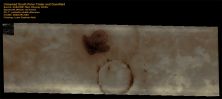
Crater-Unnamed_Buried_South_Polar_Crater.jpgUnnamed (and Buried) South Polar Crater (Absolute Natural Colors; credits for the additional process. and color.: Dr Paolo C. Fienga - Lunexit Team)124 visitenessun commentoMareKromium
|
|

Craters-Buried_Crater-01.jpgUnder the Sand (Absolute Natural Colors; credits for the additional process. and color.: Dr Paolo C. Fienga - Lunexit Team)223 visiteCaption NASA originale:"This MGS-MOC image shows a partially-buried crater in the North Polar Region of Mars.
The circular feature is surrounded and partly overlain by some of the many, many sand dunes in the area. The steepest slopes on each dune — their "slip faces" — face toward the SouthEast, indicating that the dominant winds responsible for sand transport in this Region come from the NorthWest".
Location near: 76,0° North; 82,2° West
Image width: ~3 Km (~1,9 mi)
Illumination from: lower left
Season: Northern SpringMareKromium
|
|

Craters-Unnamed_Buried_Craters-MGS-PIA06855-00.jpgUnnamed Buried Craters in Utopia Planitia (Original NASA/MGS/MSSS b/w Frame)122 visiteCaption NASA:"This Mars Global Surveyor (MGS) Mars Orbiter Camera (MOC) image shows a cracked Plain in Western Utopia Planitia. The three circular crack patterns indicate the location of three buried Unnamed Impact Craters. These landforms are located near 41,9° North Lat. and 275,9° West Long. The image covers an area approximately 3 km (about 1,9 mi) across. Sunlight illuminates this scene from the lower left".
|
|

Craters-Unnamed_Buried_Craters-MGS-PIA06855-01.jpgUnnamed Buried Craters in Utopia Planitia (Enhanced Absolute Natural Colors; credits for the additional process. and color.: Dr Paolo C. Fienga - Lunexit Team)156 visiteCaption NASA:"This Mars Global Surveyor (MGS) Mars Orbiter Camera (MOC) image shows a cracked Plain in Western Utopia Planitia. The three circular crack patterns indicate the location of three buried Unnamed Impact Craters. These landforms are located near 41,9° North Lat. and 275,9° West Long. The image covers an area approximately 3 km (about 1,9 mi) across. Sunlight illuminates this scene from the lower left".MareKromium
|
|
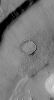
Craters-Unnamed_Crater-Deuteronilus_Mensae-PIA08472-00.jpgAlmost Buried Unnamed Crater in Deuteronilus Mensae (Original NASA/JPL/ASU b/w Frame)64 visiteCaption NASA originale: "This Unnamed Crater appears to be in the process of being covered over by downslope movement of material. These large slopes of material are common in Deuteronilus Mensae".
Image information: VIS instrument;
Latitude: 41,1° North;
Longitude: 17,8° East;
Resolution: 19 meter/pixel.
|
|
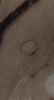
Craters-Unnamed_Crater-Deuteronilus_Mensae-PIA08472-01.jpgAlmost Buried Unnamed Crater in Deuteronilus Mensae (Absolute Natural Colors; credits for the additional process. and color.: Dr Paolo C. Fienga - Lunexit Team)141 visiteCaption NASA originale: "This Unnamed Crater appears to be in the process of being covered over by downslope movement of material. These large slopes of material are common in Deuteronilus Mensae".
Image information: VIS instrument;
Latitude: 41,1° North;
Longitude: 17,8° East;
Resolution: 19 meter/pixel. MareKromium
|
|
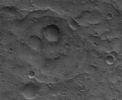
Craters-Unnamed_Crater_in_Terra_Sabaea-01.jpgBuried Crater in Terra Sabaea (Original NASA/MGS/MSSS b/w Frame)68 visiteCaption originale:"This MGS-MOC image shows a 1,5 mt (~5 feet) per pixel view of a subdued circular feature which is probably an ancient Impact Crater that was buried and only partially exhumed (a common occurrence on Mars)".
Location near: 21,9° South Lat. and 338,6° West Long.
Image width: ~3 Km (~1,9 mi)
Illumination from: upper left
Season: Southern Summer
|
|

Craters-Unnamed_Craters-Utopia_Planitia-01.jpgOld Buried Unnamed Craters in Northern Utopia Planitia (Natural Colors; credits for the additonal process. and color.: Dr Paolo C. Fienga - Lunexit Team)173 visiteOriginal caption:"This MGS-MOC image shows 2 circular features on the Plains of Northern Utopia. A common sight on the Martian Northern Plains, these rings indicate the locations of Buried Impact Craters".
Location near: 65,1° North Lat. and 261,2° West Long.
Image width: ~2 Km (~1,2 mi)
Illumination from: lower left
Season: Northern SummerMareKromium
|
|

ESP_014097_1120_RED_abrowse.jpgDisappearing Craters (Natural Colors; credits: Lunar Explorer Italia)82 visiteImpact Craters that form at High Latitudes often disappear faster than those that form in Equatorial Regions. The craters in this image are only barely detectable.
Over time, craters in ice, particularly large craters, "relax".
Their depth-to-diameter ratio decreases as the bowl of the crater gets shallower with time. The craters slowly appear softer and smoother, fading into the surrounding landscape, until they remain only as circular patterns on flat ground, before they eventually disappear altogether. The larger the crater, the faster it will relax.
The reason for the crater degradation is partly due to in-filling by snow or dust and slumping off of the crater walls, and also partly from processes that produce the patterned ground you see in this HiRISE image. But the primary reason for the shallowing is because the ground at High Latitudes on Mars is ice-rich, and ice is not very strong. At warmer temperatures found in the Inner Solar System, ice generally flows more easily than rock, so ice cannot support the structure of the crater as well as rock. The crater relaxes as the ice begins to flow back to a level surface.
All of the processes listed above have likely acted on these craters, and recently, they have also been swept by Dust Devils, which left dark streaks in their wake.MareKromium
|
|

OPP-SOL040-1P131737438RAD0552P2541L456C1.jpgMonochrome Mars - Sol 40 (Multispectral Color Imagery; credits: Lyle.org)68 visitenessun commentoMareKromium
|
|
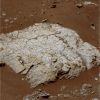
OPP-SOL224-3.jpgBuried Boulder - Sol 224 (possible True Colors; credits: Dr G. Barca & Lunexit)77 visitenessun commentoMareKromium
|
|

PSP_005349_0930_RED_abrowse-0.jpgCircular Feature in the South Polar Residual Cap (Absolute Natural Colors; credits for the additional process. and color.: Dr Paolo C. Fienga - Lunexit Team)123 visiteThis 4 Km-diameter Circular Surface Feature near the Edge of the South Polar Residual Cap was recognized in Mariner 9 and Viking Orbiter images taken in the '70s, but its origin could not be inferred. It was therefore targeted for HiRISE stereo imaging.
The bright areas in this image are covered by CO2 frost, and the "Swiss Cheese" terrain typical of the South Polar Residual Cap covers much of the imaged area.
The Dark Walls of the Circular Depression do not have as much Frost on them, and are fractured in a polygonal pattern. Apparently the Surface of the Walls has been extensively modified by thermal expansion and contraction of water ice. It also appears that the "Swiss Cheese" Terrain of the Residual Cap has buried the Floor of the Circular Depression, as well as the Terrain surrounding the Feature, making it difficult to infer its origin.
Its circular symmetry is consistent with an impact origin, but there is no evidence of a Crater Rim or Ejecta Blanket (perhaps because they have been buried).
The Depression may also have formed by collapse, but there is little evidence of extensional fractures that would be expected around a Collapse Pit. Analysis of HiRISE stereo data may help the interpretation of this Feature.MareKromium
|
|
| 16 immagini su 2 pagina(e) |
1 |
|








