| Risultati della ricerca nelle immagini - "Bosporos" |

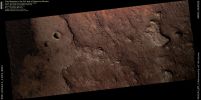
Channel-CoracisFossae-BosporusPlanum-20091106a.jpgDry Riverbed and a possible Skylight (or an EXTREMELY fresh Impact Crater) between Coracis Fossae and Bosporos Planum (CTX Frame - Natural Colors; credits: Lunexit)65 visitenessun commentoMareKromium
|
|

Channel-CoracisFossae-BosporusPlanum-20091106b.jpgDry Riverbed and a possible Skylight (or an EXTREMELY fresh Impact Crater) between Coracis Fossae and Bosporos Planum (EDM - credits: Lunexit)70 visiteIl rilievo ambiguo è sostanzialmente indefinibile a questa risoluzione, ma la sua colorazione "pitch black" e l'apparente assenza di rim ci fa pensare ad un Pozzo Verticale da Collasso.
Le "sbavature" scure che caratterizzano l'intero versante Nord della Surface Feature e, in parte, il lato Est-Sud/Est (senza interessamento della sua zona Ovest ed Ovest-Sud/Ovest), invece, potrebbero anche far pensare ad un impatto il quale, oltre che essere occorso assai di recente, potrebbe - se non altro parzialmente - essere ricondotto alla Classe dei "Mid-Air Impact" (ossia il bolide generatore del dettaglio si sarebbe, in questo caso, parzialmente disintegrato - esploso - in prossimità del suolo, mentre una sua parte avrebbe comunque raggiunto la superficie, così creando un cratere).
L'ipotesi del Vertical Collapse Pit, comunque, ci sembra preferibile (anche se una ragionevole spiegazione delle "sbavature" scure, in questo scenario, non siamo in grado di poterla fornire).MareKromium
|
|
PSP_006625_1405_RED_abrowse-00-PCF-LXTT.jpgClay Minerals in the NW side of Bosporos Montes (Absolute Natural Colors; credits for the additional process. and color.: Dr Paolo C. Fienga - Lunexit Team)85 visiteThe Bosporos Montes make up part of the Rim of the giant Argyre Impact Basin on Mars. The Compact Reconnaissance Imaging Spectrometer (CRISM) identified this as a location with Clay Minerals (---> minerali a matrice argillosa). Such minerals contain water and may have formed under conditions favorable for life.
This HiRISE image was taken to support the CRISM Team’s investigation of this area. While HiRISE does not have the ability to identify minerals the way CRISM can, the enhanced colors in this image are similar to those seen in other Clay-containing parts of Mars.
The light-toned Mesas and Plains are crisscrossed with small Fractures that could have formed as a muddy Clay Deposit dried. However, this material is strong enough to form Boulders where it has been hit by Impact Craters.MareKromium
|
|

Q-S-BosporusRupes-PIA08047_modest.jpgBosporos Rupes77 visiteThis image was taken in the mid-latitudes of Mars' Southern Hemisphere near the giant Argyre Impact Basin. It is located just to the West of a prominent scarp known as Bosporos Rupes. The left side of the image shows cratered plains. Some of the craters are heavily mantled and indistinct, whereas others exhibit sharp rims and dramatic topography. The largest crater in this half of the image is about 2,5 Km wide. Mounds and ridges, which may be remnants of an ice-rich deposit, are visible on its floor. Three sinuous valleys occupy the center of the image. Valleys such as these were first observed in data returned by the NASA Mariner 9 spacecraft, which reached Mars in 1971. The right side of the image shows part of an impact crater that is approx. 20 Km in diameter. The furrowed appearance of the crater's inner wall suggests that it has been extensively modified, perhaps by landslides and flowing water. Like other craters in the area, the floor of this crater has a rough and dissected texture that is often attributed to the loss of ice-rich material.
This image was taken by the High Resolution Imaging Science Experiment (HiRISE) camera onboard NASA's Mars Reconnaissance Orbiter spacecraft on March 24, 2006. The image is centered at 40,64° South Latitude, 303,49° East Longitude. The image is oriented such that North is 7° to the left of up. The range to the target was 2.044 Km (about 1.270 miles). At this distance the image scale is 2,04 mt (6,69 feet) per pixel, so objects as small as 6,1 mt (20 feet) are resolved. In total this image is 40,90 Km (about 25,41 miles) or 20.081 pixels wide and 11,22 Km (such as 6,97 miles) or 5.523 pixels high. The image was taken at a Local Mars Time of 07:30 and the scene is illuminated from the upper right with a solar incidence angle of 81,4° (this meaning that the Sun was about 8,6° above the horizon).
|
|

Q-U-Bosporus Planum (IR-VIS)-01.jpgBosporus Planum - detail mgnf (1)106 visiteCaption originale NASA, riferita al full-frame:"This is the first color image of Mars from the High Resolution Imaging Science Experiment on NASA's Mars Reconnaissance Orbiter. At the center portion of the camera's array of light detectors there are extra detectors to image in green and near-infrared color bandpasses, to be combined with the black-and-white images (from red-bandpass detectors) to create color images.
This is not natural color as seen by human eyes, but infrared color - shifted to longer wavelengths. This image also has been processed to enhance subtle color variations. The southern half of the scene is brighter and bluer than the northern half, perhaps due to early-morning fog in the atmosphere".
|
|

Q-U-Bosporus Planum (IR-VIS)-02.jpgBosporus Planum - detail mgnf (2)65 visiteCaption originale NASA, riferita al full-frame:"Large-scale streaks in the northern half are due to the action of wind on surface materials. The blankets of material ejected from the many small fresh craters are generally brighter and redder than the surrounding surface, but a few are darker and less red. Two greenish spots in the middle right of the scene may have an unusual composition, and are good future targets for the Compact Reconnaissance Imaging Spectrometer for Mars, a mineral-identifying instrument on MRO (http://crism.jhuapl.edu/). In the bottom half of the image we see a redder color in the rough areas, where wind and sublimation of water or carbon dioxide ice have partially eroded patches of smooth-textured deposits".
|
|

Q-U-Bosporus Planum (IR-VIS)-03.jpgBosporus Planum - detail mgnf (3)75 visiteCaption NASA originale, riferita al full-frame:"This image was taken by HiRISE on March 24, 2006.
The image is centered at 33,65° South Latitude and 305,07° East Longitude. It is oriented such that North is 7° to the left of up.
The range to the target was 2.493 Km (about 1.549 miles) and at this distance the image scale is 2,49 mt (such as approx. 8,17 feet) per pixel, so objects as small as 7,5 mt (about 24,6 feet) are resolved. In total this image is 49,92 Km (such as about 31,02 miles) or 20.081 pixels wide and 23,66 Km (about 14,70 miles) or 9.523 pixels long. The image was taken at a MLT of 07:33 and the scene is illuminated from the upper right with a solar incidence angle of 78° (this meaning that the Sun, at the time the picture was taken, was 12° above the local horizon).
At an Ls of 29° (with Ls an indicator of Mars' position in its orbit around the Sun), the season on Mars is Southern Autumn".
|
|

Q-U-Bosporus Planum (IR-VIS)-04.jpgBosporus Planum - detail mgnf (4)68 visitenessun commento
|
|
| 8 immagini su 1 pagina(e) |
|





