| Risultati della ricerca nelle immagini - "Boreale" |

Chasma_Boreale-TRA_000840_2750_IRB-001-PCF-LXTT.jpgOn the Edge of Chasma Boreale (Natural Colors; credits for the additional process. and color.: Dr Paolo C. Fienga - Lunexit Team)243 visitenessun commentoMareKromium
|
|

Chasma_Boreale-TRA_000840_2750_IRB-004-PCF-LXTT.jpgOn the Edge of Chasma Boreale (Natural Colors; credits for the additional process. and color.: Dr Paolo C. Fienga - Lunexit Team)296 visitenessun commentoMareKromium
|
|
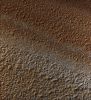
Chasma_Boreale-TRA_000840_2750_IRB-005-PCF-LXTT.jpgOn the Edge of Chasma Boreale (Natural Colors; credits for the additional process. and color.: Dr Paolo C. Fienga - Lunexit Team)270 visitenessun commentoMareKromium
|
|

Chasma_Boreale-TRA_000840_2750_IRB-005-PCF-LXTT_(2).jpgChasma Boreale (Enhanced Natural Colors; credits for the additional process. and color.: Dr Paolo C. Fienga - Lunexit Team)277 visitenessun commentoMareKromium
|
|

Dunes-Dark_Dunes-Chasma_Boreale-PIA07350-00.jpgDark Dunes in Chasma Boreale (Original NASA/JPL/MSSS b/w Frame)113 visiteCaption NASA originale:" This MGS-MOC image shows Dark Sand Dunes overlying an eroded, layered substrate in Chasma Boreale, amid the materials of the Martian North Polar Cap.
Location near: 84,5° North Lat. and 358,3° West Long.
Image width: ~3,0 Km (~1,9 mi)
Illumination from: lower left
Season: Northern Summer".
|
|

Dunes-Dark_Dunes-Chasma_Boreale-PIA07350-01.jpgDark Dunes in Chasma Boreale (Absolute Natural Colors; credits for the additional process. and color.: Dr Paolo C. Fienga - Lunexit Team)153 visiteCaption NASA originale:" This MGS-MOC image shows Dark Sand Dunes overlying an eroded, layered substrate in Chasma Boreale, amid the materials of the Martian North Polar Cap".
Location near: 84,5° North Lat. and 358,3° West Long.
Image width: ~3 Km (~1,9 mi)
Season: Northern SummerMareKromium
|
|

ESP_013751_1115_RED_abrowse.jpgDD Tracks in Thyles Rupes (Natural Colors; credits: Lunexit)69 visiteThe Dark Streaks are a result of a Surface-Atmosphere interaction that creates thermally-driven Vortices. These Martian Vortices are giant Dust Devils that “vacuum” the bright Surface dust revealing the darker Subsurface rock.
This image was taken in the late Southern Summer and shows that the Dust Devil direction of movement changes with the winds as the season progresses from Spring to Fall. Dust Devils are sensitive to changes in low-speed ambient winds and will follow the dominant daytime wind direction.
The direction of the Vortex is visible by the scallop pattern that is left behind as a Dust Devil will erase the front part of the circular track as it follows the wind.MareKromium
|
|

North_Polar_Features-North_Polar_Margin-Chasma_Boreale-PIA07052-PCF-LXTT.jpgNorth Polar "Scarp" (Absolute Natural Colors; credits for the additional process. and color.: Dr Paolo C. Fienga - Lunexit Team)254 visiteCaption NASA:"This 1,6 meters (~5 feet) per pixel Mars Global Surveyor (MGS) Mars Orbiter Camera (MOC) image shows a typical North Polar Scarp and associated dark windblown Sand Dunes. Layers of material -- possibly Dust and Ice -- are exposed by the Scarp. The small white patches in the image are remnants of seasonal Frost. When this North Polar image was acquired in late September 2004, most of the Polar Frost had sublimed away. This image is located near 85,1° North Lat. and 210,8°West Longitude. The scene covers an area of approximately 3 Km (about 1,9 mi) across, and is illuminated by sunlight from the lower left.MareKromium
|
|
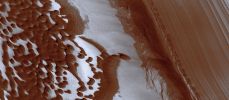
North_Polar_Regions-Chasma_Boreale-MGS-01.jpgBrown Dunes in Chasma Boreale (Enhanced Natural Colors; credits for the additional process. and color.: Dr Paolo C. Fienga - Lunexit Team)66 visitenessun commentoMareKromium
|
|
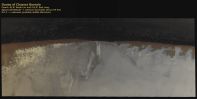
North_Polar_Regions-Chasma_Boreale-PCF-LXTT.jpgChasma Boreale (Absolute Natural Colors; credits for the additional process. and color.: Dr Paolo C. Fienga - Lunexit Team)68 visitenessun commentoMareKromium
|
|
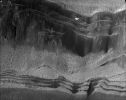
North_Polar_Regions-Chasma_Boreale-PIA01926-det.jpgThe Walls of Chasma Boreale97 visiteThe Martian terrain in this remarkable image is at the head of a large chasm, named Chasma Boreale, which cuts through Mars' North Polar Layered Deposits (MNPLD). These ice-rich layered deposits are about 3000 mt (about 9.800 feet) thick and 1000 Km (1.600 miles) across, much like the Greenland ice-sheet on Earth. The head of Chasma Boreale ends in a steep icy cliff more than 1000 mt (about 3300 feet) high. The cliff has both light- and dark-toned layers, seen at right in this image. The image was taken by the HiRISE camera on NASA's MRO. The internal layers of the ice-sheet are visible in the cliff walls. The dark-toned flat area in the center and left of the image is the floor of this chasm, which contains many craters.
Scientists have proposed that Chasma Boreale was formed by a catastrophic flood that began under the ice-sheet and was later widened by wind erosion. However, the large number of craters on the chasm's floor implies that the floor is much older than the ice sheet. These craters should have been removed by the suggested flood; their presence has caused some Mars researchers to instead speculate that no large flood occurred and that Chasma Boreale was not covered with very much ice.
In addition to layered ice, there is also some material within the north polar layered deposits that appears to be composed of sand. The dark material near the base of the cliff wall is thought to be aprons of debris being eroded from sand-rich layers. Zooming in on this dark material with HiRISE reveals ripples, which are diagnostic of moving sand.
Some bright spots of material visible on the cliff wall were not present in previous years. These are likely patches of water frost. Each year layers of carbon dioxide and water frost coat this terrain before being removed during the summer. The water frost lasts longer, and patches that are shaded by nearby steep topography (such as this one) can persist even into late summer.
An unexpected surprise, not visible with previous camera resolutions, is the fragmentation of the exposed surfaces of these icy layers into polygonal blocks. These blocks appear to be breaking away from the layer margins and forming boulder-sized debris, which then rolls down slope (a process called mass-wasting). These boulders are likely to be large blocks of dusty water ice; once separated from the main ice-sheet they can be eroded away by sunlight. More boulder-sized objects are visible out in the floor of the chasm. Polygons are also visible throughout the chasm floor, indicating that water-ice is just below the surface.
Image TRA_000845_2645 was taken by the HiRISE camera on Oct. 1, 2006. The complete image is centered at 84.6 degrees latitude, 3.4 degrees east longitude. The range to the target site was 316 kilometers (198 miles). At this distance the image scale is 63 centimeters (25 inches) per pixel (with 2 x 2 binning), so objects about 186 centimeters (73 inches) across are resolved. The image shown here has been map-projected to 50 centimeters (20 inches) per pixel. North is up. The image was taken at a local Mars time of 3:34 p.m. and the scene is illuminated from the west with a solar incidence angle of 62.3 degrees, thus the sun was about 27.7 degrees above the horizon. At a solar longitude of 114.3 degrees, the season on Mars is northern summer.
|
|
PSP_006980_2610_RED_abrowse~0.jpgChasma Boreale (Natural Colors; credits: Lunexit)70 visitenessun commentoMareKromium
|
|
| 25 immagini su 3 pagina(e) |
1 |
|








