| Risultati della ricerca nelle immagini - "Blanket" |
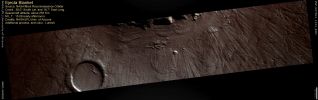
PSP_007822_1415_RED_abrowse~0.jpgEjecta Blanket (MULTISPECTRUM; credits: Lunexit)102 visiteThe Ejecta Blanket of a large (20 Km diameter) impact crater is shown here in vivid detail. The ejecta formed strong linear patterns in the topography that extend radially outward from the crater. This ejecta is rocky material that was ejected from the crater as a result of the high-velocity impact of an object about 100-200 meters in diameter, which probably escaped from the asteroid belt.
Since the impact event, this ejecta has been subject to millions of years of wind erosion that may have etched the surface and accentuated the radial pattern. There are also small-scale landforms such as fractured mounds that may have formed due to the presence of subsurface ice (note: this is a so-called "periglacial phenomenon"). MareKromium
|
|
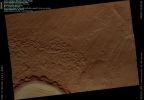
PSP_010100_2165_RED_abrowse.jpgEjecta Blanket (Natural Colors; credits: Lunar Explorer Italia)68 visiteThis image of a crater in the Utopian Region can be described as what happens when heat produced from an impact comes into contact with Mars’ icy Surface.
Since the Surface Temperature of Mars is well below the freezing point of water, Mars’ soil is a mixture of soil and permafrost. When this impact occurred, a great deal of energy in the form of heat was released onto the Surface, creating a melted feature in the bright icy soil. This melting and then refreezing of the ice (as the impact cooled) caused what is known as a "Periglacial Formation". This is depicted towards the middle of the image where the Ejecta Blanket lays.
This is likely a geologically newer surface since the only impacts disrupting the image are a few small craters that are mostly towards the bottom left-hand side of the full image.
The fact the Ejecta Blanket is still intact and not fully collapsed supports the idea that is it a newer surface feature as it has not been affected by erosional processes.MareKromium
|
|
|
|
| 2 immagini su 1 pagina(e) |
|








