| Risultati della ricerca nelle immagini - "Bedrock" |
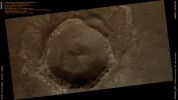
ESP_020086_2020_RED_abrowse-00.jpgUnnamed Crater with Light-toned Layered Bedrock (Absolute Natural Colors; credits for the additional process. and color.: Dr Paolo C. Fienga - Lunexit Team)102 visitenessun commentoMareKromium
|
|

ESP_020950_1410_RED_abrowse.jpgRelatively recent Impact Crater with Gullies and exposed Bedrock (Absolute Natural Colors; credits for the additional process. and color.: Dr Paolo C. Fienga - Lunexit Team)390 visitenessun commentoMareKromium
|
|
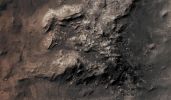
ESP_025296_1535-PCF-LXTT-00-A.jpgExposed "Uplifted" Bedrock (CTX Frame "A" - Absolute Natural Colors; credits for the additional process. and color.: Dr Paolo C. Fienga - Lunar Explorer Italia)136 visiteMars Local Time: 14:54 (early afternoon)
Coord. (centered): 26,3° South Lat. and 305,2° East Long.
Spacecraft altitude: 255,8 Km (such as about 159,9 miles)
Original image scale range: 25,6 cm/pixel (with 1 x 1 binning) so objects ~ 77 cm across are resolved
Map projected scale: 25 cm/pixel
Map projection: EQUIRECTANGULAR
Emission Angle: 1,2°
Sun - Mars - MRO (or "Phase") Angle: 62,0°
Solar Incidence Angle: 61° (meaning that the Sun is about 29° above the Local Horizon)
Solar Longitude: 45,4° (Northern Spring)
Credits: NASA/JPL/University of Arizona
Additional process. and coloring: Lunar Explorer ItaliaMareKromium
|
|
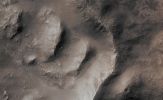
ESP_025296_1535-PCF-LXTT-00-B.jpgExposed "Uplifted" Bedrock (CTX Frame "B" - Absolute Natural Colors; credits for the additional process. and color.: Dr Paolo C. Fienga - Lunar Explorer Italia)149 visiteMars Local Time: 14:54 (early afternoon)
Coord. (centered): 26,3° South Lat. and 305,2° East Long.
Spacecraft altitude: 255,8 Km (such as about 159,9 miles)
Original image scale range: 25,6 cm/pixel (with 1 x 1 binning) so objects ~ 77 cm across are resolved
Map projected scale: 25 cm/pixel
Map projection: EQUIRECTANGULAR
Emission Angle: 1,2°
Sun - Mars - MRO (or "Phase") Angle: 62,0°
Solar Incidence Angle: 61° (meaning that the Sun is about 29° above the Local Horizon)
Solar Longitude: 45,4° (Northern Spring)
Credits: NASA/JPL/University of Arizona
Additional process. and coloring: Lunar Explorer ItaliaMareKromium
|
|
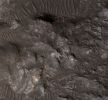
ESP_025296_1535-PCF-LXTT-02-A.jpgExposed "Uplifted" Bedrock (CTX Frame "C" - Absolute Natural Colors; credits for the additional process. and color.: Elisabetta Bonora and Marco Faccin - Lunexit Team)160 visiteMars Local Time: 14:54 (early afternoon)
Coord. (centered): 26,3° South Lat. and 305,2° East Long.
Spacecraft altitude: 255,8 Km (such as about 159,9 miles)
Original image scale range: 25,6 cm/pixel (with 1 x 1 binning) so objects ~ 77 cm across are resolved
Map projected scale: 25 cm/pixel
Map projection: EQUIRECTANGULAR
Emission Angle: 1,2°
Sun - Mars - MRO (or "Phase") Angle: 62,0°
Solar Incidence Angle: 61° (meaning that the Sun is about 29° above the Local Horizon)
Solar Longitude: 45,4° (Northern Spring)
Credits: NASA/JPL/University of Arizona
Additional process. and coloring: Lunar Explorer Italia MareKromium
|
|
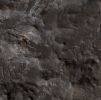
ESP_025296_1535-PCF-LXTT-02-B.jpgExposed "Uplifted" Bedrock (CTX Frame "D" - Absolute Natural Colors; credits for the additional process. and color.: Elisabetta Bonora and Marco Faccin - Lunexit Team)154 visiteMars Local Time: 14:54 (early afternoon)
Coord. (centered): 26,3° South Lat. and 305,2° East Long.
Spacecraft altitude: 255,8 Km (such as about 159,9 miles)
Original image scale range: 25,6 cm/pixel (with 1 x 1 binning) so objects ~ 77 cm across are resolved
Map projected scale: 25 cm/pixel
Map projection: EQUIRECTANGULAR
Emission Angle: 1,2°
Sun - Mars - MRO (or "Phase") Angle: 62,0°
Solar Incidence Angle: 61° (meaning that the Sun is about 29° above the Local Horizon)
Solar Longitude: 45,4° (Northern Spring)
Credits: NASA/JPL/University of Arizona
Additional process. and coloring: Lunar Explorer Italia MareKromium
|
|
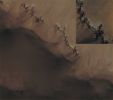
ESP_025570_2330-PCF-LXTT-00.jpgExposed Bedrock on the Wall of an Unnamed Northern Crater (CTX Frame and EDM - Absolute Natural Colors; credits for the additional process. and color.: Dr Paolo C. Fienga - Lunar Explorer Italia)154 visiteMars Local Time: 14:46 (early afternoon)
Coord. (centered): 52,6° North Lat. and 15,5° East Long.
Spacecraft altitude: 309,4 Km (such as about 193,4 miles)
Original image scale range: 61,9 cm/pixel (with 2 x 2 binning) so objects ~ 1 mt and 86 cm across are resolved
Map projected scale: 50 cm/pixel
Map projection: EQUIRECTANGULAR
Emission Angle: 7,9°
Sun - Mars - MRO (or "Phase") Angle: 38,4°
Solar Incidence Angle: 45° (meaning that the Sun is about 45° above the Local Horizon)
Solar Longitude: 54,9° (Northern Spring)
Credits: NASA/JPL/University of Arizona
Additional process. and coloring: Lunar Explorer ItaliaMareKromium
|
|
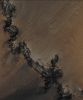
ESP_025570_2330-PCF-LXTT-01.jpgExposed Bedrock on the Wall of an Unnamed Northern Crater (EDM - Absolute Natural Colors; credits for the additional process. and color.: Dr Paolo C. Fienga - Lunar Explorer Italia)155 visiteMars Local Time: 14:46 (early afternoon)
Coord. (centered): 52,6° North Lat. and 15,5° East Long.
Spacecraft altitude: 309,4 Km (such as about 193,4 miles)
Original image scale range: 61,9 cm/pixel (with 2 x 2 binning) so objects ~ 1 mt and 86 cm across are resolved
Map projected scale: 50 cm/pixel
Map projection: EQUIRECTANGULAR
Emission Angle: 7,9°
Sun - Mars - MRO (or "Phase") Angle: 38,4°
Solar Incidence Angle: 45° (meaning that the Sun is about 45° above the Local Horizon)
Solar Longitude: 54,9° (Northern Spring)
Credits: NASA/JPL/University of Arizona
Additional process. and coloring: Lunar Explorer ItaliaMareKromium
|
|

PSP_003830_1740_RED_abrowse-00.jpgLayered Bedrock in Candor Chasma (CTX Frame - Absolute Natural Colors; credits for the additional process. and color.: Dr Paolo C. Fienga - Lunexit Team)125 visiteThis image shows an area of Layered Deposits in Candor Chasma. Here, Sheets and Dunes of dark-toned Sand cover the light-toned, Layered Bedrock. Accumulations of dark Sand accentuate bedding within the light-toned Bedrock, giving some areas a sort of "zebra-striped" pattern.
In the left side of the scene, the Bedrock has been eroded into steep, craggy Cliffs. Some sections of these Cliffs are covered by triangular-shaped Debris Fans that are intermediate in color between the dark-toned Sand and light-toned Bedrock. These Fans may contain a mix of light-toned Bedrock that has crumbled away from the surrounding Cliffs as well as wind-blown Sand and Dust.
The Surfaces of some Fans are dissected by Gullies, which most likely formed through Dry Avalanching. The bottoms of the Gully Channels are often darker in tone than the surrounding Fan Surface. This may be due to accumulations of wind-blown Sand in the Gully Floor.MareKromium
|
|
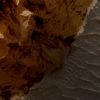
PSP_003830_1740_RED_abrowse-01.jpgLayered Bedrock in Candor Chasma (EDM n.1 - Absolute and Enhanced Natural Colors; credits for the additional process. and color.: Dr Paolo C. Fienga - Lunexit Team)132 visiteThis EDM shows a clear example of a "Gullied Fan", taken from the left (Northern) portion of the whole scene.MareKromium
|
|

PSP_004052_2045_RED_abrowse-02-PIA13726.jpgUnnamed Crater with Layers near Mawrth Vallis (Enhanced Natural Colors; credits: NASA/JPL-Caltech/University of Arizona)132 visiteThis image covers part of an Unnamed Impact Crater roughly 4 Km (approx. 2,5 miles) in diameter; the upper portion of the picture shows a one Km segment of the Crater's Inner Wall and Rim.
The Surface outside the Crater is relatively dark, while the Inner Wall of the Crater exposes lighter, Layered Bedrock of diverse colors. A few dark patches on the Crater Wall have small Dunes or Ripples on their surfaces, and are likely Pits filled with Dark Sand. This Crater provides a window into the Sub-Surface of Mars, revealing Layered Sedimentary Deposits.
Just about 30 Km (approx. 18,6 miles) to the East of this Crater lies Mawrth Vallis, an ancient Channel that may have been carved by catastrophic Floods.
In Layered Deposits surrounding Mawrth Vallis, the orbiting spectrometers OMEGA (on Mars Express) and CRISM (on MRO) have detected Phyllosilicate (such as Clay) minerals, which must have formed in the presence of water.
In this Region on Mars, the colors of the Layers seen by HiRISE often correlate with distinct water-bearing minerals observed by CRISM, so the color diversity seen here may reflect a dynamic environment at this location on early Mars.
Note: the color in these images is enhanced; it is not as it would normally appear to the human eye.MareKromium
|
|

PSP_006769_1595_RED_abrowse.jpgSouthern Highlands Panorama (Enhanced Natural Colors; credits: Lunexit)80 visiteThis image shows a portion of the Southern Highlands cut by Arda Valles, an ancient Valley Network.
The Valley Network is degraded as seen by the lack of obvious walls and a V-shaped bottom. The valley networks are thought to have formed by running liquid water on the surface of Mars billions of years ago, with a few being active more recently.
Arda Valles has many dunes within it and craters on top of it, which show that is has been around for long enough for craters to form. The surface that Arda Valles cuts is more cratered than the valley surface because wind has moved material into the valley throughout time such that the surface in the valley gets covered and past craters might be buried there.MareKromium
|
|
| 13 immagini su 2 pagina(e) |
1 |
|








