| Risultati della ricerca nelle immagini - "Aurora" |

Aurora Borealis - Norway.jpgBlack Aurora over Norway94 visiteDa "NASA - Picture of the Day" del 29 Marzo 2006:"What causes gaps between aurora curtains? These unusual gaps can make auroral displays appear more detailed and intricate. Research using data from four Cluster Spacecraft orbiting the Earth has likely found the secret: auroral gaps, sometimes knows as "black auroras", are actually anti-auroras. In normal auroras, electrons and/or predominantly negatively charged particles fall toward Earth along surfaces of constant magnetic field. They ionize the Earth's atmosphere on impact, causing the bright glows. In auroral gaps, however, negatively charged particles may be sucked out from the Earth's ionosphere along adjoining magnetic field lines. These dark anti-auroras can climb to over 20.000 Km and last for several minutes. Pictured above, a series of well-defined auroral gaps is seen dividing green aurora curtains high above Harstad, Norway, earlier this month".
|
|

Aurora Borealis.jpgAurora over Wisconsin120 visiteLo "spettacolo" delle Aurore Boreali che stanno manifestandosi un pò ovunque in Nord America non accenna a diminuire: questa si è verificata nel Wisconsin. Ecco la caption originale da "NASA - Picture of the Day" del 17 Novembre 2004:"The auroral displays of the past week are being reported as some of the most beautiful in memory. In particular, impressive auroral bands fanned out over much of eastern North America after sunset on November 8. The multicolored aurora pictured above was caught reflecting in one of the many small lakes in central Wisconsin near that time. Continued solar activity might create more aurora visible over the next few nights as the Leonids meteor shower peaks". Non comprendiamo, a dire il vero, la curiosa relazione implicita che ci sembra essere stata fatta tra il verificarsi di queste Aurore ed i prossimo picco delle Leonidi.
Forse non abbiamo capito bene o magari ci sta semplicemente sfuggendo qualcosa...
|
|

Aurora Borealis~0.jpgAurora Borealis over North Dakota89 visiteDa "NASA - Picture of the Day" del 20 Novembre 2005:"This aurora was a bit of a surprise. For starters, on this Friday morning in August 2002, no intense auroral activity was expected at all. Possibly more surprising, however, the aurora appeared to show an usual structure of green rays from some locations. In the above image, captured from North Dakota, USA, a picket fence of green rays stretches toward the horizon. Mirroring the green rays is a red band, somewhat rare in its own right. Lights from the cities of Bismarck and Mandan are visible near the horizon. Large sunspot groups indicate that activity from an active Sun is relatively likely, possibly causing other streams of energetic particles to cascade onto the Earth and so causing more auroras".
|
|

AuroraBorealis-Alaska.jpgAurora over Alaska86 visiteCaption NASA:"Higher than the highest mountain, higher than the highest airplane, lies the realm of the aurora. Aurora rarely reach below 60 Km, and can range up to 1000. Aurora light results from solar shockwave causing energetic electrons and protons to striking molecules in the Earth's atmosphere. Frequently, when viewed from space, a complete aurora will appear as a circle around one of the Earth's magnetic poles. The above digitally enhanced photograph was taken in 2005 January shows a spectacular aurora borealis above the frozen landscape of Bear Lake, Alaska, USA.
The above image was voted Wikipedia Commons Picture of the Year for 2006".
|
|

Aurora_Borealis-2.jpgAurora Borealis over Juneau73 visiteCaption NASA:"Some auroras can only be seen with a camera. They are called sub-visual and are too faint to be seen with the unaided eye. The reason is that the human eye only accumulates light for a fraction of a second at a time, while a camera shutter can be left open indefinitely. When photographing an already picturesque scene above Juneau, Alaska, USA, a camera caught green sub-visual aurora near the horizon. Auroras are sparked by energetic particles from the Sun impacting the magnetic environment around the Earth. Resultant energetic particles such as electrons and protons rain down near the Earth's poles and impact the air.
The impacted air molecules temporarily lose electrons, and when oxygen molecules among them reacquire these electrons, they emit green light. Auroras are known to have many shapes and colors". MareKromium
|
|
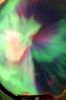
Aurora_Borealis-Coronal_Aurora-1.jpg"Auroral Corona" from l'Observatoire de la Découverte in Val Belair near Quebec - Canada87 visiteDa "NASA - Picture of the Day" del 9 Novembre 2004: "...This fisheye picture captures a particularly active and colorful 'Auroral Corona' that occurred on November 7, 2004 (...) The above aurora has an unusually high degree of detail, range of colors and breadth across the sky. The vivid green, red, and blue auroral colors are likely caused by high atmospheric oxygen and hydrogen reacting to incoming electrons. The trigger events were magnetically induced explosions on the Sun from sunspot region 696 over the past few days. Continued activity from this active solar region could mean more auroras visible to northern observers over the next few days. Early in the morning but far in the background, planets, stars and the Moon will be simultaneously putting on their own show".
Una piccola (nostra) nota di commento: dietro la vivace bellezza dell'immagine ed i "romantici" commenti, c'è un nuovo incremento dell'attività solare in un periodo in cui, invece, il nostro Sole è usualmente calmo.
|
|
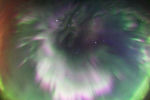
Aurora_Borealis-Coronal_Aurora-sep11aurora_moussette_f.jpgNorthern Lights over Canada77 visiteSo far, the Aurora Borealis - or "Northern Lights" - have made some remarkable visits to September's Skies. The reason, of course, is the not-so-quiet Sun. In particular, a large solar active region now crossing the Sun's disk has produced multiple, intense flares and a large Coronal Mass Ejection (CME) that triggered wide spread auroral activity just last weekend. This colorful example of spectacular curtains of aurora was captured with a fish-eye lens in skies over Quebec, Canada, on September 11, 2005.
Also featured is the planet Mars, the brightest object above and left center. Seen near Mars (just below and to the right) is the tightly knit Pleiades star cluster.
Although they can appear to be quite close, the Northern Lights actually originate at extreme altitudes, 100 Km or so above the Earth's surface.
|
|
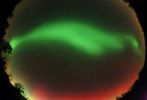
Aurora_Borealis-Coronal_Aurora.jpgCoronal Aurora near Warrensbourg - Missouri (USA)91 visiteIn relazione a quanto detto e scritto solo pochi giorni fa, ecco una nuova Aurora la quale, oltre ad essere stata particolarmente intensa (come potete ben vedere), è accaduta ad un latitudine che di Polare o presso-Polare non ha proprio nulla. La NASA dice che è un fenomeno inusuale ma "normale", vista l'attività solare di questi giorni. Permetteteci, a questo riguardo, una battuta: è proprio il fatto che sia la NASA a dire di non preoccuparci che ci fa preoccupare... EccoVi il commento originale da "NASA - Picture of the Day" del giorno 12.11.2004: "(...) Amazing! Unbelievable!, The best I've ever seen! ... They aren't talking about a movie, though. Instead, even casual sky critics are remarking on November's stunning auroral displays, visible with surprising intensities well beyond the confines of high latitudes where auroral activity is normally observed (...)". Vedete?!? Entusiasmo, eccitazione, linguaggio più da show che da Scienza e dintorni: è il nuovo corso della NASA...
|
|

Aurora_Borealis.jpgAurora Borealis over Chena Lakes70 visiteCaption NASA:"Sometimes, after your eyes adapt to the dark, a spectacular sky appears. In this case, a picturesque lake lies in front of you, beautiful green aurora flap high above you, brilliant stars shine far in the distance, and, for a brief moment, a bright meteor streaks by. This digitally fused breathtaking panorama was captured late last month across one of the Chena Lakes in North Pole, Alaska, USA, and includes the Pleiades open cluster of stars on the image right. The shot is unusual not only for the many wonders it has captured simultaneously, but because lakes this far north tend to freeze and become non-reflecting before a sky this dark can be photographed".MareKromium
|
|

Aurora_Borealis_-_00.jpgOn the shoulder of Giants...72 visitenessun commentoMareKromium
|
|

Aurora_Borealis_-_01.jpgRed Space-Waterfall79 visitenessun commentoMareKromium
|
|

Aurora_Borealis_-_02.jpgPeaceful Morning Sky89 visitenessun commentoMareKromium
|
|
| 24 immagini su 2 pagina(e) |
1 |
|








