| Risultati della ricerca nelle immagini - "Amazonis" |
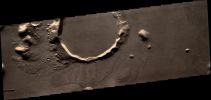
Crater-Unnamed_Crater_and_Lava_Flows_in_Amazonis_Planitia-PCF-LXTT.jpgUnnamed Crater and Lava Flows in Amazonis Planitia (Absolute Natural Colors; credits for the additional process. and color.: Drr Gianluigi Barca and Paolo C. Fienga - Lunexit Team)193 visitenessun commentoMareKromium
|
|
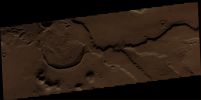
Craters-Exhumed_Craters_in_Amazonis_Planitia.jpgExhumed Craters in Amazonis Planitia (Darkened Absolute Natural Colors; credits for the additional process. and color.: Dr Paolo C. Fienga - Lunexit Team)77 visiteCaption NASA originale:"The exhumation of craters, such as the uncovering of old craters hidden from view by younger surface material, is common in many Regions of Mars. This Unnamed Crater and its covering material are located in Amazonis Planitia".
Coord.: 3,7° North Lat. and 194,9° East Long.MareKromium
|
|

Craters-Unnamed_Crater_in_Amazonis_Planitia-M1101105.jpgUnnamed Crater in Amazonis Planitia (Original NASA/MGS/MSSS b/w Frame)79 visitenessun commento
|
|
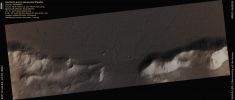
ESP_014184_2070_RED_abrowse.jpgLava Flows in Amazonis Planitia (Absolute Natural Colors; credits for the additional process. and color.: Dr Paolo C. Fienga - Lunexit Team)217 visitenessun commentoMareKromium
|
|
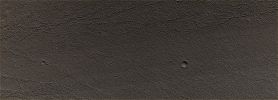
ESP_017546_1965_RED_abrowse-PCF-LXTT.jpgFeatures of Amazonis Planitia (Absolute Natural Colors; credits for the additional process. and color.: Dr Paolo C. Fienga - Lunexit Team)198 visiteMars Local Time: 15:10 (early afternoon)
Coord. (centered): 16,1° North Lat. and 205,7° East Long.
Spacecraft altitude: 283,3 Km (such as about 177,0 miles)
Original image scale range: 56,7 cm/pixel (with 2 x 2 binning) so objects ~ 1 mt and 70 cm across are resolved
Map projected scale: 50 cm/pixel
Map projection: EQUIRECTANGULAR
Emission Angle: 2,3°
Phase Angle: 47,3°
Solar Incidence Angle: 45° (meaning that the Sun is about 45° above the Local Horizon)
Solar Longitude: 81,9° (Northern Spring)
Credits: NASA/JPL/University of Arizona
Additional process. and coloring: Lunar Explorer ItaliaMareKromium
|
|
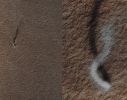
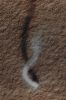
ESP_026051_2160-PCF-LXTT-01.jpgSerpentine Dust Devil in Amazonis Planitia (CTX Frame - Absolute Natural Colors; credits for the additional process. and color.: Dr Paolo C. Fienga - Lunexit Team)134 visiteA "towering" (----> very tall, of imposing height) Dust Devil (also hereafter written "DD") casts a serpentine shadow over the Surface in this beautiful, late Springtime image of the Amazonis Planitia Region of Mars. The length of the shadow of this DD indicates (a simple calculation is needed and all the necessary data to make it are available) that the Dust Plume is/should be more than 800 meters, or about half a mile, in height; on the other hand, the delicate arc that gave to the Dust Plume its serpentine appearence, was most likely produced by a Westerly (----> coming from the West) Breeze which blew at about 250-meter of its height, thus causing the top of the Plume itself to bend towards the East. The Dust Plume itself is approximately 30 meters in diameter.
A consistent number of Dust Devil Tracks (also hereafter written "DD Tracks" or "DDT" for short) trend from the North/West to the South/East and it is really interesting to notice that these Tracks are quite bright, whereas Dust Devil Tracks visible elsewhere on Mars are usually dark. However, Dark DD Tracks are believed to form where Bright Dust is lifted from the Surface by these swirling small Hurricanes, thus revealing a darker Substrate; but here, in the Amazonis Planitia Region of Mars, the Dust Cover (such as the amount of Dust covering the Surface of the Region) is still too thick to be penetrated by such kind of a scouring (as a matter of fact, you have to remember that a thick blanket of Bright and fresh Dust was deposited over Amazonis Planitia recently, during a Regional and - relatively - long Dust Storm, that occurred right before the arrival of the NASA - Mars Reconnaissance Orbiter). Anyway, the Bright Tracks could also form when the already settled Dust is stirred up by the strong Winds generated by the Dust Devils (Tangential Winds whose Speed reached up to 70 mph - miles-per-hour - have, actually, already been recorded in previous HiRISE images of other Dust Devils).
It is also extremely interesting to underline that this image was taken during the time of year when Mars is farthest from the Sun. Just as on Earth, Martian Winds are powered by Solar Heating. Exposure to the Sun's Rays should be at a minimum during this season and yet, even now, Dust Devils act relentlessly to clean the Surface of freshly deposited Dust, a little bit at a time.
Picture's Data
Mars Local Time: 15:03 (Early Afternoon)
Coord. (centered): 35,8° North Lat. and 207,5° East Long.
Spacecraft altitude: 307,7 Km (such as about 192,3 miles)
Original image scale range: 30,8 cm/pixel (with 1 x 1 binning) so objects ~ 92 cm across are resolved
Map projected scale: 25 cm/pixel
Map projection: EQUIRECTANGULAR
Emission Angle: 16,1°
Phase Angle: 25,1°
Solar Incidence Angle: 41° (meaning that the Sun is about 49° above the Local Horizon)
Solar Longitude: 71,3° (Northern Spring)
Credits: NASA/JPL/University of ArizonaMareKromium
|
|
ESP_026051_2160-PCF-LXTT-02.jpgSerpentine Dust Devil in Amazonis Planitia (EDM - Absolute Natural Colors; credits for the additional process. and color.: Dr Paolo C. Fienga - Lunexit Team)112 visitenessun commentoMareKromium
|
|
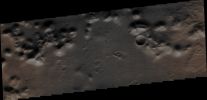
Hills_and_Knobs_in_Amazonis_Planitia-PIA15135-PCF-LXTT.jpgHills and Knobs in Amazonis Planitia (Absolute Natural Colors; credits for the additional process. and color.: Dr Paolo C. Fienga - Lunexit Team)213 visiteOrbit Number: 43710
Latitude: 8,404° North
Longitude: 183,638° East
Instrument: VIS
Captured: October, 22nd, 2011
Mars Local Time (M.L.T.): 09:29 (Morning Hours)
MareKromium
|
|
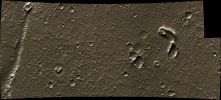
PSP_001578_2000-MF-LXT.jpgFaulting in Amazonis Planitia (Natural Colors; credits: Dr M. Faccin & Lunexit)63 visiteThis HiRISE image is centered on a long "Strike-Slip Fault" on the Young Plains of the Amazonis Planitai Region.
The most famous example of a Strike-Slip Fault on Planet Earth is probably the San Andreas Fault in California.
The Plains of Amazonis, as seen here, show only a few large and medium-sized craters, indicating that the Surface has been "remodeled" relatively recently.
The fact that the Fault visible here has cut the Plains, indicates that tectonic processes (as well as Marsquakes) have occurred even more recently (whereas that the word "recently", on Mars, is a relative term - since it is likely that both the Surface and the Fault are more than a billion years old.
Other interesting features that can be seen in this frame are "Moats" (---> fossi e fossati) - visible around Knobs (---> colline a ceppo) - and a few Impact Craters.MareKromium
|
|

PSP_010334_1760_RED.jpgYardangs in Southern Amazonis Planitia (natural colors; credits: Lunexit)75 visiteThis image shows Yardangs, or Ridges formed from wind abrasion, in the Southern Amazonis Planitia, which is located between the Tharsis and Elysium Volcanic Provinces on Mars.
Yardangs typically form in dry, desert environments with strong prevailing winds that are unidirectional and carry an abrasive sediment load. Abrasive winds erode the surface into parallel elongate landforms, or ridges, that are often three or more times longer than they are wide. When viewed from above, these landforms resemble the hull of a boat. Yardangs typically form in easily-eroded material, most likely sedimentary rock or volcanic ash deposits that contain some amount of sand. Sometime after the formation of these landforms, they were covered by a relatively thin, uniform coating of dust giving the area a monotone appearance. Dark slope streaks, interpreted as forming by avalanching of the dry dust, are visible on several of the slopes.
Yardangs are found on both Earth and Mars and are common on Mars in the Regions West and South-West of Olympus Mons, such as the area in this image in the southern Amazonis Planitia.MareKromium
|
|
|
|
| 10 immagini su 1 pagina(e) |
|








