| Risultati della ricerca nelle immagini - "Alba" |

Albategnius-1.jpgAlbategnius Crater (1)160 visiteAlabategnius: un grande cratere del diametro di circa 120 km e con pareti (o murate) che arrivano sino a 4000 mt. Le sue coordinate sono: Lat. 12° Sud e Long. 4° Est. La sua posizione è nella Regione Centrale della Luna, una Regione caratterizzata (in buona misura) da grandi bacini d'impatto.
Albateignus non è difficile da localizzare - leggermente ad Est del Cratere Ptolemaeus.
|
|

Albategnius-2.jpgAlbategnius Crater (2)149 visiteAlbategnius (Al-Battani, Muhammad ibn Jabir) (approx. 850-929)
--------------------------------------------------------------------------------
An Iraqi prince, born in Batan, Mesopotamia (Iraq), who was the leading Astronomer and Mathematician of his time. He drew up improved tables of the Sun and Moon, measured the eccentricity of Earth’s orbit and the inclination of Earth’s Equator to its orbital plane. He was capable of making an extremely accurate measurement of the length of the Earth year - which was also used in the Gregorian reform of the Julian Calendar. His observations at Rakku, made over (probably) a 40-year period, were summarized in his work "Movements of the Stars" (first published in Europe in 1537).
Thanks to his contribution, Johannes Hevelius (1611-1687) was able to theorize and discover the secular variation in the Moon’s motion.
|
|

Collapse_Features-PIA13734.jpgCollapse Features near Alba Mons (Absolute Natural Colors; credits for the additional process. and color.: Dr Paolo C. Fienga - Lunexit Team)112 visitenessun commentoMareKromium
|
|
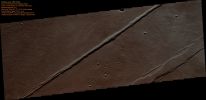
Graben-Alba_Mons-PIA13464-1.jpgGraben (CTX Frame - Absolute Natural Colors; additional process.: Dr Paolo C. Fienga - Lunexit Team)111 visitenessun commentoMareKromium
|
|
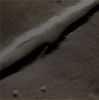
Graben-Alba_Mons-PIA13464-2.jpgUnusual Surface Feature on the edge and inside the Graben (EDM - Absolute Natural Colors; additional process.: Dr Paolo C. Fienga - Lunexit Team)139 visitenessun commentoMareKromium
|
|

PSP_001510_2195_RED_abrowse.jpgAlba Patera (Natural Colors; credits: Lunexit)63 visiteThis HiRISE image shows a small portion of the Rim of the Caldera at the top of the Volcano Alba Patera. This Volcano has shallower slopes than most of the other large Volcanoes on Mars. Unfortunately, this image is not able to help us understand what is unique about Alba Patera because of the thick Dust Cover that covers almost every surface detail but, instead, it shows that the Dust has been carved into streamlined shapes by the wind, cut by small Landslides.
Interestingly, there are some isolated patches that appear smooth and undisturbed by the wind.MareKromium
|
|
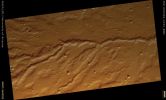
PSP_009369_2255_RED.jpgErosion on the Flank of Alba Patera (natural colors; credits: Lunar Explorer Italia)100 visiteMars Local Time: 15:15 (early afternoon)
Coord. (centered): 45,0° North Lat. and 243,2° East Long.
Spacecraft altitude: 295,0 Km (such as about 184,4 miles)
Original image scale range: 29,5 cm/pixel (with 1 x 1 binning) so objects ~89 cm across are resolved
Map projected scale: 25 cm/pixel
Map projection: EQUIRECTANGULAR
Emission Angle: 0,4°
Phase Angle: 44,3°
Solar Incidence Angle: 44° (meaning that the Sun is about 46° above the Local Horizon)
Solar Longitude: 104,0° (Northern Summer)
Credits: NASA/JPL/University of Arizona
Additional process. and coloring: Lunar Explorer ItaliaMareKromium
|
|
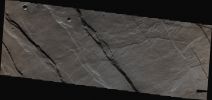
Volcanic_Features-Fractures-AM-PIA16499-PCF-LXTT-IPF.jpgFractures near and around Alba Mons (Absolute Natural Colors; credits for the additional process. and color.: Dr Paolo C. Fienga - Lunar Explorer Italia - Italian Planetary Foundation)86 visiteIn addition to its great size (consider that its Lava Flow Fields extend from over than 1400 Km from the Summit) and relatively low relief (the Summit of the Volcano reaches an elevation of "only" 6,8 Km as to the surrounding Lava Plains), Alba Mons possesses a number of other very distinguishing features. For instance, the central portion of the Volcano is surrounded by an incomplete Ring of Faults (---> Graben) and Fractures (like the ones that we see in today's APOD), called Alba Fossae (the ones located on the Volcano's Western Flank), and Tantalus Fossae (which are found on its Eastern Flank).
Alba Mons also has very long and well preserved Lava Flows that form a Radiating Pattern, starting from its Central Region. The enormous lengths of some individual Flow (something more than 300 Km - such as about 190 miles) implies that the Lavas which formed them were not only very fluid (---> meaning that they possessed very Low Viscosity) at the time of the eruption, but that they also must have been erupted in an extremely high volume (---> quantity). Many of the Flows have distinctive morphologies, consisting of long, sinuous Ridges with discontinuous Central Lava Channels. The low areas between the Ridges (and particularly along the Alba's Northern Flank) show a branching pattern of shallow Gullies and Channels (---> Valley Networks) that likely formed by water runoff. Last, but not least, Alba Mons shows, among other things, some of the oldest, and most extensively exposed Deposits that can be found in the whole Volcanic District of Tharsis.
Orbit Number: 47503
Latitude: 45,2558° North
Longitude: 248,587° East
Instrument: VIS
Captured: August, 29th, 2012
This frame (which is an Original Mars Odyssey Orbiter b/w frame published on the NASA - Planetary Photojournal with the ID n. PIA 16499) has been additionally processed and then colorized in Absolute Natural Colors (such as the colors that a human eye would actually perceive if someone were onboard the NASA - Mars Odyssey Orbiter and then looked down, towards the Surface of Mars), by using an original technique created - and, in time, dramatically improved - by the Lunar Explorer Italia Team.MareKromium
|
|
| 8 immagini su 1 pagina(e) |
|








