| Risultati della ricerca nelle immagini - "Air" |

Craters-Airy_Crater-The_Prime_Meridian-0.JPGMars' Prime Meridian, such as: Longitude "0" (1 - Original NASA/MGS/MSSS CTX b/w Frame)86 visiteOn Earth, the Longitude of the Royal Observatory in Greenwich, England is defined as the "Prime Meridian" or the 0 point of Longitude. Locations on Earth are measured in degrees East or West from this position.
The Prime Meridian was defined by an International Agreement in 1884 as the position of the Transit Circle: a large telescope located in the Observatory's Meridian Building. The Transit Circle was built by Sir George Biddell Airy, the 7th Astronomer Royal, in 1850. While visual observations with Transit were the basis of navigation until the space age, it is interesting to note that the current definition of the Prime Meridian is in reference to orbiting satellites and Very Long Baseline Interferometry (VLBI) measurements of distant radio sources such as quasars.
However, said "International Reference Meridian" is now about 100 mt East of the Transit Circle at Greenwich.
For Mars, the Prime Meridian was first defined by German astronomers W. Beer and J. H. Mädler in 1830-32.
|
|

Craters-Airy_Crater-The_Prime_Meridian-1.JPGMars' Prime Meridian, such as: Longitude "0" (2 - Original NASA/MGS/MSSS CTX b/w Frame)92 visiteBeer and Mädler used a small circular feature, which they designated "a" as a reference point to determine the rotation period of Mars. The Italian astronomer G. V. Schiaparelli, in his 1877 map of Mars, used this feature as the 0 point of Longitude. It was subsequently named Sinus Meridiani ("Middle Bay") by Camille Flammarion.
When Mariner 9 mapped the Planet at about 1 Km (0,62 mile) resolution in 1972, an extensive control net of locations was computed by Merton Davies of the RAND Corporation. Davies designated a 0,5-Km-wide crater, subsequently named Airy-0 (within the large crater Airy in Sinus Meridiani) as the Longitude 0 point.
Airy-0 was imaged once by Mariner 9 and once by the Viking 1 orbiter in 1978, and these 2 images were the basis of the Martian Longitude System for the rest of the 20th Century. The MGS has attempted to take a picture of Airy-0 on every close overflight since the beginning of the mapping of Mars.
|
|
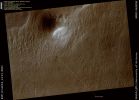
ESP_014264_2235_RED_abrowse-00.jpgSigns of a possible (and recent) "Mid-Air Meteor Strike" (CTX Frame - Natural Colors; credits: Lunexit)71 visitenessun commentoMareKromium
|
|
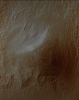
ESP_014264_2235_RED_abrowse-01.jpgSigns of a possible (and recent) "Mid-Air Meteor Strike" (EDM - Natural Colors; credits: Dr G. Barca & Lunexit)78 visiteIn questo EDM, ottimamente curato - come sempre - dal nostro Dr Barca, si può vedere l'evidente "scurimento" (che qualcuno potrebbe anche chiamare "bruciatura") del suolo, senza che però sia possibile scorgere un (anche di modestissime dimensioni) cratere da impatto.
Questa situazione (bruciatura del suolo, presenza di veri detriti di origine indeterminabile e mancanza di cratere) abbiamo deciso di battezzarla come "Mid-Air Meteor Strike", ossìa effetto di collisione meteorica avvenuta a mezz'aria (ergo, SENZA impatto - se non altro nel senso più tecnico della parola).
Una curiosità: la NASA ha classificato/titolato questo frame come "New Crater with Ice". Curioso: poichè noi non riusciamo a vedere nè il cratere in questione (tantomeno un cratere che sia "new"...), nè il ghiaccio (il quale, vista la Latitudine di cui si parla, comunque risulterebbe difficilmente visibile in superficie - se non altro in assenza di nevicate recenti).
Cosa ne pensiamo? Che anche alla NASA sbagliano...MareKromium
|
|

OPP-SOL001-1P128287557EFF0000P2303L2M1.jpgAir-Bags' tracks near Opportunity (1)158 visiteLe caratteristiche tracce lasciate dagli Air-Bags che proteggevano il Rover Opportunity sono a pochi centimetri dall'occhio Dx della PanCam e la 'foto-ricordo' è inevitabile.
Non vennero spese molte parole per definire la stranezza di queste 'impronte' le quali, sin da subito, lasciarono presagire a qualche Ricercatore un pò 'visionario' la possibilità che il suolo di Marte non fosse esattamente 'arido' (anzi...).
Bene: noi Vi riproponiamo quei frames che furono rapidamente (e forse frettolosamente) abbandonati per guardare il resto del paesaggio. Giudicate Voi!
|
|

OPP-SOL001-1P128287837EFF0000P2303L2M1.jpgAir-Bags' tracks near Opportunity (2)148 visitenessun commento
|
|
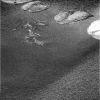
OPP-SOL003-1P128448954EFF0200P2213L2M1.jpgAir-Bags' tracks near Opportunity (3)146 visiteAncora qualche panoramica sulle impronte lasciate dagli airbags sulle sabbie di Eagle Crater. Il Filtro/colore usato per questa ripresa è il n. 2; la sabbia schiacciata dagli air-bags durante i rimbalzi sembra essere altamente riflettente (quasi 'luccicante'). E' un effetto ottico determinato - come spesso è accaduto - dal filtro/colore adottato? Forse si.
Nelle immagini a colori di queste impronte (vedi Sez. "Mars in Colors") la sabbia schiacciata dagli impatti sembra tutt'altro che luccicante (diremmo che appare color marrone scuro ed opaco, in netto contrasto con il color rosso - piuttosto vivo - del resto del paesaggio).
I dati che possediamo, come vedete, sono contraddittori; la NASA non ha chiarito e noi non possiamo fare altro che proporVi le immagini più interessanti, in maniera tale che possiate maturare una Vostra opinione. Il tempo ci dirà, forse, qualcosa di più.
|
|

OPP-SOL003-1P128449364EFF0200P2213R2M1.jpgAir-Bags' tracks near Opportunity (4)185 visiteUna ripresa ravvicinata e davvero spettacolare di una singola impronta lasciata da sul suolo Marziano dagli air-bags.
Essa è così netta e perfettamente disegnata sulla sabbia che, volendo, possiamo anche contare le cuciture che sono state fatte operate su uno di questi 'palloni para-urti' che hanno protetto - a dire il vero molto bene - il Rover durante il landing.
Inutile dire che, a nostro parere, su una sabbia secca ed arida quale potrebbe essere quella di un comune deserto terrestre, un'impronta del genere non sarebbe neppure immaginabile.
|
|

OPP-SOL006-1N128724268EFF0211P1527R0M1.jpgAirbags' Tracks - Sol 6104 visiteDue "Cartoline da Marte" che ci mostrano l'orizzonte di Meridiani Planum (sia quello prossimo, sia quello più lontano) così come appare agli occhi di Opportunity durante il Sol 6.
L'immagine è molto nitida e suggestiva; i dettagli del panorama che emergono li conoscete, comunque provate a notare come, a distanza di 6 Soles dal landing, le tracce lasciate dagli airbags sìano ancora splendidamente nette, precise e definite.
Le possibili cause?
1) una totale assenza di vento - e sappiamo che non è così -;
2) una totale mancanza di atmosfera - idem c.s.;
3)...sabbie "umide e fangose"?
|
|

OPP-SOL006-1N128724268EFF0211P1527R0M1.jpgAirbags' Tracks - Sol 6 (Absolute Natural Colors; credits for the additoonal process. and color.: Dr Paolo C. Fienga - Lunexit Team)227 visitenessun commentoMareKromium
|
|

OPP-SOL006-1N128724318EFF0211P1527L0M1.jpgAirbags' Tracks - Sol 697 visitenessun commento
|
|

OPP-SOL006-1N128724318EFF0211P1527L0M1.jpgAirbags' Tracks - Sol 6 (Absolute Natural Colors; credits for the additoonal process. and color.: Dr Paolo C. Fienga - Lunexit Team)220 visitenessun commentoMareKromium
|
|
| 22 immagini su 2 pagina(e) |
1 |
|








