| Risultati della ricerca nelle immagini - "Aeolis" |

Landslide_Deposits-20080423a-PCF-LXTT.jpgLandslide Deposits in Aeolis Planum (Natural Colors; credits: Dr Paolo C. Fienga - Lunexit Team)98 visitenessun commentoMareKromium
|
|

PSP_010494_1790_RED_abrowse.jpgMound in Aeolis (Natural Colors; credits: Lunar Explorer Italia)87 visiteMars Local Time: 15:40 (middle afternoon)
Coord. (centered): 1,1° South Lat. and 135,7° East Long.
Spacecraft altitude: 268,1 Km (such as about 167,6 miles)
Original image scale range: 53,6 cm/pixel (with 1 x 1 binning) so objects ~ 1,61 mt across are resolved
Map projected scale: 50 cm/pixel
Map projection: EQUIRECTANGULAR
Emission Angle: 0,0°
Phase Angle: 56,6°
Solar Incidence Angle: 57° (meaning that the Sun is about 33° above the Local Horizon)
Solar Longitude: 145,6° (Northern Summer)
Credits: NASA/JPL/University of Arizona
Additional process. and coloring: Lunar Explorer ItaliaMareKromium
|
|
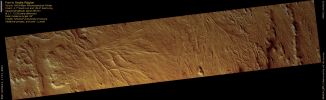
Psp_009623_1755_red.jpgFan in Aeolis Planum Region (natural colors; credits: Lunexit)93 visiteThis image shows a "Fan" of long raised ridges in the Aeolis Region of Mars.
These ridges are thought to be Inverted Stream Channels, where formerly low-lying streambeds have been hardened and then turned into ridges when the surrounding material was eroded.
This can occur if the stream deposited minerals, filling in pore spaces and hardening the streambed.
The assortment of ridges here is extremely complex, with strands cutting across each other. However, the actual stream system here could have been simpler, with ridges preserving different time periods in the history of the system. This possibility is supported by several sites where one ridge runs smoothly across another without disruption. One way for this to occur would be to have one streambed hardened and buried, with the stream subsequently changing course and cutting across its buried old route.
Although not all of the channels were active at once, this site clearly preserves a complex history, probably requiring thousands of years to foMareKromium
|
|
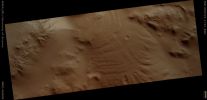
Psp_009729_1735_red.jpgTerraced Fan in Aeolis Planum Region (possible True Colors; credits: Lunar Explorer Italia)82 visiteThis image shows the South-Western Region of a degraded crater’s floor, located near the Equator. The high-standing ridge near the left side of the scene is a terrace that slumped off the crater’s rim (located to the far left of this frame, but out of the image). The bumpy terrain near the bottom of the image is also material that has slumped off the crater rim.
The center of the image contains a terraced fan. The fan emanates from a valley (not pictured, located in the lower part of the scene) that intersects the crater’s south rim, which suggests that the valley might have transported fluid, likely water, into the crater. If this happened, then the fan marks where the flow deposited its sediment.
Mars Local Time: 15:29 (early afternoon)
Coord. (centered): 6,5° South Lat. and 141,2° East Long.
Spacecraft altitude: 266,7 Km (such as about 166,7 miles)
Original image scale range: 26,7 cm/pixel (with 1 x 1 binning) so objects ~80 cm across are resolved
Map projected scale: 25 cm/pixel
Map projection: EQUIRECTANGULAR
Emission Angle: 6,2°
Phase Angle: 63,8°
Solar Incidence Angle: 59° (meaning that the Sun is about 31° above the Local Horizon)
Solar Longitude: 116,8° (Northern Summer)
Credits: NASA/JPL/University of Arizona
Additional process. and coloring: Lunar Explorer ItaliaMareKromium
|
|
| 4 immagini su 1 pagina(e) |
|








