| Risultati della ricerca nelle immagini - "Abalos" |

ESP_018011_2565_RED_abrowse.jpgBetween Abalos and Olympia Undae... (Absolute Natural Colors; credits: Dr Paolo C. Fienga - Lunexit Team)67 visiteThis HiRISE image shows some large Sand Dunes near the North Pole of Mars. The picture was taken in summertime, with only small patches of ice remaining on the Surface: this show up as bright, somewhat blue, spots on slopes that provide some shading from the Sun.
Geologists would classify these Dunes as "sand-starved" because the ground between the Dunes has almost no sand; in addition, this ground shows a pattern of cracks that is typical of icy permafrost undergoing through seasonal expansion and contraction.
It is also possible that some Subsurface Ice exists inside the Dunes themselves; if so, the Dunes are not currently moving, and the ice is acting as a "stabilizer".
This idea is supported by the observation that there are small Landslide Gullies being cut into the Dunes, something not seen if the Dunes are rejuvenated as they move in the wind. However, to test this idea this area has been repeatedly imaged by multiple cameras on different spacecrafts.
With meticulous care it will be eventually possible to determine just how much the Dunes have moved or changed over the past years.MareKromium
|
|
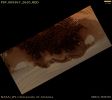
PSP_009367_2620_RED.jpgAeolian Source Layers exposed in Northwestern Abalos Scopuli (possible True Colors; credits: Lunar Explorer Italia)83 visiteMars Local Time: 14:25 (early afternoon)
Coord. (centered): 81,7° North Lat. and 282,6° East Long.
Spacecraft altitude: 320,1 Km (such as about 200,1 miles)
Original image scale range: 32 cm/pixel (with 1 x 1 binning) so objects ~96 mt across are resolved
Map projected scale: 25 cm/pixel
Map projection: EQUIRECTANGULAR
Emission Angle: 5,7°
Phase Angle: 54,5°
Solar Incidence Angle: 59° (meaning that the Sun is about 31° above the Local Horizon)
Solar Longitude: 103,9° (Northern Summer)
Credits: NASA/JPL/University of Arizona
Additional process. and coloring: Lunar Explorer ItaliaMareKromium
|
|
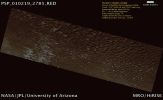
PSP_010219_2785_RED_abrowse-00.jpgDunes in Abalos Undae (ctx frame - possible True Colors; credits: Lunexit)66 visiteThe Abalos Undae Dunefield stretches westward, away from a portion (Abalos Colles) of the ice-rich North Polar Layered Deposits that is separated from the main Planum Boreum dome by two large chasms (---> abissi, crepacci).
These dunes are special because their sands may have been derived from erosion of the Rupes Tenuis unit (the lowest stratigraphic unit in Planum Boreum, beneath the icier layers) during formation of the chasms.
Some researchers have argued that these chasms were formed partially by melting of the polar ice.MareKromium
|
|
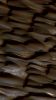
PSP_010219_2785_RED_abrowse-01.jpgDunes in Abalos Undae (edm - possible True Colors; credits: Lunexit)67 visiteThis enhanced-color close-up (1,2 Km across) shows an example of dunes in Abalos Undae.
The enhanced color data illuminate differences in composition: the dunes appear of a green/bluish color because of their basaltic composition, while the reddish-white areas are probably covered in dust and residual ice. Upon close inspection, tiny ripples and grooves are visible on the surface of the dunes (both ripples and grooves are formed by wind action, as are the dunes themselves).
It is possible that these dunes are no longer migrating (the process of dune formation forces dunes to move in the direction of the main winds) and that the tiny ripples are the only active parts of the dunes today.MareKromium
|
|
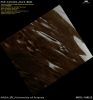
PSP_010369_2625_RED_abrowse.jpgDunes and Brown-Orange Streaks in Abalos Mensa (ctx frame - Natural Colors; credits: Lunexit)65 visitenessun commentoMareKromium
|
|
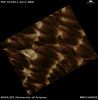
PSP_010501_2615_RED_abrowse.jpgAbalos Undae (Natural Colors; credits: Lunar Explorer Italia)83 visiteMars Local Time: 14:25 (early afternoon)
Coord. (centered): 81,6° North Lat. and 279,6° East Long.
Spacecraft altitude: 318,7 Km (such as about 199,2 miles)
Original image scale range: 63,8 cm/pixel (with 1 x 1 binning) so objects ~ 1,91 mt across are resolved
Map projected scale: 50 cm/pixel
Map projection: EQUIRECTANGULAR
Emission Angle: 0,1°
Phase Angle: 69,6°
Solar Incidence Angle: 70° (meaning that the Sun is about 20° above the Local Horizon)
Solar Longitude: 145,8° (Northern Summer)
Credits: NASA/JPL/University of Arizona
Additional process. and coloring: Lunar Explorer ItaliaMareKromium
|
|
|
|
| 6 immagini su 1 pagina(e) |
|








