| Risultati della ricerca nelle immagini - "9" |

00-Titan.JPGTitan in possible True Colors (credits: NASA)61 visiteAttraverso l’oculare di un (anche) modesto telescopio, Titano, il più grande satellite naturale del pianeta Saturno, appare come un corpo puntiforme che splende debolmente di un delicato color giallo-pallido.
Si tratta di un oggetto celeste reso affascinante dalla sua posizione – apparentemente assai prossima – rispetto al Gigante Anellato (la sua distanza angolare da Saturno non supera mai i 20 raggi saturniani), ma certo non si può dire che Titano, in sé, riesca a suggerire particolari interessi e curiosità visive, anzi: nessun rilievo superficiale di questo Mondo, infatti, risulta discernibile nelle osservazioni effettuate da Terra (nemmeno usando le più sofisticate ed avanzate tecniche fotografiche) e, come abbiamo appreso grazie alle immagini ottenute dalle Sonde Voyager prima e dall’Orbiter Cassini poi, anche da distanza (relativamente) ravvicinata questo mondo risulta alquanto indecifrabile (anche se occorre dire che, già dalla metà degli Anni ’70, l’effettuazione di una serie di osservazioni ripetute di Titano – effettuate usando i più grandi telescopi terrestri al tempo disponibili – aveva, peraltro correttamente, suggerito agli Astronomi una sostanziale NON uniformità, in termini di albedo, della sua superficie la quale venne ben interpretata, sin d’allora, come indice della possibile presenza di aree superficiali sensibilmente disomogenee ed equiparabili a continenti).
MareKromium
|
|

040-vg1_3493350.jpgMimas' Miscellanea of Misteries75 visitenessun commento
|
|

101955-Bennu-000.gif101955 Bennu - Full Rotation (GIF-Movie)72 visiteCaption NASA"This series of images taken by the OSIRIS-REx Spacecraft shows Asteroid 101955 Bennu in one full rotation from a distance of about 50 miles (such as approx. 80 Km).
The Spacecraft’s PolyCam Camera obtained the thirty-six 2,2-millisecond frames over a period of 4 hours and 18 minutes".MareKromium
|
|

101955-Bennu-001.gif101955 Bennu - North Polar Rotation (GIF-Movie)66 visiteCaption NASA:"This series of MapCam images was taken over the course of about 4 hours and 19 minutes on Dec. 4, 2018, as OSIRIS-REx made its first pass over 101955 Bennu’s North Pole.
The images were captured as the Spacecraft was inbound toward 101955 Bennu, shortly before its closest approach of the Asteroid’s Pole.
As the Asteroid rotates and grows larger in the field of view, the range to the center of 101955 Bennu shrinks from about 7,1 to 5,8 miles (such as about 11,4 to 9,3 Km).
This first pass was one of the five Flyovers of 101955 Bennu’s Poles and Equator that OSIRIS-REx conducted during its Preliminary Survey of the Asteroid".MareKromium
|
|

101955-Bennu-005.jpg101955 Bennu - What a World!!! (image-mosaic)84 visiteCaption NASA:"This mosaic image of Asteroid 101955 Bennu is composed of 12 PolyCam images collected on Dec. 2, 2018, by the OSIRIS-REx Spacecraft from a range of about 15 miles (such as a little more than 24 Km).
The image was obtained at a 50° Phase Angle (i.e.: the Angle formed by the Spacecraft, the Asteroid and the Sun) and 101955 Bennu spans approximately 1500 pixels in the camera’s field of view".MareKromium
|
|

101955-Bennu-011.jpg101955 Bennu - Boulderland72 visiteCaption NASA:"An abundance of Boulders litters the Surface of the Asteroid 101955 Bennu in this dramatic close-up from the OSIRIS-REx Spacecraft.
Taken on March 28 from a distance of just 3,4 Km (approx. 2,1 miles) the field of view is about 50 meters across while the light colored boulder at top right is about 4,8 meters tall.
Likely a loose conglomerate rubble pile Asteroid, Bennu itself spans less than 500 meters. That's about the height of the Empire State Building.
Mapping the near Earth Asteroid since the Spacecraft's arrival in December of 2018, the OSIRIS-REx mission plans a TAG (Touch-and-Go) maneuver for July 2020 to sample Bennu's rugged Surface, returning the sample to planet Earth in September 2023. Citizen scientists have been invited to help choose the sample collection site". MareKromium
|
|

101955-Bennu-011.png101955 Bennu - Just like Itokawa (Natural Colors; credits for the additional process. and color.: E. Bonora & Marco Faccin)217 visiteNotate la posizione "anomala" e "sporgente" dei mega-boulders (mega-macigni) visibili. Bizzarro, vero?!? La "causa" della nascita di 101955 Bennu? Aggregazione Gravitazionale di detriti. Così come Itokawa. Asteroidi fragili, polverosi e senza crateri. Ere di "lavoro" (miliardi di anni terrestri) e questo ne é un (altro esempio di) risultato.MareKromium
|
|
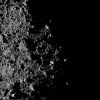
101955-Bennu-North_Pole-010.png101955 Bennu - North Polar Terminator64 visiteCaption NASA:"This image shows a Region near asteroid Bennu’s North Pole on the Terminator Line (such as the line between the Asteroid’s day and night sides).
The OSIRIS-Rex Spacecraft’s MapCam camera obtained the image on Feb. 20, 2019 while in orbit around the Asteroid from a distance of approx. 1,1 miles (such as about 1,8 Km).
At this distance, each pixel covers approximately 4,5" (---> inches, such as about 12 cm) of 101955 Bennu’s Surface. The largest Boulder, located slightly left (Sx) of the center, measures around 52 feet (approx. 16 meters) across, which, for scale, is the length of the trailer on a semi-truck.
During the Mission’s Orbital Phase, OSIRIS-REx circled the Asteroid near 101955 Bennu’s Terminator Line. While this positioning helped to maintain the Spacecraft in a stable orbit, the half-light/half-dark view of it created challenging conditions for science imaging".MareKromium
|
|
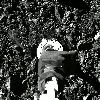
101955-Bennu-Z-Landing-GIF_Movie.gifThe Landing on 101955 Bennu134 visiteCaption NASA:" On October 20, 2020, after a careful approach to the boulder-strewn Surface, the OSIRIS-REx Spacecraft's arm reached out and touched Asteroid Bennu.
Dubbed a Touch-And-Go (TAG) sampling event, the 30 cm wide sampling head (TAGSAM) appears to crush some of the rocks in this snapshot. The close-up scene was recorded by the spacecraft's SamCam some 321 million kilometers from planet Earth, just after surface contact.
One second later, the Spacecraft fired Nitrogen gas from a bottle intended to blow a substantial amount of Bennu's regolith into the sampling head, collecting the loose surface material. Data show the Spacecraft spent approximately 5 more seconds in contact with Bennu's Nightingale sample site and then performed its back-away burn. Timelapse frames from SamCam reveal the aftermath". MareKromium
|
|
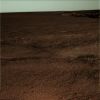
112-OPP-SOL1019-1P218649755EFF7700P2435L2M1~0.jpgAbsolute Victoria - Sol 1019 (Absolute Natural Colors; credits: Dr Paolo C. Fienga - Lunexit Team)56 visitenessun commentoMareKromium
|
|

40-vg1_p21227c.jpgClosing-up on a "Restless World" (1 - Natural Colors; credits: NASA/JPL-Caltech)58 visitenessun commento
|
|

41-vg1_p21286.jpgClosing-up on the restless World (Extremely Enhanced Natural Colors; credits: NASA/JPL-Caltech)63 visitenessun commento
|
|
| 1225 immagini su 103 pagina(e) |
1 |
 |
|
|
|
|
|
|
|
|
|





