| Risultati della ricerca nelle immagini - "21" |

162173-Ryugu-000.jpg162173 Ryugu121 visiteLe caratteristiche superficiali di questo Asteroide della "Classe Apollo" lo rendono incredibilmente simile ad ALMENO altri due Asteroidi che ben conosciamo: 25143 Itokawa e 101955 Bennu. Tutti (almeno in teoria...) formatisi per "aggregazione gravitazionale di corpuscoli".
Interessanti, per tanti motivi. Ma soprattutto perché sono, di fatto, degli Asteroidi quasi completamente identici: nessun Cratere da Impatto e Boulders "enormi" ben visibili nelle loro immagini di profilo (tipo "Skyline").
A questo punto bisogna ammettere che i Tecnici della JAXA (l'Agenzia Spaziale Giapponese) hanno un "occhio" ed una "mira" davvero eccezionali! Chissà, oltre le dichiarazioni di facciata, che cosa stanno cercando... Volete un'ipotesi? Magari l'Origine della Vita sulla Terra. Oppure le modalità attraverso le quali questi Asteroidi non solo si formano, ma poi "sopravvivono", nonostante la loro "fragilità", alle Onde Gravitazionali (vedi: Limite di Roche) ed alle Ere (e qui parliamo di miliardi di anni).MareKromium
|
|
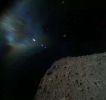
162173-Ryugu-001.jpg162173 Ryugu - Sunlit, and almost Sunstruck...123 visitenessun commentoMareKromium
|
|

162173-Ryugu-002.jpg162173 Ryugu - Wow! The shadow of Hayabusa 2125 visitenessun commentoMareKromium
|
|

162173-Ryugu-003.jpg162173 Ryugu - What a Shadow!!!114 visitenessun commentoMareKromium
|
|

162173-Ryugu-005.jpg162173 Ryugu - From the Surface120 visitenessun commentoMareKromium
|
|

162173-Ryugu-006.jpg162173 Ryugu103 visite...ma non Vi sembra di aver già visto qualcosa del genere?!?... Osservate BENE!!!...MareKromium
|
|

162173-Ryugu-020.png162173 Ryugu - Orbital Pattern131 visiteNella Nomenclatura Ufficiale, 162173 Ryugu è un Asteroide appartenente alla cosiddetta "Classe Apollo" (ossia una serie di Asteroidi prossimi alla Terra - Near-Earth - caratterizzati da un'orbita avente un Semiasse Maggiore superiore ad una U.A. - Unità Astronomica, e cioé la distanza media fra la Terra ed il Sole, vale a dire circa 150 MKM) ed un Perielio inferiore ad 1,017 U.A.
Scoperto nell'AD 1999, Ryugo presenta un'orbita caratterizzata da un Semiasse Maggiore pari a 1,189 U.A. e da un'eccentricità di 0,190, inclinata di 5,88405° rispetto all'Eclittica.
Le sue caratteristiche orbitali lo qualificano come "oggetto potenzialmente pericoloso" per la Terra ed esso è stato selezionato come obiettivo della missione Hayabusa 2 della JAXA, la quale prevede di recuperare alcuni campioni dall'Asteroide e riportarli sulla Terra. MareKromium
|
|

APOLLO 17 AS 17-140-21391.jpgAS 17-140-21391 - The Man on the Moon (detail mgnf)66 visite
|
|

Lutetia-05-CTX-EDM-PCF-LXTT-IPF.jpgAsteroid 21-Lutetia (CTX Frame and EDM - Absolute Natural Colors; credits for the additional process. and color.: Dr Paolo C. Fienga - Lunexit Team)167 visite21 Lutetia is a relatively large Main-Belt Asteroid, measuring about 100 Km in diameter (approx. 120 km along its Major Axis). It was discovered in the AD 1852 by the French-German Astronomer Hermann Goldschmidt, and is named after Lutetia, such as the Latin name of the city that stood where Paris was later built. The Asteroid 21 Lutetia has an irregular shape and is heavily cratered, with the largest Impact Crater reaching about 45 Km in diameter.
The Surface of this Asteroid is geologically heterogeneous and it is intersected by a system of Grooves and Scarps, which are thought to be the external manifestation of deep, internal, Fractures; it also possess an high Average Density, which could have meant that is (likely) made of Iron and Nickel rich Rock (even though, as we shall better see later on, this - however logical - claim, is still unproven). The ESA - Rosetta Probe passed as close as about 3162 Km (approx. 1965 miles) from 21 Lutetia in July 2010 and, at the time of Rosetta's Fly-By, it was the largest Asteroid ever visited by a Spacecraft (that, until the NASA - Dawn Spaceraft arrived at 4 Vesta, in July 2011).
The composition of 21 Lutetia has puzzled astronomers for some time, and that is because, while classified among the M-type Asteroids, most of which are Metallic (better yet: rich of Metallic Minerals/Elements), 21 Lutetia must be one of the so-called Anomalous Members of this classification, since it does not display much evidence of Metallic Minerals on its Surface. As a matter of fact, after most part of the data received from the Rosetta Probe were analyzed, several indications of a NON-Metallic Surface of this Asteroid were found, like, for instance, a flat, Low Frequency Spectrum (similar to that of Carbonaceous Chondrites and C-type Asteroids - which is, of course, deeply different from the one of the so-called Metallic Meteorites, such as those Meteorites which are logically believed to derive from a Metallic - such as, we repeat, Iron and Nickel-rich - Celestial Body), a low Radar Albedo (unlike the high Albedoes of Strongly Metallic Asteroids, like 16 Psyche), evidence of Hydrated Materials on its Surface, abundant Silicates, and a thicker layer of Regolith than most of the other known (as far as their composition is concerned) Asteroids.MareKromium
|
|
|
|
|
| 9 immagini su 1 pagina(e) |
|








