| Risultati della ricerca nelle immagini - "(or" |

APOLLO_12_AS_12-57-8455_HR.jpgAS 12-57-8455 (HR) - Soil surface NOT greatly disturbed by the LM descent engine exhaust68 visitenessun commento
|
|

North_Polar_Features-The_Erg-PCF-LXTT-3.jpgNorth Polar Erg (Absolute Natural Colors; credits for the additional process. and color.: Dr Paolo C. Fienga - Lunexit Team)68 visiteCaption NASA:"A vast Region of sand dunes is located on the margin of the North Polar Cap of Mars. This 'sea' of sand is call "Polar Erg".
Coord.: 80,5° North Lat. and 183,5° East Long.
MareKromium
|
|

North_Polar_Features-The_Erg-PCF-LXTT-4.jpgNorth Polar Erg (Absolute Natural Colors; credits for the additional process. and color.: Dr Paolo C. Fienga - Lunexit Team)83 visiteCoord.: 73,8° North Lat. and 310,3° East Long.MareKromium
|
|
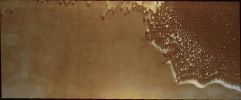
North_Polar_Features-The_Erg-PCF-LXTT-5.jpgVastitas Borealis and the North Polar Erg (Absolute Natural Colors; credits for the additional process. and color.: Dr Paolo C. Fienga - Lunexit Team)80 visiteCoord.: 76,5° North Lat. and 295,6° East Long.MareKromium
|
|
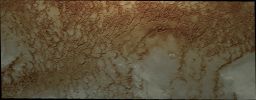
North_Polar_Regions-North_Polar_Erg-PCF-LXTT.jpgNorthern Dunes (Natural Colors; credits for the additional process. and color.: Dr Paolo C. Fienga - Lunexit Team)65 visiteCaption NASA:"This region of North Polar Dunes has less dune materials than other portions of the North Polar Erg. This allows the base (assumption) that the dunes are moving across to be observed".MareKromium
|
|
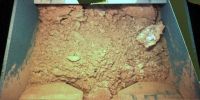
PHOE-SOL011-PIA10773.jpgArtificially illuminated Martian Soil - Sol 1192 visiteAvevamo visto giusto, quindi: quando il terriccio di Vastitas appare di una colorazione simile (giallo-arancio, arancio mattone ed arancio vivo) è perchè il "gruppo luce" di Phoenix sta lavorando. Leggete il commento NASA al riguardo:"NASA's Phoenix Mars Lander scooped up this Martian Soil on the mission's 11th Sol after landing (June 5, 2008) as the first soil sample for delivery to the laboratory on the lander deck.
The material includes a light-toned clod possibly from crusted surface of the ground, similar in appearance to clods observed near a foot of the Lander.
This approximately true-color view of the contents of the scoop on the Robotic Arm comes from combining separate images taken by the Robotic Arm Camera on Sol 11, using illumination by red, green and blue light-emitting diodes on the camera.
The scoop loaded with this sample was poised over an open sample-delivery door of Thermal and Evolved-Gas Analyzer at the end of Sol 11, ready to be dumped into the instrument on the next Sol".MareKromium
|
|
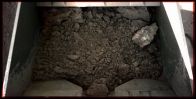
PHOE-SOL011-lg_3181.JPGMore ICE and "greenish" Soil - Sol 11 (Superdefinition; credits: Dr Marco Faccin)77 visiteAncora un'immagine in Superdefinizione che ci riporta ai VERI colori di Marte ed alla EFFETTIVA texture della superficie di Vastitas: insomma, un nuovissimo piccolo-Grande Capolavoro del Dr Faccin.MareKromium
|
|
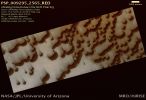
PSP_009295_2565_RED.jpgAbrading Dunes in the North Polar Erg (natural colors; credits: Lunexit)66 visiteThis location is where Mars Global Surveyor (a.k.a.: MGS) saw evidence of dunes that either shrank or completely disappeared over a span of a few years. HiRISE provides new details at higher resolution.
As seen here, the dunes show clear evidence of erosion.
Based on the shape of the dunes in this picture, the strongest winds have blown from the upper right (South-East) to lower left (North-West).
Streamers of dark sand are visible on the white, frost-covered surface downwind of the dunes. This is particularly prominent at the “horns” of the barchan dunes (these are the dunes with the prominent points at their edges).
Scientists believe these dunes are cemented, by ice, such that the wind is progressively eroding them over time. Future observations by HiRISE will determine if the dunes shrink as indicated by MGS, or maybe even migrate, over time.MareKromium
|
|

PSP_009396_2590_red.jpgDefrosted Margin of the North Polar Erg (natural colors; credits: Lunexit)66 visiteThis image shows a traverse across a section of the North Polar Erg, a vast Sea of Sand that surrounds the Polar Cap.
The source of the dunes may be from the eroding North Polar Layered Deposits. Wind, acting on this mixture of sand, dust and ice, has formed several dune types on top of bright megaripples and polygons. A dark mantle of sand lies beyond the dunes.
The central part of the field contains transverse dunes with the dominant wind direction coming from the North/West-West. The outer edges of the Dunefield transition into "Star Dunes" (with multiple arms) and "Barchanoid Dunes" (crescent-like shape). The Star Dunes indicate a multidirectional wind regime or a change in wind direction over the Dunefield’s evolution.
The dunes are somewhat confined to their location and may have taken hundreds of years to form.MareKromium
|
|
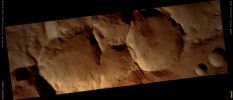
Psp_009572_1620_red.jpgSecondary Craters in Hesperia Planum (Enhanced and Saturated Natural Colors; credits for the additional process. and color.: Dr Paolo C. Fienga - Lunar Explorer Italia)72 visiteMars Local Time: 15:33 (middle afternoon)
Coord. (centered): 17,7° South Lat. and 109,6° East Long.
Spacecraft altitude: 257,5 Km (such as about 160,9 miles)
Original image scale range: 25,8 cm/pixel (with 1 x 1 binning) so objects ~77 cm across are resolved
Map projected scale: 25 cm/pixel
Map projection: EQUIRECTANGULAR
Emission Angle: 3,8°
Phase Angle: 63,7°
Solar Incidence Angle: 66° (meaning that the Sun is about 24° above the Local Horizon)
Solar Longitude: 111,1° (Northern Summer)
Credits: NASA/JPL/University of Arizona
Additional process. and coloring: Lunar Explorer Italia
Nota Lunexit: la caption NASA originale titola la foto "Fresh or Well-Preserved Chain of Impact Craters". A nostro avviso, le features di questo frame NON sono rappresentative di Crateri da Impatto Primari bensì - ed al limite - da Crateri da Impatto Secondari (è la loro forma, infatti, alquanto irregolare e squadrata, che ci suggerisce di escludere l'ipotesi per cui si tratti di Primary Impact Craters).MareKromium
|
|

ZZ-ZZ-ZZ-ZZ-ZZ-ZZ-ZZ-ZZ-ZZ-ZZ-ZZ-ZZ-APOLLO 17 AS 17-136-20856 HR-3.jpgAS 17-136-20856 (HR-2) - Strange things...136 visite...Secondo noi questo "oggetto" potrebbe e dovrebbe essere un mero photoartifact ma...Come fare ad averne la certezza? In fondo, poi, a ben guardare, ci ricorda addirittura lo 'space debris' ritratto in un famosissimo frame Apollo 10.
Che dire? Noi Vi proponiamo le immagini. Il resto...è nelle mani della NASA e della Vostra buona volontà.
|
|
|
| 11 immagini su 1 pagina(e) |
|








