| Risultati della ricerca nelle immagini - "(craters)" |

030-The Moon from Clem-Copernicus.jpg054 - Copernicus77 visiteCopernicus is a rayed crater, 97 Km in diameter, that formed about 800 MY ago. In this image of the Crater Copernicus, color differences are shown for the eastern half of the crater.
A false-color mosaic is created by making ratio images and assigning each to one of the 3 primary colors: the red channel is controlled by the 750/415-nnmts ratio; the green channel is controlled by the 750/950-nnmts ratio and the blue channel is controlled by the 415/750-nnmts ratio.
|
|

040-The Moon from Clem-KeplerCrater-1.jpg151 - Kepler Crater74 visitenessun commento
|
|

043-The Moon from Clem-North Pole-2.jpg035 - Plaskett Crater (natural colors)77 visitePlaskett Crater ID:
Location: 82° North Lat. and 174° East Long.;
Dimension: about 110 Km in diameter
Interesting Features: the huge "central peak"
|
|

051-The Moon from Clem-Aristarchus.jpg043 - Aristarchus Plateau (natural colors)84 visiteA mosaic of more than 250 images showing the complex and diverse Aristarchus Region of the Moon in approximately natural colors (blue = 415 nanometers, green = 750 nanometers, red = 950 nanometers). The plateau is an uplifted block of complex, highland terrain, partly flooded by later mare basalt lavas. Dark, pyroclastic glasses partly cover the uplifted terrain. The crater Aristarchus (47 Km in diameter) has formed in the South-East corner of the plateau, excavating both highlands and mare rocks.
|
|
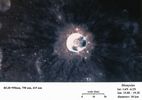
052-The Moon from Clem-Dionysus.jpg061 - Dionysius Crater (natural colors)73 visiteThe Crater Dionysius (3° North Lat. and, 17° East Long.; western edge of Mare Tranquillitatis; 18 Km in diameter) shows striking contrasts in albedo. The outside of the Crater is a very bright halo in its near-rim field, while farther out, darker material is exposed, including rare dark rays. Crater deposits on the left side of this mosaic are on light Cayley plains of highland composition, while deposits on the right side are on the basalts of Mare Tranquillitatis.
|
|

090-The Moon from Clem-KeplerCrater.jpg152 - Kepler Crater82 visitenessun commento
|
|

ZZ-B-APOLLO 15-ErathostenesA&B.jpgThe Lunar Domes: Erathostenes A & B329 visiteRingraziando, come sempre, gli Amici che ci hanno scritto, siamo felici di contribuire a risolvere una querelle - comunque molto interessante - che ci è stata proposta dall'Amico Fabio Italiano (alias "OldGrey") e relativa alle "Cupole Lunari" apparse nel frame AS 15-91-12403. Risponde il Dr Alessio Feltri:"...L'effetto ottico è dato dal fatto che l'orlo del cratere non è regolare.
Tra l'altro la pensilina, che ti avevo definito "coperchio", null'altro è che un ulteriore esempio di queste strane formazioni, in cui una parte dell'orlo si protende parzialmente sulla depressione sottostante. Nessuna astronave quindi, ma piuttosto delle geometrie di craterizzazione (molto) atipiche.
L'occasione è utile per rilevare come solo mettendo in dubbio il significato di un'immagine scontata sia possibile avvicinarsi al vero. Quello che dall'alto sembra un normale cratere, può non rivelarsi tale acquisendone un gran numero di immagini alternative, mentre ciò che sembra strano può rivelarsi normale. Come nel caso in questione...".
|
|

ZZ-C-APOLLO 15-ErathostenesA&B-2.jpgThe Lunar Domes: Erathostenes A & B & Wolff264 visitenessun commento
|
|
| 8 immagini su 1 pagina(e) |
|








