| |
| Risultati della ricerca nelle immagini - "(SST)" |

Cassiopeia_A-PIA11748.jpgSNR Cassiopeia "A"71 visiteFor the first time, a multiwavelength three-dimensional reconstruction of a SuperNova Remnant has been created. This stunning visualization of Cassiopeia A, or Cas A, the result of an explosion approximately 330 years ago, uses data from several telescopes: X-ray data from NASA's Chandra X-ray Observatory, InfraRed data from NASA's Spitzer Space Telescope and optical data from the National Optical Astronomy Observatory 4-meter telescope at Kitt Peak, Ariz., and the Michigan-Dartmouth-MIT 2.4-meter telescope, also at Kitt Peak. In this visualization, the green region is mostly Iron observed in X-rays. The yellow region is a combination of Argon and Silicon seen in X-rays, optical, and infrared — including jets of Silicon — plus outer debris seen in the optical. The red region is cold debris seen in the infrared. Finally, the blue reveals the outer blast wave, most prominently detected in X-rays.
Most of the material shown in this visualization is debris from the explosion that has been heated by a shock moving inwards. The red material interior to the yellow/orange ring has not yet encountered the inward moving shock and so has not yet been heated. These unshocked debris were known to exist because they absorb background radio light, but they were only recently discovered in infrared emission with Spitzer. The blue region is composed of gas surrounding the explosion that was heated when it was struck by the outgoing blast wave, as clearly seen in Chandra images.
To create this visualization, scientists took advantage of both a previously known phenomenon — the Doppler effect — and a new technology that bridges astronomy and medicine. When elements created inside a supernova, such as Iron, Silicon and Argon, are heated they emit light at certain wavelengths. Material moving towards the observer will have shorter wavelengths and material moving away will have longer wavelengths. Since the amount of the wavelength shift is related to the speed of motion, one can determine how fast the debris are moving in either direction.
Because Cas A is the result of an explosion, the stellar debris is expanding radially outwards from the explosion center. Using simple geometry, the scientists were able to construct a 3-D model using all of this information. A program called 3-D Slicer — modified for astronomical use by the Astronomical Medicine Project at Harvard University in Cambridge, Mass. — was used to display and manipulate the 3-D model. Commercial software was then used to create the 3-D fly-through.
The blue filaments defining the blast wave were not mapped using the Doppler Effect because they emit a different kind of light —synchrotron radiation — that does not emit light at discrete wavelengths, but rather in a broad continuum. The blue filaments are only a representation of the actual filaments observed at the blast wave.
This visualization shows that there are two main components to this supernova remnant: a spherical component in the outer parts of the remnant and a flattened (disk-like) component in the inner region. The spherical component consists of the outer layer of the star that exploded, probably made of helium and carbon. These layers drove a spherical blast wave into the diffuse gas surrounding the star.
The flattened component — that astronomers were unable to map into 3-D prior to these Spitzer observations — consists of the inner layers of the star. It is made from various heavier elements, not all shown in the visualization, such as Oxygen, Neon, Silicon, Sulphur, Argon and Iron.
High-velocity plumes, or jets, of this material are shooting out from the explosion in the plane of the disk-like component mentioned above. Plumes of Silicon appear in the North/East and South/West, while those of Iron are seen in the South/East and North. These jets were already known and Doppler velocity measurements have been made for these structures, but their orientation and position with respect to the rest of the debris field had never been mapped before now.
This new insight into the structure of Cas A gained from this 3-D visualization is important for astronomers who build models of supernova explosions. Now, they must consider that the outer layers of the star come off spherically, but the inner layers come out more disk-like with high-velocity jets in multiple directions.MareKromium
|
|

Centaurus_Region~0.jpgCentaurus Region64 visite"...Aquila muscas non captat..."
(Binder)
"...L'Aquila non cattura le mosche..."MareKromium
|
|

DR22.jpgCygnus Region (DR22; NGC 4145 and NGC 4361)69 visiteThese images are some of the first to be taken during Spitzer's warm mission -- a new phase that began after the telescope, which operated for more than five-and-a-half years, ran out of liquid coolant. The pictures were snapped with the two InfraRed Channels that still work at Spitzer's still-quite-chilly temperature of 30 Kelvin (about - 406 degrees Fahrenheit). The two InfraRed Channels are part of Spitzer's InfraRed Array Camera: 3.6-micron light is blue and 4.5-micron light is orange.
The main image shows a cloud, known as DR22, bursting with new stars in the Cygnus Region of the sky.
Spitzer's infrared eyes can see dust, and see through dust, giving it a unique view into star-forming nests. The blue areas are dusty clouds, and the orange is mainly hot gas.MareKromium
|
|

Galactic_Center-PIA12074.jpgNewborn Stars found near the Galactic Centre68 visiteThis InfraRed image from NASA's Spitzer Space Telescope shows 3 "baby stars" in the bustling center of our Milky Way galaxy.
The three stars are the first to be discovered in the region — previous attempts to find them were unsuccessful because there is so much dust standing between us and our galaxy's core.
Spitzer was able to find the newborn stars with its sharp InfraRed eyes, which can cut through dust.
The center of our galaxy is a hectic place. It's stuffed with stars, gas and dust. Astronomers have long wondered how stars can form in such chaotic circumstances. While they have known that stars are born there, they weren't able to see the stars forming until now. Astronomers plan to search for more newborn stars in the region, and ultimately learn more about stellar births at the center of the Milky Way.MareKromium
|
|

M-016-PIA09107.jpgM 16 - The "Eagle Nebula"65 visiteThis majestic view taken by NASA's Spitzer Space Telescope tells an untold story of life and death in the Eagle Nebula, an industrious star-making factory located 7000 L.Y. away in the Serpens constellation. The image shows the region's entire network of turbulent clouds and newborn stars in infrared light.
The color green denotes cooler towers and fields of dust, including the three famous space pillars, dubbed the "Pillars of Creation," which were photographed by NASA's Hubble Space Telescope in 1995 (see inset).
But it is the color red that speaks of the drama taking place in this region. Red represents hotter dust thought to have been warmed by the explosion of a massive star about 8,000 to 9,000 years ago. Since light from the Eagle nebula takes 7000 years to reach us, this "supernova" explosion would have appeared as an oddly bright star in our skies about 1000 to 2000 years ago.
According to astronomers' estimations, the explosion's blast wave would have spread outward and toppled the three pillars about 6,000 years ago (which means we wouldn't witness the destruction for another 1,000 years or so). The blast wave would have crumbled the mighty towers, exposing newborn stars that were buried inside, and triggering the birth of new ones.
The pillars of the Eagle nebula were originally sculpted by radiation and wind from about 20 or so massive stars hidden from view in the upper left portion of the image. The radiation and wind blew dust away, carving out a hollow cavity (center) and leaving only the densest nuggets of dust and gas (tops of pillars) flanked by columns of lighter dust that lie in shadow (base of pillars). This sculpting process led to the creation of a second generation of stars inside the pillars.
If a star did blow up in this region, it is probably located among the other massive stars in the upper left portion of the image. Its blast wave might have already caused a third generation of stars to spring from the wreckage of the busted pillars.
This image is a composite of infrared light detected by Spitzer's infrared array camera and multiband imaging photometer. Blue is 4.5-micron light; green is 8-micron light; and red is 24-micron light.
|
|

M-016-PIA09108.jpgThe many colors of the Eagle65 visiteThis set of images from NASA's Spitzer Space Telescope shows the Eagle Nebula in different hues of infrared light. Each view tells a different tale. The left picture shows lots of stars and dusty structures with clarity. Dusty molecules found on Earth called polycyclic aromatic hydrocarbons produce most of the red; gas is green and stars are blue.
The middle view is packed with drama, because it tells astronomers that a star in this region violently erupted, or went supernova, heating surrounding dust (orange). This view also reveals that the hot dust is shell shaped, another indication that a star exploded.
The final picture highlights the contrast between the hot, supernova-heated dust (green) and the cooler dust making up the region's dusty star-forming clouds and towers (red, blue and purple).
The left image is a composite of infrared light with the following wavelengths: 3.6 microns (blue); 4.5 microns (green); 5.8 microns (orange); and 8 microns (red). The right image includes longer infrared wavelengths, and is a composite of light of 4.5 to 8.0 microns (blue); 24 microns (green); and 70 microns (red). The middle image is made up solely of 24-micron light.
|
|

M-033-PIA11969.jpgM 33 - Spiral Galaxy (3-color composite)64 visiteOne of our closest galactic neighbors shows its awesome beauty in this new image from NASA's Spitzer Space Telescope. M 33, also known as the "Triangulum Galaxy", is a member of what's known as our Local Group of galaxies.
Along with our own Milky Way, this group travels together in the universe, as they are gravitationally bound. In fact, M 33 is one of the few galaxies that is moving toward the Milky Way despite the fact that space itself is expanding, causing most galaxies in the universe to grow farther and farther apart.
When viewed with Spitzer's InfraRed eyes, this elegant spiral galaxy sparkles with color and detail. Stars appear as glistening blue gems (several of which are actually foreground stars in our own galaxy), while dust rich in organic molecules glows green. The diffuse orange-red glowing areas indicate star-forming regions, while small red flecks outside the spiral disk of M 33 are most likely distant background galaxies. But not only is this new image beautiful, it also shows M 33 to be surprising large — bigger than its Visible-Light appearance would suggest.
With its ability to detect cold, dark dust, Spitzer can see emission from cooler material well beyond the visible range of M 33's disk. Exactly how this cold material moved outward from the galaxy is still a mystery, but winds from giant stars or supernovas may be responsible.
M 33 is located about 2,9 MLY away in the constellation Triangulum. This is a three-color composite image showing InfraRed observations from two of Spitzer instruments. Blue represents combined 3.6- and 4.5-micron light and green shows light of 8 microns, both captured by Spitzer's IRAC.
Red is 24-micron light detected by Spitzer's Multiband Imaging Photometer.MareKromium
|
|

M-033-PIA11970.jpgM 33 - Spiral Galaxy64 visiteOne of our closest galactic neighbors shows its awesome beauty in this new image from NASA's Spitzer Space Telescope.
M 33, also known as the "Triangulum Galaxy", is a member of what's known as our Local Group of galaxies. Along with our own Milky Way, this group travels together in the universe, as they are gravitationally bound.
In fact, M 33 is one of the few galaxies that is moving toward the Milky Way despite the fact that space itself is expanding, causing most galaxies in the universe to grow farther and farther apart.
When viewed with Spitzer's InfraRed eyes, this elegant spiral galaxy sparkles with color and detail. Stars appear as glistening blue gems (many of which are actually foreground stars in our own galaxy), while dust in the spiral disk of the galaxy glows pink and red. But not only is this new image beautiful, it also shows M 33 to be surprising large —bigger than its Visible-Light appearance would suggest.
With its ability to detect cold, dark dust, Spitzer can see emission from cooler material well beyond the visible range of M 33's disk. Exactly how this cold material moved outward from the galaxy is still a mystery, but winds from giant stars or supernovas may be responsible.
M 33 is located about 2,9 MLY away in the constellation Triangulum. This composite image was taken by Spitzer's InfraRed Array Camera (a.k.a.: IRAC). The color blue indicates InfraRed Light of 3.6 microns, green shows 4.5-micron light, and red 8.0 microns.MareKromium
|
|
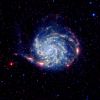
M-101-PIA10968.jpgM 101 - The "Pinwheel Galaxy"65 visiteThe Pinwheel Galaxy, otherwise known as Messier 101, sports bright reddish edges in this new infrared image from NASA's Spitzer Space Telescope. Research from Spitzer has revealed that this outer red zone lacks organic molecules present in the rest of the galaxy. The red and blue spots outside of the spiral galaxy are either foreground stars or more distant galaxies.
The organics, called Polycyclic Aromatic Hydrocarbons (PAH), are dusty, carbon-containing molecules that help in the formation of stars. On Earth, they are found anywhere combustion reactions take place, such as barbeque pits and exhaust pipes. Scientists also believe this space dust has the potential to be converted into the stuff of life.
Spitzer found that the PAH decrease in concentration toward the outer portion of the Pinwheel Galaxy, then quickly drop off and are no longer detected at its very outer rim. According to astronomers, there's a threshold at the rim where the organic material is being destroyed by harsh radiation from stars. Radiation is more damaging at the far reaches of a galaxy because the stars there have less heavy metals, and metals dampen the radiation.
The findings help researchers understand how stars can form in these harsh environments, where PAH are lacking. Under normal circumstances, the PAH help cool down star-forming clouds, allowing them to collapse into stars. In regions like the rim of the Pinwheel — as well as the very early universe — stars form without the organic dust. Astronomers don't know precisely how this works, so the rim of the Pinwheel provides them with a laboratory for examining the process relatively close up.
In this image, infrared light with a wavelength of 3,6 microns is colored blue; 8-micron light is green; and 24-micron light is red.
All three of Spitzer's instruments were used in the study: the infrared array camera, the multiband imaging photometer and the infrared spectrograph.MareKromium
|
|
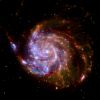
M-101-PIA11797.jpgM 10163 visiteIn 1609, Galileo improved the newly invented telescope, turned it toward the heavens, and revolutionized our view of the universe. In celebration of the 400th anniversary of this milestone, 2009 has been designated as the International Year of Astronomy.
Today, NASA's Great Observatories are continuing Galileo's legacy with stunning images and breakthrough science from the Hubble Space Telescope, the Spitzer Space Telescope, and the Chandra X-ray Observatory.
While Galileo observed the sky using visible light seen by the human eye, technology now allows us to observe in many wavelengths, including Spitzer's infrared view and Chandra's view in X-rays. Each wavelength region shows different aspects of celestial objects and often reveals new objects that could not otherwise be studied.
This image of the spiral galaxy Messier 101 is a composite of views from Spitzer, Hubble, and Chandra.
The red color shows Spitzer's view in infrared light. It highlights the heat emitted by dust lanes in the galaxy where stars can form.
The yellow color is Hubble's view in visible light. Most of this light comes from stars, and they trace the same spiral structure as the dust lanes.
The blue color shows Chandra's view in X-ray light. Sources of X-rays include million-degree gas, exploded stars, and material colliding around black holes.
Such composite images allow astronomers to see how features seen in one wavelength match up with those seen in another wavelength. It's like seeing with a camera, night vision goggles, and X-ray vision all at once.
In the four centuries since Galileo, astronomy has changed dramatically. Yet our curiosity and quest for knowledge remain the same. So, too, does our wonder at the splendor of the universe.
The International Year of Astronomy Great Observatories Image Unveiling is supported by the NASA Science Mission Directorate Astrophysics Division. The project is a collaboration between the Space Telescope Science Institute, the Spitzer Science Center, and the Chandra X-ray Center.
MareKromium
|
|

M-101-SST.jpgM 101 - Spiral Galaxy (a.k.a.: The "Pinwheel Galaxy")80 visite"...He brought him outside and said, "Look toward Haeven and count the Stars, if you are able to count them"..."
- Genesis 15:5MareKromium
|
|
N-49-PIA09071.jpgSupernova Remnant N 4984 visite"...I would like to inform all the intrepid Muslims in the World that the Author of the book entitled "The Satanic Verses", which has been compiled, printed and published in opposition to Islam, the Prophet and the Qur'an, as well as those publishers who were aware of its contents, have been declared madhur el dam (those whose blood must be shed). I call on all zealous Muslim to execute them quickly, wherever they find them, so that no-one will dare to insult Islam again. Whoever is killed in this path will be regarded as a martyr..."
Ruhollah Khomeini (1900 - 1989) - Fatwa against Salman Rushdie
"...Islam is a beautiful Religion (...) a true Religion of Peace and Tolerance; the only one..."
Mahmoud Ahmadinejad (current President of the Islamic Republic of Iran)
|
|
| 32 immagini su 3 pagina(e) |
1 |
|

|
|





