| |
| Risultati della ricerca nelle immagini - "(HST)" |

30-Doradus.jpg30 Doradus and R-13668 visiteThe massive, young stellar grouping, called R136, is only a few million years old and resides in the 30 Doradus Nebula, a turbulent star-birth region in the Large Magellanic Cloud (LMC), a satellite galaxy of our Milky Way. Many of the stars are among the most massive known. Several of them are over 100 times more massive than our Sun. These hefty stars are destined to become supernovae in a few million years.
The image, taken by Hubble's Wide Field Camera 3, spans about 100 light-years. The nebula is close enough to Earth that Hubble can resolve individual stars, giving astronomers important information about the stars' birth and evolution.
The brilliant stars are carving deep cavities in the surrounding material by unleashing a torrent of ultraviolet light, and hurricane-force stellar winds (streams of charged particles), which are etching away the enveloping hydrogen gas cloud in which the stars were born. The image reveals a fantasy landscape of pillars, ridges, and valleys, as well as a dark region in the center that roughly looks like the outline of a holiday tree. Besides sculpting the gaseous terrain, the brilliant stars can also help create a successive generation of offspring. When the winds hit dense walls of gas, they create shocks, which may be generating a new wave of star birth.
The movement of the LMC around the Milky Way may have triggered the massive cluster's formation in several ways. The gravitational tug of the Milky Way and the companion Small Magellanic Cloud may have compressed gas in the LMC. Also, the pressure resulting from the LMC plowing through the Milky Way's halo may have compressed gas in the satellite. The cluster is a rare, nearby example of the many super star clusters that formed in the distant, early universe, when star birth and galaxy interactions were more frequent. Previous Hubble observations have shown astronomers that super star clusters in faraway galaxies are ubiquitous. The LMC is located 170,000 light-years away and is a member of the Local Group of Galaxies, which also includes the Milky Way.
The Hubble image was taken at infrared wavelengths (1.1 microns and 1.6 microns). Hubble sees through the dusty nebula, revealing many stars that cannot be seen in visible light. The large bright star just above the center of the image is in the 30 Doradus nebula. The Hubble observations of 30 Doradus were made October 20-27, 2009.MareKromium
|
|

30-Doradus_and_R-136.jpg30 Doradus and R-13677 visiteJust in time for the holidays: a Hubble Space Telescope picture postcard of hundreds of brilliant blue stars wreathed by warm, glowing clouds. The festive portrait is the most detailed view of the largest stellar nursery in our local galactic neighborhood. The massive, young stellar grouping, called R136, is only a few million years old and resides in the 30 Doradus Nebula, a turbulent star-birth region in the Large Magellanic Cloud (LMC), a satellite galaxy of our Milky Way. There is no known star-forming region in our galaxy as large or as prolific as 30 Doradus. Many of the diamond-like icy blue stars are among the most massive stars known. Several of them are over 100 times more massive than our Sun. These hefty stars are destined to pop off, like a string of firecrackers, as supernovas in a few million years.
The image, taken in ultraviolet, visible, and red light by Hubble's Wide Field Camera 3, spans about 100 light-years. The nebula is close enough to Earth that Hubble can resolve individual stars, giving astronomers important information about the birth and evolution of stars in the universe. The Hubble observations were taken Oct. 20-27, 2009. The blue color is light from the hottest, most massive stars; the green from the glow of oxygen; and the red from fluorescing hydrogen.MareKromium
|
|

ARP-147.jpgARP 14773 visiteJust a couple of days after the orbiting observatory was brought back online, Hubble aimed its prime working camera, the Wide Field Planetary Camera 2 (WFPC2), at a particularly intriguing target, a pair of Gravitationally Interacting Galaxies called Arp 147.
The image demonstrated that the camera is working exactly as it was before going offline, thereby scoring a "perfect 10" both for performance and beauty.
The two galaxies happen to be oriented so that they appear to mark the number 10. The left-most galaxy, or the "one" in this image, is relatively undisturbed apart from a smooth ring of starlight. It appears nearly on edge to our line of sight. The right-most galaxy, resembling a zero, exhibits a clumpy, blue ring of intense star formation.
The blue ring was most probably formed after the galaxy on the left passed through the galaxy on the right. Just as a pebble thrown into a pond creates an outwardly moving circular wave, a propagating density wave was generated at the point of impact and spread outward. As this density wave collided with material in the target galaxy that was moving inward due to the gravitational pull of the two galaxies, shocks and dense gas were produced, stimulating star formation.
The dusty reddish knot at the lower left of the blue ring probably marks the location of the original nucleus of the galaxy that was hit.
Arp 147 appears in the Arp Atlas of Peculiar Galaxies, compiled by Halton Arp in the 1960s and published in 1966.
This picture was assembled from WFPC2 images taken with three separate filters. The blue, visible-light, and infrared filters are represented by the colors blue, green, and red, respectively.
The galaxy pair was photographed on October 27-28, 2008. Arp 147 lies in the constellation Cetus, and it is more than 400 MLY away from Earth.MareKromium
|
|

ARP194-HST-2009-18-a-full_jpg.jpgArp 194 (Galaxy Cluster)70 visiteTo commemorate the Hubble Space Telescope's 19 years of historic, trailblazing science, the orbiting telescope has photographed a peculiar system of galaxies known as Arp 194. This interacting group contains several galaxies, along with a "cosmic fountain" of stars, gas, and dust that stretches over 100.000 LY.
The Northern (upper) component of Arp 194 appears as a haphazard collection of dusty spiral arms, bright blue star-forming regions, and at least two Galaxy Nuclei that appear to be connected and in the early stages of merging. A third, relatively normal, spiral galaxy appears off to the right.
The Southern (lower) component of the galaxy group contains a single large spiral galaxy with its own blue star-forming regions.
However, the most striking feature of this galaxy troupe is the impressive blue stream of material extending from the Northern Component. This "fountain" contains complexes of "Super Star Clusters", each one of which may contain dozens of individual young Star Clusters. The blue color is produced by the hot, massive stars which dominate the light in each cluster. Overall, the "fountain" contains many millions of stars.
These young star clusters probably formed as a result of the interactions between the galaxies in the Northern Component of Arp 194. The compression of gas involved in galaxy interactions can enhance the star-formation rate and give rise to brilliant bursts of star formation in merging systems.
Hubble's resolution shows clearly that the stream of material lies in front of the southern component of Arp 194, as evidenced by the dust that is silhouetted around the star-cluster complexes. It is therefore not entirely clear whether the southern component actually interacts with the northern pair.
The details of the interactions among the multiple galaxies that make up Arp 194 are complex. The shapes of all the galaxies involved appear to have been distorted, possibly by their gravitational interactions with one another.
Arp 194, located in the constellation Cepheus, resides approximately 600 MLY away from Earth. It contains some of the many interacting and merging galaxies known in our relatively nearby universe. These observations were taken in January of 2009 with the Wide Field Planetary Camera 2. Images taken through blue, green, and red filters were combined to form this picturesque image of galaxy interaction.MareKromium
|
|

ARP_274-HST-2009-14-a-print.jpgGalaxy Triplet Arp 27470 visiteArp 274, also known as NGC 5679, is a system of 3 galaxies that appear to be partially overlapping in the image, although they may be at somewhat different distances. The spiral shapes of 2 of these galaxies appear mostly intact. The third galaxy (to the far left) is more compact, but shows evidence of star formation.
Two of the three galaxies are forming new stars at a high rate. This is evident in the bright blue knots of star formation that are strung along the arms of the galaxy on the right and along the small galaxy on the left.
The largest component is located in the middle of the triplet. It appears as a Spiral Galaxy, which may be barred. The entire system resides at about 400 Million Light-Years away from Earth in the Virgo constellation.
Hubble's Wide Field Planetary Camera 2 was used to image Arp 274. Blue, visible, and infrared filters were combined with a filter that isolates hydrogen emission. The colors in this image reflect the intrinsic color of the different stellar populations that make up the galaxies. Yellowish older stars can be seen in the central bulge of each galaxy.
A bright central cluster of stars pinpoint each nucleus. Younger blue stars trace the spiral arms, along with pinkish nebulae that are illuminated by new star formation. Interstellar dust is silhouetted against the starry population. A pair of foreground stars inside our own Milky Way are at far right.MareKromium
|
|

Centaurus_Region~0.jpgCentaurus Region77 visite"...Aquila muscas non captat..."
(Binder)
"...L'Aquila non cattura le mosche..."MareKromium
|
|

Cepheid-HST-2009-08-a-print.jpgRefined Hubble Constant narrows possible explanations for Dark Energy85 visiteWhatever Dark Energy is, explanations for it have less wiggle room following a Hubble Space Telescope observation that has refined the measurement of the Universe's present Expansion Rate to a precision where the error is smaller than 5%. The new value for the Expansion Rate, known as the "Hubble Constant", or "H0" (after Edwin Hubble who first measured the expansion of the universe nearly a century ago), is 74,2 Km-per-second-per-megaparsec (with an error margin of ± 3,6).
The results agree closely with an earlier measurement gleaned from Hubble of 72 ± 8 km/sec/megaparsec, but are now more than twice as precise.
The Hubble measurement, conducted by the SHOES (Supernova H0 for the Equation of State) Team and led by Adam Riess, of the Space Telescope Science Institute and the Johns Hopkins University, uses a number of refinements to streamline and strengthen the construction of a cosmic "Distance Ladder", a Billion LY in length, that astronomers use to determine the Universe's Expansion Rate.
Hubble observations of pulsating stars called "Cepheid Variables" in a nearby cosmic mile marker, the galaxy NGC 4258, and in the host galaxies of recent supernovae, directly link these distance indicators. The use of Hubble to bridge these rungs in the ladder eliminated the systematic errors that are almost unavoidably introduced by comparing measurements from different telescopes.
Riess explains the new technique: "It's like measuring a building with a long tape measure instead of moving a yard stick end over end. You avoid compounding the little errors you make every time you move the yardstick. The higher the building, the greater the error".
Lucas Macri, professor of physics and astronomy at Texas A&M, and a significant contributor to the results, said, "Cepheids are the backbone of the distance ladder because their pulsation periods, which are easily observed, correlate directly with their luminosities. Another refinement of our ladder is the fact that we have observed the Cepheids in the Near-InfraRed parts of the electromagnetic spectrum where these variable stars are better distance indicators than at optical wavelengths."
This new, more precise value of the Hubble Constant was used to test and constrain the properties of Dark Energy, the form of energy that produces a repulsive force in space, which is causing the expansion rate of the Universe to accelerate.
By bracketing the expansion history of the universe between today and when the universe was only approx. 380.000 years old, the astronomers were able to place limits on the nature of the Dark Energy that is causing the expansion to speed up.
(The measurement for the far, early universe is derived from fluctuations in the Cosmic Microwave Background (---> Radiazione di Fondo), as resolved by NASA's Wilkinson Microwave Anisotropy Probe, WMAP, in 2003.)
Their result is consistent with the simplest interpretation of Dark Energy: that it is mathematically equivalent to Albert Einstein's hypothesized Cosmological Constant, introduced a century ago to push on the fabric of space and prevent the Universe from collapsing under the pull of gravity. (Einstein, however, removed the Constant once the expansion of the universe was discovered by Edwin Hubble.)
"If you put in a box all the ways that Dark Energy might differ from the Cosmological Constant, that box would now be 3 times smaller", says Riess. "That's progress, but we still have a long way to go to pin down the nature of Dark Energy".
Though the cosmological constant was conceived of long ago, observational evidence for Dark Energy didn't come along until 11 years ago, when two studies, one led by Riess and Brian Schmidt of Mount Stromlo Observatory, and the other by Saul Perlmutter of Lawrence Berkeley National Laboratory, discovered Dark Energy independently, in part with Hubble observations. Since then astronomers have been pursuing observations to better characterize Dark Energy.
Riess's approach to narrowing alternative explanations for Dark Energy — whether it is a static Cosmological Constant or a dynamical field (like the repulsive force that drove inflation after the Big Bang) — is to further refine measurements of the Universe's expansion history.
Before Hubble was launched in 1990, the estimates of the Hubble Constant varied by a factor of two. In the late 1990s the Hubble Space Telescope Key Project on the Extragalactic Distance Scale refined the value of the Hubble constant to an error of only about 10%. This was accomplished by observing Cepheid variables at optical wavelengths out to greater distances than obtained previously and comparing those to similar measurements from ground-based telescopes.
The SHOES team used Hubble's Near Infrared Camera and Multi-Object Spectrometer (NICMOS) and the Advanced Camera for Surveys (ACS) to observe 240 Cepheid variable stars across 7 galaxies. One of these galaxies was NGC 4258, whose distance was very accurately determined through observations with radio telescopes. The other 6 galaxies recently hosted Type Ia Supernovae that are reliable distance indicators for even farther measurements in the Universe.
Type Ia Supernovae all explode with nearly the same amount of energy and therefore have almost the same intrinsic brightness.
By observing Cepheids with very similar properties at Near-InfraRed wavelengths in all 7 galaxies and using the same telescope and instrument, the team was able to more precisely calibrate the luminosity of Supernovae.
With Hubble's powerful capabilities, the team was able to sidestep some of the shakiest rungs along the previous Distance Ladder involving uncertainties in the behavior of Cepheids. Riess would eventually like to see the Hubble constant refined to a value with an error of no more than 1%, to put even tighter constraints on solutions to Dark Energy.MareKromium
|
|

From_HST-2009-19-a-print.jpgStarbursts in Dwarf Galaxies are a Global Affair70 visiteBursts of star making in a galaxy have been compared to a Fourth of July fireworks display: They occur at a fast and furious pace, lighting up a region for a short time before winking out.
But these fleeting starbursts are only pieces of the story, astronomers say. An analysis of archival images of small, or dwarf, galaxies taken by NASA's Hubble Space Telescope suggests that starbursts, intense regions of star formation, sweep across the whole galaxy and last 100 times longer than astronomers thought. The longer duration may affect how dwarf galaxies change over time, and therefore may shed light on galaxy evolution.
"Our analysis shows that starburst activity in a dwarf galaxy happens on a global scale", explains Kristen McQuinn of the University of Minnesota in Minneapolis and leader of the study. "There are pockets of intense star formation that propagate throughout the galaxy, like a string of firecrackers going off". According to McQuinn, the duration of all the starburst events in a single dwarf galaxy would total 200 to 400 MYs.
These longer timescales are vastly more than the 5 to 10 MYs proposed by astronomers who have studied star formation in dwarf galaxies. "They were only looking at individual clusters and not the whole galaxy, so they assumed starbursts in galaxies lasted for a short time".
Dwarf galaxies are considered by many astronomers to be the building blocks of the large galaxies seen today, so the length of starbursts is important for understanding how galaxies evolve.
"Astronomers are really interested to find out the steps of galaxy evolution", McQuinn says. "Exploring these smaller galaxies is important because, according to popular theory, large galaxies are created from the merger of smaller, dwarf galaxies. So understanding these smaller pieces is an important part of filling in that scenario".
McQuinn's team analyzed archival Advanced Camera for Surveys data of three dwarf galaxies, NGC 4163, NGC 4068 and IC 4662. Their distances range from 8 to 14 MLYs away. The trio is part of a survey of starbursts in 18 nearby dwarf galaxies. Hubble's superb resolution allowed McQuinn's team to pick out individual stars in the galaxies and measure their brightness and color, two important characteristics astronomers use to determine stellar ages.
By determining the ages of the stars, the astronomers could reconstruct the starburst history in each galaxy.
Two of the galaxies, NGC 4068 and IC 4662, show active, brilliant starburst regions in the Hubble images. The most recent starburst in the third galaxy, NGC 4163, occurred 200 MYs ago and has faded from view. The team looked at regions of high and low densities of stars, piecing together a picture of the starbursts. The galaxies were making a few stars, when something, perhaps an encounter with another galaxy, pushed them into high star-making mode. Instead of forming eight stars every thousand years, the galaxies started making 40 stars every thousand years, which is a lot for a small galaxy, McQuinn says. The typical dwarf is 10 to 30.000 LYs wide. By comparison, a normal-sized galaxy such as our Milky Way is about 100.000 LYs wide.
About 300 to 400 MYs ago star formation occurred in the outer areas of the galaxies. Then it began migrating inward as explosions of massive stars triggered new star formation in adjoining regions. Starbursts are still occurring in the inner parts of NGC 4068 and IC 4662.
The total duration of starburst activity depends on many factors, including the amount of gas in a galaxy, the distribution and density of the gas, and the event that triggered the starburst. A merger or an interaction with a large galaxy, for example, could create a longer starburst event than an interaction with a smaller system.
McQuinn plans to expand her study to a larger sample of more than 20 galaxies. "Studying nearby dwarf galaxies, where we can see the stars in great detail, will help us interpret observations of galaxies in the distant universe, where starbursts were much more common because galaxies had more gas with which to make stars".
McQuinn's results appeared in the April 10 issue of The Astrophysical Journal.MareKromium
|
|
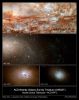
Galaxies-HST.jpgGalaxies!71 visiteThese images taken with NASA's Hubble Space Telescope are close-up views of four galaxies from a large survey of nearby galaxies.
The galaxies have very different masses and sizes and showcase the diversity of galaxies found in the ANGST study. Although the galaxies are separated by many light-years, they are presented as if they are all at the same distance to show their relative sizes.
The images, taken with Hubble's Advanced Camera for Surveys, reveal rich detail in the stellar populations and in the interstellar dust scattered between the stars. Hubble's sharp views reveal the colors and brightnesses of individual stars, which astronomers used to derive the history of star formation in each galaxy.
In the composite image at the top, NGC 253 is ablaze with the light from thousands of young, blue stars. The spiral galaxy is undergoing intense star formation. The image demonstrates the sharp "eye" of the Advanced Camera, which resolved individual stars. The dark filaments are clouds of dust and gas. NGC 253 is the dominant galaxy in the Sculptor Group of galaxies and it resides about 13 million light-years from Earth.
In the view of the spiral galaxy NGC 300, second from top, young, blue stars are concentrated in spiral arms that sweep diagonally through the image. The yellow blobs are glowing hot gas that has been heated by radiation from the nearest young, blue stars. NGC 300 is a member of the Sculptor Group of galaxies and it is located 7 million light-years away.
The dark clumps of material scattered around the bright nucleus of NGC 3077, the small, dense galaxy at bottom, left, are pieces of wreckage from the galaxy's interactions with its larger neighbors. NGC 3077 is a member of the M81 group of galaxies and it resides 12.5 million light-years from Earth.
The image at bottom, right, shows a swarm of young, blue stars in the diffuse dwarf irregular galaxy NGC 4163. NGC 4163 is a member of a group of dwarf galaxies near our Milky Way and is located roughly 10 million light-years away.
These galaxies are part of a detailed survey called the ACS Nearby Galaxy Survey Treasury program (ANGST). In the census, Hubble observed roughly 14 million stars in 69 galaxies. The survey explored a region called the "Local Volume," and the galaxy distances ranged from 6.5 million light-years to 13 million light-years from Earth. The Local Volume resides beyond the Local Group of galaxies, an even nearer collection of a few dozen galaxies within about 3 million light-years of our Milky Way Galaxy.
The natural-color images were constructed using observations taken in infrared, visible, and blue light. The observations of NGC 253 and NGC 300 were taken in September 2006; of NGC 3077 in November 2006; and of NGC 4163 in December 2006.
Object Names: NGC 253, NGC 300, NGC 3077, NGC 4163
MareKromium
|
|
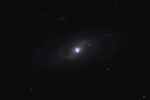
Gravitational_Lensing-00.jpgThe "Einstein Cross"118 visiteDalla Rubrica "NASA - Picture of the Day" del giorno 7 Febbraio 2010:"Most Galaxies have a single Nucleus, we know that. But does this Galaxy have four?
The strange answer leads astronomers to conclude that the Nucleus of the surrounding galaxy is not even visible in this image. The central cloverleaf is rather light emitted from a background Quasar. The Gravitational Field of the visible foreground galaxy breaks light from this distant Quasar into four distinct images.
The Quasar must be properly aligned behind the center of a massive galaxy for a mirage like this to be evident. The general effect is known as "Gravitational Lensing", and this specific case is known as the "Einstein Cross". Stranger still, the images of the Einstein Cross vary in relative brightness, enhanced occasionally by the additional gravitational microlensing effect of specific stars in the foreground galaxy".MareKromium
|
|
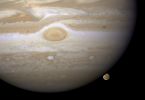
Jupiter-HST-2008-42-a-ful-001_jpg.jpgHiding... (natural colors; credits: NASA)68 visiteNASA's Hubble Space Telescope has caught Jupiter's moon Ganymede playing a game of "peek-a-boo", In this crisp Hubble image, Ganymede is shown just before it ducks behind the giant planet.
Ganymede completes an orbit around Jupiter every 7 days. Because Ganymede's orbit is tilted nearly edge-on to Earth, it routinely can be seen passing in front of and disappearing behind its giant host, only to reemerge later.
Composed of rock and ice, Ganymede is the largest moon in our Solar System. It is even larger than the planet Mercury.
But Ganymede looks like a dirty snowball next to Jupiter, the largest planet in our solar system. Jupiter is so big that only part of its Southern Hemisphere can be seen in this image.
Hubble's view is so sharp that astronomers can see features on Ganymede's surface, most notably the white impact crater, Tros, and its system of rays, bright streaks of material blasted from the crater. Tros and its ray system are roughly the width of Arizona.
The image also shows Jupiter's Great Red Spot, the large eye-shaped feature at upper left. A storm the size of two Earths, the Great Red Spot has been raging for more than 300 years. Hubble's sharp view of the gas giant planet also reveals the texture of the clouds in the Jovian Atmosphere as well as various other storms and vortices.
Astronomers use these images to study Jupiter's Upper Atmosphere. As Ganymede passes behind the giant planet, it reflects sunlight, which then passes through Jupiter's Atmosphere. Imprinted on that light is information about the gas giant's atmosphere, which yields clues about the properties of Jupiter's high-altitude haze above the cloud tops.
This color image was made from three images taken on April 9, 2007, with the Wide Field Planetary Camera 2 in red, green, and blue filters. The image shows Jupiter and Ganymede in close to natural colors.MareKromium
|
|

Jupiter-HST-2008-42-a-ful-002_jpg.jpgHiding... (natural colors; credits: NASA)67 visitenessun commentoMareKromium
|
|
| 46 immagini su 4 pagina(e) |
1 |
 |
|
|
|








