| Risultati della ricerca nelle immagini - ""F-Ring"" |

AI-Saturn-Streak in the Sky-N00018041.jpgA new "Bright Streak" in the Sky of Saturn97 visiteUna nuova "striscia luminosa" (bright streak) nel Cielo di Saturno, ripresa il giorno 14 Settembre 2004. Che dire? Secondo noi - anche se accettassimo acriticamente la teoria che spiega alcune (comunque brevi e piuttosto deboli) striature di luce che, spesso, appaiono nelle immagini scattate guardando verso lo spazio come "raggi cosmici" - questa specifica "striscia" sembra qualcosa di molto particolare. Qualcosa che non può essere semplicemente ricondotto all'emissione luminosa di una micro-particella che schizza nello spazio a velocità presso-relativistica.
Secondo noi, questa striscia (come anche altre, riprese dalla superficie di Marte) è causata da qualcosa di diverso.
Cosa?
E se lo sapessimo...Ve lo diremmo!
|
|

AL-Streak Again-N00018570.jpgStreak again!89 visiteUna nuova "Striscia nel Cielo" - del 17/9/2004 - da guardare con estrema cura. Il motivo è questo: abbiamo svolto una semplice analisi sul frame scoprendo che la Striscia, stavolta, è costituita - ed è la 1ma volta che lo si vede con estrema chiarezza - da una sequenza di punti luminosi ravvicinatissimi i quali, per altro, non hanno tutti la stessa intensità luminosa. Un effetto similare (se non identico) lo si può ottenere, sulla Terra, riprendendo - con obbiettivo grandangolare o simile - una porzione di cielo notturno (con esposizione fra i 10 ed i 18/20") mentre un qualsiasi velivolo convenzionale si trovi in transito attraverso tale porzione di cielo. Effettuato lo sviluppo dell'immagine, noterete che il corpo del velivolo risulterà costituito da una serie ravvicinatissima di punti luminosi i quali diventeranno "più luminosi" in corrispondenza dei flash emessi dalle sue luci di posizione. Cosa implichiamo con questo discorso?
Che la Streak in the Sky di oggi NON E' CERTAMENTE un raggio cosmico!
|
|

Saturn-The Atlas Ring-The New Object-PIA06115.jpgThe "New Object" found in Saturn's "F-Ring" (1)76 visiteEcco il nuovo enigma che ci viene proposto da Saturno e che, come già si era detto, potrà affascinare coloro che conoscono la storia (o la "leggenda", se preferite) dei "Ringmasters of Saturn". Questa, in originale, la nota di commento al fenomeno rilasciata dalla NASA: "A small new found object, temporarily designated S/2004 S 3, has been seen orbiting Saturn's outer F ring. Its nature, moon or clump, is not presently known".
Una dichiarazione che ci lascia davvero pensare...
|
|

Saturn-The Atlas Ring-The New Object-PIA06116.jpgThe "New Object" found in Saturn's "F-Ring" (2)80 visiteMa c'è di più: ingrandite le 2 immagini che Vi abbiamo proposto e poi osservate attentamente in alto alla Vostra Dx. Vedrete una piccola, ma ben definita, linea luminosa. Andate quindi sul Sito NASA "Planetary Photojournal - Images of Saturn": c'è una bellissima animazione ottenuta montando in sequenza 18 frames, oltre ai 2 qui pubblicati (ripresi con frequenza di 1 ogni 8 minuti su un arco di 135 minuti). Noterete che la "striscia" di luce di cui Vi stiamo parlando appare solo in 6.
Strano, vero?!?
|
|

StreamerChannel-PIA10509.jpgStreamer Channel84 visiteOk: quando Lunexit "chiama", la NASA...risponde! Pubblicata oggi (11 Novembre 2008) sul Planetary Photojournal, ecco la risposta NASA alla nostra illazione: la "vibrazione" dell'Anello "F" di Saturno è, effettivamente, uno Streamer Channel, provocato dalla Luna Pastore Prometheus.
L'effetto vibrazionale appare, nel filmato GIF del Dr Barca, più eclatante (e quindi fisicamente impossibile) solo perchè la ripresa - in quel primo contesto - era stata effettuata da una distanza inferiore ai 970.000 Km di questo frame.
Dunque nessuna "Onda Gravitazionale", ma solo uno Streamer Channel (ossìa un "canale" che viene scavato - letteralmente - da Prometheus quando attraversa l'Anello "F" di Saturno, e cioè una volta per orbita) particolarmente grande e ripreso da (relativamente) vicino.
Questa parte del Mistero, quindi, è risolta. Peccato che la NASA non ci abbia detto nulla, invece, dell'Oggetto Anomalo, ma chissà, magari in futuro...
Caption NASA:"The Cassini spacecraft focuses on a streamer-channel feature in Saturn's F-Ring.
These features are created by the moon Prometheus as it closely approaches the Ring once per orbit (see also PIA08397).
This view looks toward the unilluminated side of the Rings from about 36° above the Ring-Plane.The image was taken in Visible Light with the Cassini Spacecraft narrow-angle camera on Sept. 30, 2008.
The view was acquired at a distance of approx. 970.000 Km (such as about 602.000 miles) from Saturn and at a Sun-Ring-Spacecraft, or Phase, Angle of 45°.
Image scale is roughly 5 Km (about 3 miles) per pixel".
MareKromium
|
|

The Rings & Rhea-PIA07655.jpgThe F-Ring and crescent Rhea67 visiteThe searing arc of light seen here is Saturn's icy F-Ring, seen nearly edge-on. In the background, Rhea is lit by reflected light from Saturn and the Rings, with only the slightest sliver of light at its bottom being from direct Sunlight.
The faint material surrounding the F-Ring likely lies in the Planet's equatorial plane, extending radially farther out and in from the main F-Ring core.
A smaller fraction of this material could be vertically extended, and Cassini's investigations should help to clarify this.
The image was taken in visible light with the Cassini spacecraft narrow-angle camera on Oct. 30, 2005, at a distance of approximately 689.000 Km (about 428.000 miles) from Saturn. The image scale is approximately 4 Km (2 miles) per pixel.
|
|

The_Rings-IMG002648-0.jpgTransient Event(s) in the "F-Ring"? (context image)66 visiteCaption NASA:"The Cassini spacecraft spies an intriguing bright clump in Saturn's "F-Ring".
Also of interest is the dark gash that appears to cut through the Ring immediately below the clump. Scientists continue to monitor this ring for small, transient clumps of material, as well as the effects of the shepherd moon Prometheus.
This view looks toward the unilluminated side of the Rings from about 28° above the Ring-Plane.
The image was taken in visible light with the Cassini spacecraft narrow-angle camera on May 5, 2007 at a distance of approx. 2.1 MKM (about 1,3 MMs) from Saturn. Image scale is roughly 12 Km (about 8 miles) per pixel".
Nota: dopo aver effettuato una modesta analisi di questo frame in rapporto ad altri frames CASSINI i quali pure ci appaiono rappresentativi di quei fenomeni che la NASA chiama "clumps" (---> masse/grumi di materiale), la nostra sensazione è che la particolare (o meglio: eccezionale!) luminosità del "clump" ora in oggetto (anche iuna volta messa in correlazione con la striscia scura che vedete sulla sua Dx - striscia che costituisce un chiarissimo segnale del passaggio di qualcosa attraverso i filamenti di materiale che compongono l'Anello "F") potrebbe essere dovuta al verificarsi di una collisione occorsa all'interno dell'Anello "F" stesso, la quale è stata casualmente inquadrata da una delle fotocamere della Sonda.
Non pensiamo, quindi, nè ad un image-artifact da sovrasaturazione del frame, nè al possesso di particolari qualità e/o caratteristiche chimico/fisiche da parte del "clump" in oggetto. MareKromium
|
|

The_Rings-IMG002648-1.jpgTransient Event(s) in the "F-Ring"? (detail mgnf)78 visiteEcco la possibile sequenza degli eventi che hanno condotto all'Evento Transitorio il quale si è risolto nel brillamento di una modesta sezione dell'Anello "F" : un Corpo Errante transita attraverso l'Anello "F", lasciandosi alle spalle la traccia del proprio passaggio (e cioè il "Dark Gash", ossìa una "incisione" - o scia - scura e profonda).
Durante la corsa, il Corpo Errante (il quale assume la veste di "Impactor" - ricordate la Sonda NASA "Deep Impact" ed il suo incontro con la Cometa "Tempel-1"? Stessa situazione) entra in contatto con un clump preesistente, disintegrandolo (e disintegrandosi) in parte (effetti: brillamento, dilatazione apparente del clump preesistente e dell'Impactor; perdita di materiale in varie direzioni da parte di entrambi), e quindi procede nella sua corsa che potrebbe portare quanto rimane di esso a:
1) superare l'Anello "F" e quindi perdersi nello Spazio (qualora il suo momentum fosse rimasto sufficientemente elevato anche post-impatto), oppure
2) diventare una parte - forse anche solo temporanea - dell'Anello "F" (se il momentum si fosse perso, in larga misura, durante il transito attraverso l'Anello "F" ed a causa dell'impatto).MareKromium
|
|
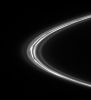
The_Rings-PIA09782.jpgPrometheus' Trail70 visiteCaption NASA:"Seen here is the end result of the process that occurs every time the moon Prometheus closely approaches Saturn's F-Ring. The moon cuts a dark channel in the ring's inner edge that then shears out over successive orbits, giving the inner edge of the ring the grooved appearance seen here.
This process is described in detail, along with a movie of Prometheus creating one of the streamer/channel features, in Soft Collision.
The view is toward the sunlit side of the Rings from about 3° below the Ring-Plane.
The image was taken in visible light with the Cassini spacecraft narrow-angle camera on Oct. 25, 2007. The view was acquired at a distance of approx. 624.000 Km (such as about 388000 miles) from Saturn and at a Sun-Ring-Spacecraft, or phase, angle of 23°.
Image scale is roughly 3 Km (about 2 miles) per pixel".MareKromium
|
|

The_Rings-PIA10470.jpgGravitational Interactions or just Evidence of a recent Collision?72 visiteCaption NASA:"The three bright, finger-like jets of material seen here suggest that a small object has collided with the core of Saturn's F-Ring. Cassini Spacecraft imaging scientists have shown that the F-Ring shepherd moon Prometheus influences the structure of the Ring in 2 ways: 1) by creating streamer-channel features as it closely approaches (and partially passes into) the Ring (see PIA08397) and 2) by perturbing the orbits of small objects within the F-Ring Region which then exert their own influence on nearby Ring particles, as seen here.
These small, embedded objects could be temporary clumps of particles, but scientists think at least one of the objects could be a more permanent moonlet.
This view looks toward the sunlit side of the Rings from about 40° below the Ring-Plane. The image was taken in visible light with the Cassini Spacecraft narrow-angle camera on Aug. 20, 2008. The view was obtained at a distance of approx. 685.000 Km (such as about 426.000 miles) from Saturn and at a Phase Angle of 40°.
The image scale is about 5 Km per pixel".MareKromium
|
|

The_Rings-PIA10518.jpgJust like a "Ribbon"...72 visiteCaption NASA:"The ever-changing F-Ring appears as wisps of smoke in this image taken downstream of the Shepherd Moon, Prometheus.
The image was taken in Visible Light with the Cassini Spacecraft narrow-angle camera on Oct. 23, 2008 at a distance of approx. 437.000 Km (about 272.000 miles) from Saturn and at a Sun-Saturn-Spacecraft Angle of 89°.
Image scale is roughly 2 Km (a little more than 1 mile) per pixel".
Nota Lunexit: un sincero Grazie alla NASA per aver pubblicato questa immagine la quale risolve - diremmo in via definitiva - il dubbio che era nato a proposito del possibile fenomeno di distorsione ottica imputabile ad un campo gravitazionale (e/o magnetico) di grande portata ed estremamente vicino a Cassini.MareKromium
|
|
|
| 11 immagini su 1 pagina(e) |
|








