| Risultati della ricerca nelle immagini - ""F"" |

APOLLO_15_AS_15-M-R16-0424.jpgAS 15-M-R16-0424 - Archimedes "F" Crater63 visiteCoord.: 25,5° North Lat. and 10° West Long.
Lens Focal Length: 3"
Camera Tilt: VERT
Camera Altitude: 99 Km
Sun Elevation (on local horizon): 2° MareKromium
|
|
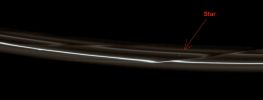
PIA10587.jpgThe "Fragile" F-Ring73 visiteCaption NASA:"Set starkly against the blackness of space are the F-Ring's delicate strands which are periodically gored by its shepherding moon, Prometheus.
Prometheus (approx. 86 Km, or about 53 miles across) and Pandora (approx. 81 Km, or about 50 miles across) both interact with the F-Ring but neither is visible here. Prometheus has the larger effect (see, for instance, PIA08397 for a movie of Prometheus creating a Streamer-Channel in the ring).
A star can be seen through the ring on the right side (Dx) of the image.
This view looks toward the unilluminated side of the Rings from about 33° above the Ring-Plane. The image was taken in visible light with the Cassini Spacecraft narrow-angle camera on Jan. 11, 2009.
The view was acquired at a distance of approx. 1 MKM (such as about 620,000 miles) from Saturn and at a Sun-Saturn-Spacecraft, or Phase, Angle of 37°.
Image scale is roughly 6 Km (about 4 miles) per pixel".MareKromium
|
|

Prometheus-PIA10593.jpgStreamer Channel (Natural Colors; credits: Lunar Explorer Italia)84 visiteCaption NASA:"Half an hour after Prometheus tore into this region of Saturn's F -Ring, the Cassini Spacecraft snapped this image just as the moon was creating a new Streamer in the Ring. The dark pattern shaped like an upside down check mark in the lower left of the image is Prometheus and its shadow.
The potato shaped moon can just be seen coming back out of the Ring. The moon's handiwork also is apparent in 2 previous Streamer-Channel formations on the right of the image. The darkest Streamer-Channel stretching from the top right to the center of the image shows Prometheus' previous apoapse passage about 15 hours earlier. A fainter, even earlier channel extends to the edge of the image.
Prometheus (about 86 Km, or approx. 53 miles across) dips into the inner edge of the F-Ring when it reaches apoapse, the moon's farthest orbital point from Saturn. At apoapse, the moon's gravity pulls particles of the ring outward into a streamer.
As Prometheus moves onward toward periapse — its orbit's closest point to the Planet — the Streamer gets longer. Then, as Prometheus moves back toward apoapse, the Streamer breaks apart which results in a dark channel.
This Streamer-Channel cycle repeats once every orbit with the Streamer-Channel features being streamers during Prometheus periapse and channels during Prometheus apoapse. The F-Ring is overexposed in this image which has been brightened to reveal the moon.
This view looks toward the unilluminated side of the Rings from about 18° above the Ring-Plane. The image was taken in Visible Light with the Cassini Spacecraft narrow-angle camera on Jan. 14, 2009.
The view was obtained at a distance of approx. 555.000 Km (345.000 miles) from Saturn and at a Sun-Saturn-Spacecraft, or Phase, Angle of 145°.
Image scale is roughly 3 Km (a little less than 2 miles) per pixel".MareKromium
|
|
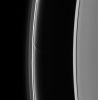
Saturn-PIA08303.jpgMore "Streamers" on sight!75 visiteA shepherd moon can do more to define ring structures than just keep the flock of particles in line, as Cassini spacecraft images such as this have shown.
Prometheus is seen here with two long streamers of material that it has pulled out of the F-Ring. When Prometheus comes close to the F-Ring in its orbit, the moon's gravity tugs on the ring particles. The disturbed particles, now pulled into orbits slightly closer to Saturn and therefore faster, shear out during successive orbits, creating the long and delicate streamers seen here.
This view looks toward the unlit side of the Rings from about 31° above the Ring-Plane.
The image was taken in visible light with the Cassini spacecraft narrow-angle camera on Sept. 29, 2006 at a distance of approx. 1,7 MKM (a little more than 1 MMs) from Prometheus and at a Sun-Prometheus-spacecraft, or phase, angle of 160°.
Image scale is roughly 10 Km (about 6 miles) per pixel.
|
|

Streamers-PIA08292.jpgThe "F-Ring Streamers" (detail mgnf - HR)66 visiteCaption NASA originale:"Multiple faint, streamer-like objects can be seen in this HR Cassini spacecraft view of the F-Ring's bright core. The regular spacing of some of the features extending from the core indicates that they could all be produced by the perturbing effect of a single body as it passes close by. Scientists are examining Cassini images closely in an attempt to determine whether there are tiny moonlets - or perhaps transient clumps of material - orbiting Saturn near the F-Ring core. The researchers believe the streamer features seen here could be caused by a related phenomenon to that by which Prometheus produces streamers in the F-Ring.
This image was taken in visible light with the Cassini spacecraft narrow-angle camera on Sept. 25, 2006 at a distance of approx. 339.000 Km (about 211.000 miles) from Saturn and at a phase angle of 69°. Image scale is roughly 2 Km (a little more than 1 mile) per pixel".
Nota: quanto scommetete che, in un prossimo futuro, il Prof. Hoagland (o anche qualcun altro della Sua Scuola) ci verrà a raccontare che gli Streamers (---> corpi fluttuanti) non sono altro che minuscole astronavi le quali hanno il compito di bilanciare gravitazionalmente la porzione più esterna degli Anelli di Saturno e che l'intero "Impianto degli Anelli" non è altro - in fondo - che una gigantesca opera di Ingegneria Planetaria, creata per mero "piacere visivo" e lasciataci da chissà quale Civilità a testimonianza del suo glorioso passato? Insomma, dopo la Sfinge e le Piramidi, perchè non dirigere il prossimo business interplanetario verso l'"Architettura Cosmica", di cui gli Anelli di Saturno non rappresentano altro che un timido preliminare?!?...
|
|

Streamers-PIA08294.jpgUnbelievable "Streamers"...74 visiteCaption NASA originale:"This close-up view of the core of Saturn's narrow outlying F-Ring provides an unprecedented look at the fine scale structure of this highly perturbed Ring.
The structure seen here could be further evidence of the gravitational effects of small moons orbiting in the F-Ring Region. The moons could produce the basic structure which then starts to shear - the inner/lower part of the F-Ring core orbits Saturn faster than the outer/upper part - giving rise to the slanted features.
The image was taken in visible light with the Cassini spacecraft narrow-angle camera on Sept. 25, 2006 at a distance of approx. 254.000 Km (about 158.000 miles) from Saturn and at a phase angle of 28°. Scale in the original image was roughly 1 Km (3.845 feet) per pixel. The image has been magnified by a factor of two and contrast enhanced".
|
|

The Rings-PIA08259.jpgGravitational Disturbances72 visiteCaption NASA originale:"The clumpy disturbed appearance of the brilliant F-Ring constantly changes. The irregular structure of the Ring is due, in large part, to the gravitational perturbations on the ring material by one of Saturn's moons, Prometheus (about 102 Km, or 63 miles across).
Interior to the F-Ring, the A-Ring bears a striking resemblance to a classic grooved, vinyl record. Visible here are the Keeler Gap (about 42 Km, or 26 miles wide) and the Encke Gap (about 325 Km, or 200 miles wide).
The image was taken using a spectral filter sensitive to wavelengths of infrared light centered at 862 nnmts. The view was acquired with the Cassini spacecraft narrow-angle camera on July 26, 2006 at a distance of approx. 1,5 MKM (about 900.000 miles) from Saturn and at a Sun-Saturn-spacecraft, or phase, angle of 141°. Image scale is roughly 8 Km (such as about 5 miles) per pixel".
|
|

The Rings-PIA08290.jpgThe F-Ring (detail mgnf)71 visiteCaption NASA:"For some time, scientists have suspected the presence of tiny moonlets that orbit Saturn in association with the clumpy and braided-looking Ring. As the small satellites move close to the F-Ring core they leave a gravitational signature. In some cases they can draw out material in the form of a "streamer" - a miniature version of the interaction Cassini has witnessed between Prometheus and the F-Ring material. The dynamics of this interaction are the same, but the scale is different.
Scientists speculate that there could be several small moons with a variety of sizes involved in the creation of structures like the one seen here.
The image was taken in visible light with the Cassini spacecraft narrow-angle camera on Sept. 25, 2006 at a distance of approx. 255.000 Km (about 159.000 miles) from Saturn and at phase angle of 29°. Scale in the original image was 1 Km (about 3.873 feet) per pixel. The image has been magnified by a factor of two and contrast enhanced".
|
|
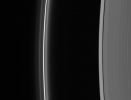
The_Rings-PIA08299.jpgSigns of Daphnis...85 visiteCaption NASA:"Edge waves in the Keeler Gap betray the presence of the embedded moon Daphnis.
Though the Cassini spacecraft cannot see Daphnis (only 7 - or approx. 4,3 miles - across) in this image (because the spacecraft is looking at its Dark Side), the tiny moon is undoubtedly located right of center, where the inner edge waves cease and the outer waves begin. The little moon was discovered in Cassini images that revealed its signature waves in the Keeler Gap (42 Km, or about 26 miles wide).
At left lies the brilliant F-Ring with its flanking strands. The bright F-Ring core is about 50 Km (approx. 30 miles) wide.
This view looks toward the unlit side of the Rings from about 32° above the Ring-Plane.
The image was taken in visible light with the Cassini spacecraft narrow-angle camera on Sept. 29, 2006 at a distance of approx. 1,7 MKM (such as a little more than 1 MMs) from Saturn and at a phase angle of 157°.
Image scale is about 10 Km (approx. 6 miles per pixel)".
|
|

The_Rings-PIA08845.jpgThe strange appearence of the F-Ring79 visiteCaption NASA:"The striated appearance of the F-Ring is immediately apparent in the region of the ring that trails behind the moon Prometheus. The F-Ring is characterized here by dark gores that stretch inward toward the planet and forward in the direction of motion.
This image has been expanded in the horizontal direction by a factor of 5 in order to make radial variations more prominent.
The curvature of the Rings is also exaggerated by the horizontal stretch.
The exterior flanking ringlets (to the right of the bright ring core) are not disturbed by Prometheus to the great degree seen in the inner ringlets. This view looks toward the unlit side of the Rings from about 31° above the Ring-Plane.
The image was taken in visible light with the Cassini spacecraft narrow-angle camera on Nov. 25, 2006 at a distance of approx. 1,7 MKM (about 1,1 MMs) from Saturn and at a phase angle of 162°. Scale in the original image is roughly 10 km per pixel".MareKromium
|
|

The_Rings-PIA08863.jpgWhat's inside the F-Ring?!?80 visiteCaption NASA:"These 2 images, taken about 8' apart, show clump-like structures and a great deal of dust in Saturn's ever-changing F-Ring. The images show an object-interior to and detached from the bright core of the F-Ring that appears to be breaking up into discrete clumps.
Cassini scientists have been monitoring clumps in the F-Ring for more than 2 years now, trying to understand whether these represent small permanent moonlets or transient aggregates of material. This view looks toward the unlit side of the Rings from about 35° above the Ring-Plane.
The images were taken in visible light with the Cassini spacecraft narrow-angle camera on Dec. 23, 2006 at a distance of approx. 2 MKM (about 1,2 MMs) from Saturn. Image scale is roughly 12 Km (about 7 miles) per pixel".
|
|

The_Rings-PIA08878.jpgThe "F-Ring", sinking in the shadows... (elab. Lunexit)88 visiteCaption NASA:"The strands of Saturn's F-Ring disappear into the darkness of the Planet's shadow.
Background stars make trails across the sky during the long exposure. This view looks toward the unlit side of the Rings from about 55° above the Ring-Plane.
The image was taken in visible light with the Cassini spacecraft narrow-angle camera on Jan. 3, 2007 at a distance of approx. 1,4 MKM (such as about 900.000 miles) from Saturn and at a Sun-Saturn-spacecraft, or phase, angle of 108°.
Image scale is roughly 8 Km (about 5 miles) per pixel".
|
|
| 29 immagini su 3 pagina(e) |
1 |
|








