| |
| Risultati della ricerca nelle immagini - ""Erg"" |
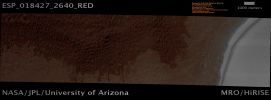
ESP_018427_2640_RED_abrowse-PCF-LXTT-1.jpgWhere the Erg meets the Polar Cap (Absolute Natural Colors; credits for the additional process. and color.: Dr Paolo C. Fienga - Lunexit Team)76 visitenessun commentoMareKromium
|
|
North_Polar_Regions-North_Polar_Erg-PIA13661.jpgNorth Polar Erg (Absolute Natural Colors; credits for the additional process. and color.: Dr Paolo C. Fienga - Lunexit Team:)117 visitenessun commentoMareKromium
|
|

North_Polar_Regions-North_Polar_Erg-PIA15943-PCF-LXTT-IPF.jpgFeatures of the North Polar Erg (Absolute Natural Colors; credits for the additional process. and color.: Dr Paolo C. Fienga/Lunar Explorer Italia/Italian Planetary Foundation)81 visiteThe highly suggestive Dunefield visible in this VIS image taken by the NASA - Mars Odyssey Orbiter during its 46719th orbit around the Red Planet is just a small portion of the gigantic Dunefield (or "Erg" ---> Sea of Sand) that encircles most part of the North Pole of Mars. The bright round spot visible on the lower left (Sx) side of the frame should be just a patch of permanent ice which is located (and therefore, somehow, protected) inside a relatively shallow depression of the Surface - possibly (but we have no way to be sure), an almost rimless and very old Impact Crater.
Latitude (centered): 80,0896° North
Longitude (centered): 194,1910° East
Instrument: VIS
Captured: June, 26th, 2012
This frame (which is an Original Mars Odyssey Orbiter b/w frame published on the NASA - Planetary Photojournal with the ID n. PIA 15943) has been additionally processed and then colorized in Absolute Natural Colors (such as the colors that a human eye would actually perceive if someone were onboard the NASA - Mars Odyssey Orbiter and then looked down, towards the Surface of Mars), by using an original technique created - and, in time, dramatically improved - by the Lunar Explorer Italia Team.MareKromium
|
|

North_Polar_Regions-North_Polar_Erg-PIA17865-PCF-LXTT-IPF.jpgSpring over the North Polar Erg (Absolute Natural Colors; credits for the additional process. and color.: Dr Paolo C. Fienga - Lunar Explorer Italia/Italian Planetary Foundation)92 visiteIn this VIS image, taken by the NASA - Mars Odyssey Orbiter on December, 1st, 2013, and during its 53.076th orbit around the Red Planet, we can see the Erg (---> Sea/Ocean of Dunes) that surrounds the North Polar Cap of Mars. It is Springtime, now, at the North Pole (---> in the Northern Hemisphere of Mars) and the Dunes are starting to lose their Frost cover. As the season continues towards Summer, the Dunes will appear darker and darker, as the Frost sublimates.
The bright (and round, as we have found out using other frames) spot visible on the upper side of the picture should be just a patch of Permanent Ice which is located (and therefore, somehow, protected) inside a relatively shallow Depression of the Surface - possibly (but we have no way to be sure), an almost rimless and very old Impact Crater. You can take a look, if you wish to get a few more visual information about this area, at the APOD of April, 1st, 2013.
Latitude (centered): 80,267° North
Longitude (centered): 157,439° East
Instrument: VIS
This image (which is an Original Mars Odyssey Orbiter b/w and Map-Projected frame published on the NASA - Planetary Photojournal with the ID n. PIA 17865) has been additionally processed, magnified, contrast enhanced, Gamma corrected and then colorized in Absolute Natural Colors (such as the colors that a human eye would actually perceive if someone were onboard the NASA - Mars Odyssey Orbiter and then looked down, towards the Surface of Mars), by using an original technique created - and, in time, dramatically improved - by the Lunar Explorer Italia Team.MareKromium
|
|

North_Polar_Regions-North_Polar_Erg-PIA17866-PCF-LXTT-IPF-1.jpgSpring over the North Polar Erg (Absolute Natural Colors; credits for the additional process. and color.: Dr Paolo C. Fienga - Lunar Explorer Italia/Italian Planetary Foundation)87 visiteIn this VIS image, taken by the NASA - Mars Odyssey Orbiter on December, 1st, 2013, and during its 53.077th orbit around the Red Planet, we can see, once again, the Erg (---> Sea/Ocean of Dunes) that surrounds the North Polar Cap of Mars. It is Springtime, now, at the North Pole (---> in the Northern Hemisphere of Mars) and the Dunes are starting to lose their Frost cover. As the season continues towards Summer, the Dunes will appear darker and darker, as the Frost sublimates.
Specifically, throughout the accurate observation (and, even more, after the colorization) of the landscape that is shown here, we are able to easily notice that, in this portion of the North Polar Erg (a portion that is positioned a little more towards the South of the Northern Hemisphere - as compared to the Latitude of the Region observed during the 53.076th orbit of the NASA - Mars Odyssey Orbiter), there has been more Frost lost from the Dunes, and this circumstance caused them to appear darker than the Dunes that were shown in yesterday's APOD.
Latitude (centered): 79,990° North
Longitude (centered): 128,365° East
Instrument: VIS
This image (which is an Original Mars Odyssey Orbiter b/w and Map-Projected frame published on the NASA - Planetary Photojournal with the ID n. PIA 17866) has been additionally processed, magnified, contrast enhanced, Gamma corrected and then colorized in Absolute Natural Colors (such as the colors that a human eye would actually perceive if someone were onboard the NASA - Mars Odyssey Orbiter and then looked down, towards the Surface of Mars), by using an original technique created - and, in time, dramatically improved - by the Lunar Explorer Italia Team.MareKromium
|
|

North_Polar_Regions-The_Erg-PIA18233-PCF-LXTT-IPF.jpgFeatures of the North Polar Erg (Absolute Natural Colors; credits for the additional process. and color.: Dr Paolo C. Fienga/Lunar Explorer Italia/Italian Planetary Foundation)75 visiteIn this VIS image, taken by the NASA - Mars Odyssey Orbiter on February, 26th, 2014, and during its 54.141st orbit around the Red Planet, we can see a small area of the North Polar Erg (---> Sea of Dunes). As the season changes from Spring to Summer, the Dunes surrounding the North Polar Cap, as you can see here, become darker and darker.
Only the round and bright Feature located on the left (Sx) margin of the frame (that we have already noticed in the past, when other pictures of this very same area were taken even by other Orbiters), seems to remain - basically - unchanged during the entire Martian Year. Unfortunately, we do not know what that Feature actually is, but our educated guess is that it could reasonably be a (relatively large) patch of Permanent Ice and Frost, thick and compacted enough to resist to the Winds' Action and then make it through the whole Martian Summer, when the temperature considerably raises, without sublimating or melting.
Latitude (centered): 79,7727° North
Longitude (centered): 198,7900° East
Instrument: VIS
This image (which is an Original Mars Odyssey Orbiter b/w and Map-Projected frame published on the NASA - Planetary Photojournal with the ID n. PIA 18233) has been additionally processed, magnified to aid the visibility of the details, contrast enhanced, Gamma corrected and then colorized in Absolute Natural Colors (such as the colors that a human eye would actually perceive if someone were onboard the NASA - Mars Odyssey Orbiter and then looked down, towards the Surface of Mars), by using an original technique created - and, in time, dramatically improved - by the Lunar Explorer Italia Team.
MareKromium
|
|
|
|
| 6 immagini su 1 pagina(e) |
|

|
|








