| Ultimi arrivi - MOON |

APOLLO_7_AS_7-03-1521-1525.gifSpace Debris or something else? (GIF-Movie)105 visiteUn intrigante (ma, forse, razionalmente spiegabile) GIF-Movie realizzato dal Dr Gianluigi Barca ci mostra che, durante le prove generali di "capture/docking" effettuate in orbita terrestre dall'Apollo 7, c'erano altri oggetti nei pressi delle due astronavi USA.
La ripetitività, in termini di posizione, albedo e movimenti relativi dei dettagli che vedete indicati dalla freccia, ci porta più che ragionevolmente ad escludere (al 100%) l'ipotesi che si tratti di meri image-artifacts.
Di che si tratta, quindi? Secondo noi, sono frammenti di metallo e ghiaccio che si sono staccati dai portelli - o meglio: dal rivestimento dei portelli - dell'astronave USA qui ripresa, al momento della loro apertura. Un fenomeno, tutto sommato, abbastanza comune e spesso riscontrato (e ben filmato, oltre che fotografato) durante le fasi di apertura del LM "nest" e successiva capture del LM da parte del CSM, prima dell'inizio della Trans-Lunar Coast.
Insomma: secondo noi NON si dovrebbe trattare di OVNI, ma di semplici "detriti spaziali".
Ottimo (davvero) il Lavoro e l'attenzione, rispettivamente, eseguito e mostrata dal bravissimo Dr Barca, che salutiamo!MareKromiumOtt 28, 2007
|
|
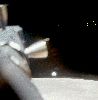
APOLLO_11_AS_11-37-5440_HR-3.gifF.M.O. (Fast Moving Object) near Apollo 11 (GIF-Movie)128 visiteUn intrigante GIF-movie realizzato dal sempre attentissimo Dr Gianluigi Barca il quale ci mostra un possibile F.M.O. (in accordo alla nomenclatura internazionale adottata in Materia) o, se non credete ai Vostri occhi, un bizzarro (e sequenziale!) image-artifact.
Decidete Voi, come sempre...
(frames AS 11-37-5439 e 5440) MareKromiumOtt 24, 2007
|
|

APOLLO_11_AS_11-37-5439_HR-1.jpgF.M.O. (Fast Moving Object) near Apollo 11 - AS 11-37-5439 (context frame)77 visitenessun commentoMareKromiumOtt 24, 2007
|
|

APOLLO_11_AS_11-37-5439_HR-2.jpgF.M.O. (Fast Moving Object) near Apollo 11 - AS 11-37-5439 (extra-detail mgnf)132 visitenessun commentoMareKromiumOtt 24, 2007
|
|

APOLLO_11_AS_11-37-5440_HR-1.jpgF.M.O. (Fast Moving Object) near Apollo 11 - AS 11-37-5440 (context frame)73 visitenessun commentoMareKromiumOtt 24, 2007
|
|

APOLLO_11_AS_11-37-5440_HR-2.jpgF.M.O. (Fast Moving Object) near Apollo 11 - AS 11-37-5440 (extra-detail mgnf)65 visitenessun commentoMareKromiumOtt 24, 2007
|
|

Z-104-TheMoon-Eclipse030307_AT_ESTEC1.jpgAfter the end of Totality...59 visiteCaption ESA:"This image was taken during the Partial Eclipse Phase of the March, 3rd, 2007 Total Lunar Eclipse, about 10 minutes after the end of totality".MareKromiumSet 29, 2007
|
|

Z-108-The_Moon-OresmeCrater.jpgOresme Crater58 visiteCaption ESA:"This image mosaic was obtained by the AMIE camera onboard the SMART-1 spacecraft. The most prominent feature is the 76 Km crater Oresme that originated in the Nectarian age.
It is located on the Far-Side of the Moon, across the North-Western part of the Lunar South Pole-Aitken Giant Impact Basin".MareKromiumSet 29, 2007
|
|

Z-109-The_Moon-PlaskettCrater.jpgCrater Plaskett & Companions60 visiteCaption ESA:"Plaskett crater is the bottom crater in this mosaic built with images taken by the Advanced Moon Imaging Experiment (AMIE) on board ESA's SMART-1 spacecraft. Plaskett and its two Companion Craters sit near the Moon’s North Pole.
The shadow lengths can be used to calculate the height of surface features.
Data like this can be turned into virtual simulations of the surface to help engineers design suitable landers. From its rim, the full Earth would graze just above the horizon for only a few days per month. However some areas within the Crater never see the Earth.
Rozhdestvenskiy is a large lunar crater of about 177 Km of diameter at it is centered at 85,2° North and 155,4° West (just above Plaskett).
Its northern rim is just 60 Km from the North Pole".MareKromiumSet 29, 2007
|
|

Z-110-The_Moon-PlaskettCrater-00.jpgThe Spectacular Crater Plaskett61 visiteCaption ESA:"This image, taken by the Advanced Moon Imaging Experiment (AMIE) on board ESA's SMART-1 spacecraft, shows crater Plaskett on the Moon.
This image was taken by SMART-1 from its polar orbit, at an altitude of 3000 Km over the surface and with a ground resolution of 300 mt per pixel.
Plaskett crater sits at 82,1° North and 174,0° East, with its centre just 240 Km away from the Lunar North Pole.
The crater, about 109 Km across, is named after the Canadian astronomer John Stanley Plaskett (1865–1941)".MareKromiumSet 29, 2007
|
|

Z-111-The_Moon-CraterPentland.jpgIn the vicinities of Crater Pentland (HR)54 visiteCaption ESA:"This HR image, taken by the Advanced Moon Imaging Experiment (AMIE) on board ESA’s SMART-1 spacecraft, shows an area close to crater Pentland on the Moon.
AMIE obtained this sequence on 18 March 2006 from a distance of 573 Km from the surface, with a ground resolution of 52 mt per pixel. The imaged area is centred at a Latitude of 67,7º South and a Longitude of 18,3º East". MareKromiumSet 29, 2007
|
|
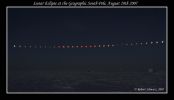
SouthPolarEclipse.jpgLunar Eclipse from the South Pole60 visiteCaption NASA:"The Moon was up continuously for 14 days in August -- when viewed from the South Pole. But during the total Lunar Eclipse on August 28, it circled only about 10° above the horizon. For Robert Scharwz, the resulting long line-of-sight through the atmosphere that blurred his images was a minor problem when he recorded this 4-hour long Lunar Eclipse sequence. A more severe problem was the outdoor air temperature of - 68° C (such as - 90 F). The extreme cold required him to make the series of exposures through a slit in a window from inside a heated room. Though the heat produced convection and further blurring, it was the only way to keep the camera at a reasonable operating temperature for an extended period of time. Still, he was rewarded with this impressive record of August's lunar eclipse from a unique perspective on planet Earth".MareKromiumSet 07, 2007
|
|
| 2195 immagini su 183 pagina(e) |
 |
|
|
|
|
30 | |
|
|
|
|





